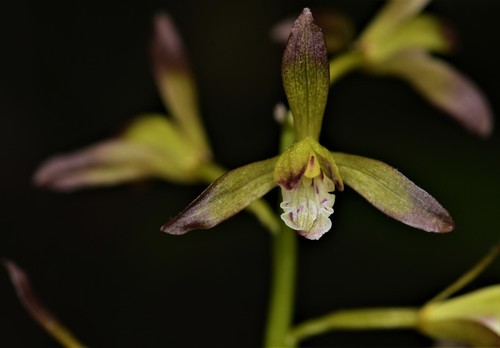


Putty Root
aplectrum hyemale
Putty Root (Aplectrum hyemale), also known as the Adam-and-Eve orchid, is a fascinating terrestrial orchid native to the deciduous forests of eastern North America. This unique plant exhibits an unusual growth cycle: it produces a single, deeply veined, evergreen leaf in autumn that persists through the harsh winter, performing photosynthesis when other deciduous plants have lost their leaves. As spring arrives, this leaf dies back, and a delicate stalk of yellowish-brown to purplish flowers emerges in late spring, seemingly out of nowhere. The common name Putty Root comes from the sticky, mucilaginous substance found inside its underground corms, which early settlers and Native Americans used as a strong adhesive to repair broken pottery and stoneware. The alternative name Adam-and-Eve refers to the paired growth of its corms, where the current year's corm remains physically linked to the previous year's corm by a short rhizome.
Habitat: Found in rich, moist deciduous forests, often in neutral to basic soils along floodplains, slopes, and wooded ravines.
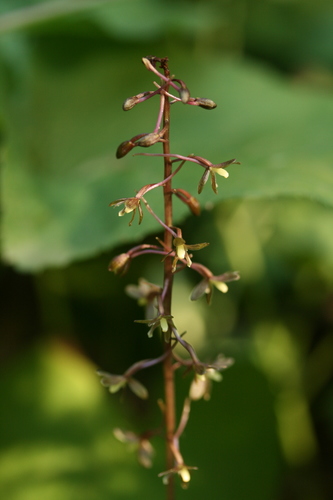
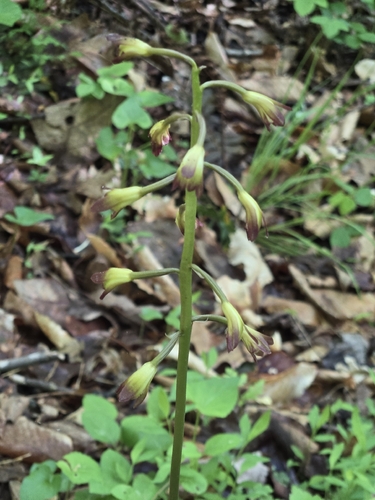
Putty Root can be identified in winter by its single, large (10 to 20 cm long), oval-shaped leaf which is dark green with prominent, parallel white veins and a silvery-purple underside. In late May to June, a leafless, purplish flowering stalk rises 30 to 60 cm high, bearing a loose cluster of 7 to 15 nodding, bell-shaped flowers. These flowers are about 1 to 2 cm wide, possessing dull yellowish-brown to greenish petals and sepals, often tipped or striped with purple, and a distinct white, three-lobed lip spotted with purple.
Category
PlantsRarity
Common
Danger
1/5 · Very low
Snaps
1
Early American settlers and Native Americans crushed the roots to extract a highly sticky slime, using it as a household glue to mend broken clay pots and plates.
The nickname Adam-and-Eve comes from the pair of underground corms linked by a rhizome, where the older, wrinkled corm represents Adam and the younger, plump corm represents Eve.
Unlike almost all other forest plants, Putty Root's single leaf grows in autumn, stays green all winter under the snow, and completely dies off before the flower stalk even begins to emerge in spring.
Produces a single, highly durable leaf in autumn that remains green all winter, capitalizing on the open forest canopy when sunlight is abundant.
The underground corms store a thick, sticky mucilage that acts as a water reservoir and natural anti-freeze agent during freezing temperatures.
Utilizes mycoheterotrophy, relying on symbiotic mycorrhizal fungi in the soil to assist with seed germination and nutrient absorption.
As a photosynthetic plant, it produces its own energy using sunlight, carbon dioxide, and water, supplemented by a symbiotic relationship with mycorrhizal soil fungi.
Age differences: Seedlings are fully mycoheterotrophic and rely entirely on mycorrhizal fungi for nutrients until they develop their first photosynthetic leaf.
Ceratobasidium species
The orchid relies on this mycorrhizal fungus to trigger seed germination and supply critical nutrients throughout its life.
Bombus bimaculatus
Queens and workers visit the flowers in late spring, acting as the primary pollinators of this orchid.

Odocoileus virginianus
Deer occasionally graze on the winter leaf or the spring flowering stalks, which can impact the orchid's survival.
No trait badges are assigned for this object yet.
No aliases listed yet.
Collections for this object will appear here as more themes are added.
Danger
1/5 · Very low
No special safety notes yet.
The easiest way to identify Putty Root is to use the Snappit nature identifier app.
30-60 cm
0.05-0.2 kg
5-20 years
As a photosynthetic plant, it produces its own energy using sunlight, carbon dioxide, and water, supplemented by a symbiotic relationship with mycorrhizal soil fungi.
Found in rich, moist deciduous forests, often in neutral to basic soils along floodplains, slopes, and wooded ravines.
Zoom in to split clusters and explore where this object has been snapped.
May 8, 2026
Advance MillsPhoto attribution
(c) Guy Babineau, some rights reserved (CC BY)
License: CC BY 4.0 ↗
Image may be shown cropped inside the card frame.

Virginia, US
You might spot Eastern Box Turtle and White-Tailed Deer.
View guide →
Virginia, US
You might spot Crane-Fly Orchid, Wild Geranium, and Cutleaf Coneflower.
View guide →

West Virginia, US
You might spot Common Merganser, Great Blue Heron, and Canada Goose.
View guide →

New York, US
You might spot Sensitive Fern, Garter Snake, and Eastern White Pine.
View guide →
Take the discovery with you
Snap it with Snappit to identify it, learn what makes it special, and add the discovery to your collection.











.jpg&width=800)



_001.jpg&width=800)




