
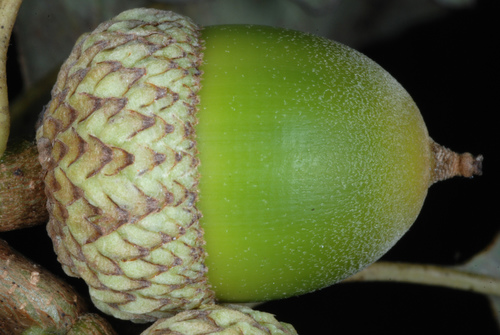


Quercus Prinoides
quercus prinoides
Quercus prinoides, commonly known as the Dwarf Chinkapin Oak, is a remarkable native North American shrub or small tree that defies the towering stature typical of its oak relatives. Usually growing no taller than 1 to 3 meters, it spreads via underground rhizomes to form dense, sprawling thickets. Despite its diminutive size, it is a prolific producer of sweet, low-tannin acorns, sometimes bearing fruit when it is only a few years old and half a meter tall. This makes it an incredibly valuable ecological resource in the dry, rocky, and sandy habitats it calls home. Its resilience, unique growth habit, and outsized contribution to local food webs make it a fascinating find for nature enthusiasts exploring upland forests and pine barrens.
Habitat: Found in dry, rocky, or sandy soils, particularly in pine barrens, limestone glades, upland ridges, and the margins of open woodlands.
The Dwarf Chinkapin Oak is a multi-stemmed, thicket-forming shrub typically reaching 1 to 3 meters in height. Its leaves are simple, alternate, and obovate to oblong, measuring 4 to 14 centimeters long, with coarsely toothed, wavy margins resembling those of chestnut oaks. The upper leaf surface is a glossy dark green, while the underside is distinctly paler with a dense coating of fine, grayish-white hairs. During the fall, the foliage turns pale yellow or orange-brown. The plant produces small, solitary or paired acorns with a cup that encloses about one-third of the nut, featuring warty, tuberculate scales.
Category
PlantsRarity
Common
Danger
1/5 · Very low
Snaps
Be the first to snap!
Because it spreads via underground rhizomes, a single genetic individual can form a dense thicket spanning several meters across.
Despite rarely exceeding head-height, a Dwarf Chinkapin Oak can produce a massive crop of sweet acorns when it is only three to five years old.
Its acorns are notably sweeter and lower in bitter tannins than those of many other oak species, making them a preferred food for a wide variety of forest wildlife.
This miniature oak is highly adapted to fire-prone environments; its above-ground stems may burn away, but it rapidly resprouts from its protected root system.
Forms large, dense clonal colonies by spreading through an extensive network of underground rhizomes, allowing it to stabilize loose sandy soils and rapidly regenerate after disturbances.
Capable of producing abundant acorn crops at a remarkably young age—often within three to five years—and at heights as low as half a meter.
Adapted to thrive in extremely dry, nutrient-poor soils like sandy barrens and rocky ridges where larger, more demanding tree species struggle to survive.
Like all green plants, the Dwarf Chinkapin Oak produces its own energy through photosynthesis.
Meleagris gallopavo
The sweet, low-tannin acorns are a highly favored food source for these large ground-foraging birds.
Satyrium edwardsii
Uses the Dwarf Chinkapin Oak as a primary larval host plant in pine-oak barrens.

Sciurus carolinensis
Forages and caches the acorns, aiding in seed dispersal for the shrub.

Odocoileus virginianus
Browses on the twigs, foliage, and acorns during various times of the year.
No trait badges are assigned for this object yet.
No aliases listed yet.
Collections for this object will appear here as more themes are added.
Danger
1/5 · Very low
No special safety notes yet.
Start with the whole plant, then compare leaf arrangement, leaf edges, stems and any flowers or fruit. Opposite leaves grow in pairs; alternate leaves come one at a time along the stem. These details tell you far more together than a single green leaf does. Plant Identifier: upload a photo and compare the visible details.
100-300 cm
20-100 years
Like all green plants, the Dwarf Chinkapin Oak produces its own energy through photosynthesis.
Found in dry, rocky, or sandy soils, particularly in pine barrens, limestone glades, upland ridges, and the margins of open woodlands.
Zoom in to split clusters and explore where this object has been snapped.
Recent snaps will appear here as new observations are added.
Take the discovery with you
Snap it with Snappit to identify it, learn what makes it special, and add the discovery to your collection.


















