




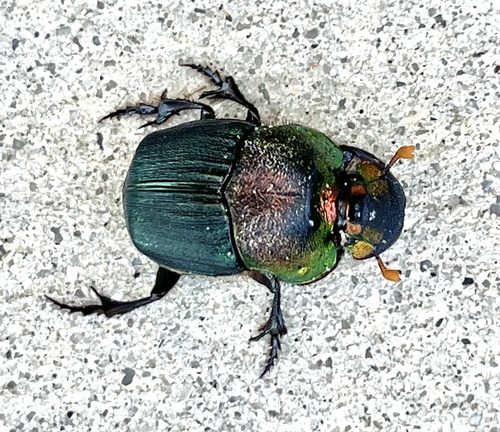
Rainbow Scarab
Phanaeus vindex
The Rainbow Scarab is a colorful beetle that shines in the sunlight! It loves to roll balls of dung, which helps keep the environment clean and healthy.
Habitat: Grasslands
The Rainbow Scarab is a stout, oval-shaped beetle with an astonishingly iridescent shell that shimmers through metallic green, blue, purple, and coppery-red hues. Males possess a distinctive, curved horn on their head, setting them apart visually from the hornless females and many other duller-colored dung beetles.
Category
InsectsRarity
Common
Danger
1/5 · Very low
Snaps
7
A Rainbow Scarab can bury a huge dung ball faster than you can tie your shoelaces!
Male Rainbow Scarabs fight like tiny gladiators, locking horns to win the best dung prizes!
Their dazzling colors aren't paint, but special light-bending structures in their shell!
They are nature's ultimate recyclers, turning animal waste into healthy soil for plants!
Rainbow Scarab can roll dung balls over 50 times its own body weight because of its powerful legs, helping it secure food and protect its eggs.
Rainbow Scarab can locate fresh animal droppings from over a mile away because of its super-sensitive antennae, helping it find food quickly.
Rainbow Scarab can dig deep, elaborate tunnels underground quickly because of its specialized shovel-like head and legs, helping it bury dung and hide its young.
Rainbow Scarabs are amazing detritivores, eating and burying animal waste to keep ecosystems clean!
Solitary animals live alone for most of their lives, only interacting with others for mating or parental care.
This trait identifies organisms whose diet includes both plant and animal matter.
Scavengers consume dead organic matter, helping to decompose carcasses and other waste in the ecosystem.
Colorful describes organisms or objects displaying a wide range of bright and distinct colors.

Grassland habitats are terrestrial biomes dominated by grasses and herbaceous plants, supporting a variety of grazing animals.

Describes organisms that break down dead organic material, recycling nutrients back into the ecosystem.

Diurnal animals are primarily active during daylight hours, typically resting or sleeping at night.

Describes a species whose presence and role have a disproportionately large effect on its environment.
No aliases listed yet.
Danger
1/5 · Very low
Don't touch insects without asking an adult first, as some can bite.
The easiest way to identify Rainbow Scarab is to use the Snappit nature identifier app.
10-22 mm
60-120 days
Rainbow Scarabs are amazing detritivores, eating and burying animal waste to keep ecosystems clean!
Grasslands
Scavenging
6
Zoom in to split clusters and explore where this object has been snapped.
May 6, 2026
Matanzas State ForestPhoto attribution
(c) Pam Kleinsasser, some rights reserved (CC BY)
License: CC BY 4.0 ↗
Image may be shown cropped inside the card frame.

Georgia, US
You might spot Joro Spider, American Sweetgum, and American Tuliptree.
View guide →

South Carolina, US
You might spot Gulf Fritillary, Poey's Furrow Bee, and Anole.
View guide →

Illinois, US
You might spot Cliff Swallow, Baldcypress, and Indian Heliotrope.
View guide →
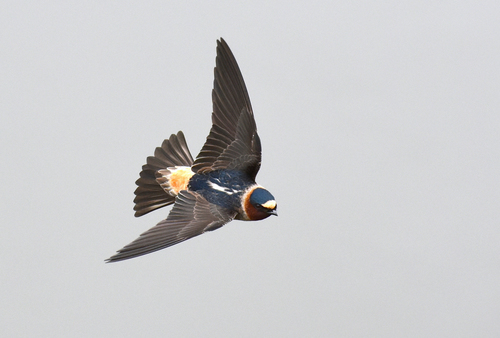
Illinois, US
You might spot Cliff Swallow, Baldcypress, and Indian Heliotrope.
View guide →

Georgia, US
You might spot Joro Spider, American Sweetgum, and American Tuliptree.
View guide →

Florida, US
You might spot Gopher Tortoise, Brown Anole, and Coontie.
View guide →
Take the discovery with you
Snap it with Snappit to identify it, learn what makes it special, and add the discovery to your collection.










.jpg&width=800)


