

Rattlesnake Fern
botrypus virginianus
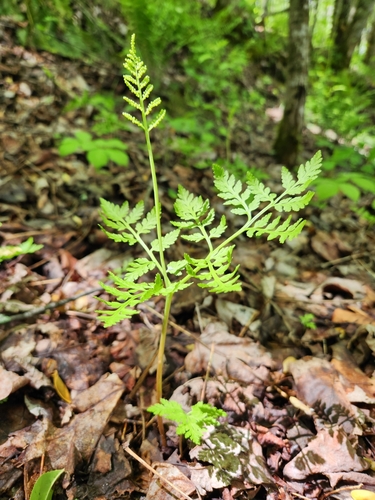
The Rattlesnake Fern, Botrypus virginianus, is a fascinating and distinctive deciduous fern native to rich, moist woodlands across North America, Europe, and Asia. Belonging to the adder's-tongue family, this unusual plant is easily recognized by its dual structure: a single, delicate, lacy sterile frond and a separate, upright, spore-bearing fertile stalk. Its common name is derived from the resemblance of this yellow-brown spore stalk to the rattle of a rattlesnake, as well as the belief that it often grows in habitats frequented by these snakes.
Habitat: Found in rich, moist deciduous forests and shaded woodlands, typically growing in humus-rich soil under a dense forest canopy.
This fern features a single, broadly triangular, bright green sterile blade that is deeply divided three to four times, giving it a soft, delicate, and lacy appearance. Emerging from the base of this leafy blade is a distinct, upright fertile stalk (the sporophore) that towers above the foliage. This stalk is topped with dense, double-rowed clusters of grape-like sporangia, which start green and mature to a striking golden or yellow-brown color as they prepare to release spores. The entire plant typically reaches a height of 15 to 75 centimeters.
Category
PlantsRarity
Common
Danger
1/5 · Very low
Snaps
4
Because the plant relies heavily on delicate underground fungal networks, it is extremely difficult to transplant and rarely survives in domestic gardens.
In traditional folk medicine, Native Americans used a poultice made from the boiled roots of this fern to treat snakebites and bruises.
The common name refers to the golden, beaded spore clusters that closely resemble the tail rattle of a timber rattlesnake.
It relies heavily on mycorrhizal fungi for nutrients, which is especially critical during its subterranean, chlorophyll-free gametophyte stage.
The tall, upright fertile stalk extends above the low sterile blade, utilizing forest drafts to maximize the wind travel of its tiny spores.
Unlike standard ferns that unroll from tight coils (fiddleheads), the young fronds of this species emerge by unfolding from a pre-formed, protected bud.
As a photosynthetic plant, it produces its own sugars from carbon dioxide, water, and sunlight, while absorbing essential minerals from the soil via a close partnership with fungi.
Age differences: The young, subterranean gametophyte lacks chlorophyll and is entirely mycoheterotrophic, relying completely on mycorrhizal fungi for food before growing photosynthetic leaves.
Glomus macrocarpum
Provides essential nutrients to the subterranean stage and root system of the fern.

Odocoileus virginianus
Occasionally browses on the foliage of the fern during late spring.
No trait badges are assigned for this object yet.
No aliases listed yet.
Collections for this object will appear here as more themes are added.
Danger
1/5 · Very low
No special safety notes yet.
The easiest way to identify Rattlesnake Fern is to use the Snappit nature identifier app.
15-75 cm
5-20 years
As a photosynthetic plant, it produces its own sugars from carbon dioxide, water, and sunlight, while absorbing essential minerals from the soil via a close partnership with fungi.
Found in rich, moist deciduous forests and shaded woodlands, typically growing in humus-rich soil under a dense forest canopy.
Zoom in to split clusters and explore where this object has been snapped.
Iowa, US
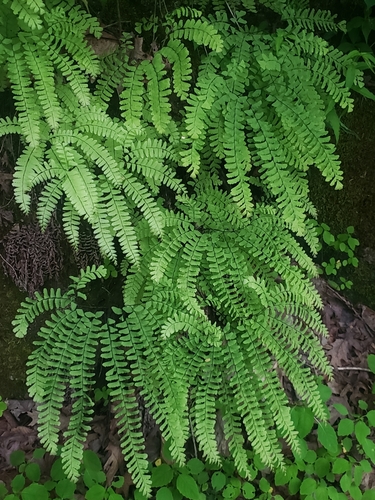
You might spot Northern Maidenhair Fern and Wood Nettle.
View guide →

Pennsylvania, US
You might spot Large Yellow Underwing and Eastern Black Carpenter Ant.
View guide →

Tennessee, US
You might spot American Robin, Northern Cardinal, and Eastern Chipmunk.
View guide →

Wisconsin, US
You might spot Eastern Forktail and Brown-Belted Bumble Bee.
View guide →
Virginia, US
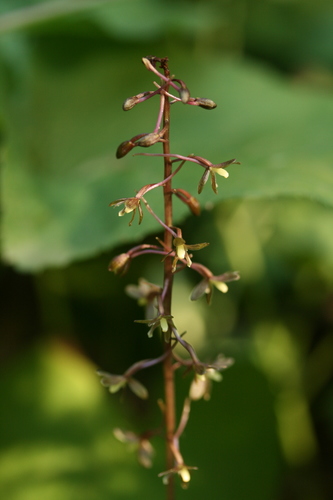
You might spot Crane-Fly Orchid, Wild Geranium, and Cutleaf Coneflower.
View guide →
Take the discovery with you
Snap it with Snappit to identify it, learn what makes it special, and add the discovery to your collection.











.jpg&width=800)



_001.jpg&width=800)




