

Rice Root
fritillaria camschatcensis
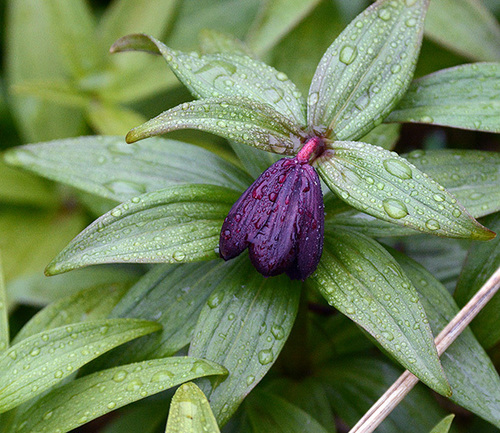
Rice Root (Fritillaria camschatcensis), also known as the chocolate lily or Kamchatka lily, is a hardy and visually striking perennial wildflower native to the cold, moist coastal regions of the North Pacific. Spanning from northern Japan and Russia through the Aleutian Islands down to Washington state, this lily thrives in damp environments like salt marshes, coastal meadows, and grassy shorelines. The plant gets its common name from its unique white bulb, which is surrounded by dozens of small, easily detached bulblets that resemble grains of rice. These starchy, nutritious roots were historically harvested as a vital staple winter food by indigenous peoples throughout the Pacific Northwest and Alaska.
Habitat: Typically found in wet coastal meadows, salt marshes, estuarine flats, grassy ocean bluffs, and open subalpine forests.
Standing between 20 to 60 centimeters tall, Rice Root features lance-shaped, deep green leaves arranged in whorls of three to six along its erect, unbranched stem. Its blossoms are nodding, bell-shaped flowers that grow in clusters of one to six near the top of the plant. These flowers are highly distinctive for their dramatic, dark coloring, ranging from deep chocolate brown to purplish-black, sometimes exhibiting a faint yellow-green checkerboard pattern on the inner petals. Bright yellow-to-orange anthers sit prominently within the dark bells, creating a stark visual contrast.
Category
PlantsRarity
Common
Danger
1/5 · Very low
Snaps
1
Indigenous peoples of Alaska and British Columbia traditionally harvested the bitter bulbs in autumn, boiling or steaming them before mashing them into a paste often eaten with seal oil.
Its dark flowers emit an odor similar to manure or rotting meat, which is highly effective at attracting flies but makes it a poor choice for indoor floral bouquets.
The tiny bulblets clinging to the main bulb look so much like grains of rice that early explorers and settlers genuinely mistook them for a wild grain crop.
Produces numerous small, white, grain-like bulblets around the main taproot that easily separate and grow into new clones, helping the plant quickly colonize coastal meadows.
Emits a foul, rotting-meat scent from its dark flowers to trick and attract scavenger flies, its primary pollinators.
Features specialized cellular physiology allowing it to withstand seasonal flooding and salt spray in coastal estuaries and salt marshes.
Produces its own energy from sunlight, water, and carbon dioxide through the process of photosynthesis, while drawing essential minerals from damp soil.

Calliphora vicina
The dark, pungent flowers are pollinated primarily by flies that are attracted to the smell of decaying organic material.

Ursus arctos
The starchy, nutrient-rich bulbs are frequently dug up and consumed by foraging bears in early spring when other food is scarce.
No trait badges are assigned for this object yet.
No aliases listed yet.
Collections for this object will appear here as more themes are added.
Danger
1/5 · Very low
No special safety notes yet.
Start with the whole plant, then compare leaf arrangement, leaf edges, stems and any flowers or fruit. Opposite leaves grow in pairs; alternate leaves come one at a time along the stem. These details tell you far more together than a single green leaf does. Plant Identifier: upload a photo and compare the visible details.
20-60 cm
5-15 years
Produces its own energy from sunlight, water, and carbon dioxide through the process of photosynthesis, while drawing essential minerals from damp soil.
Typically found in wet coastal meadows, salt marshes, estuarine flats, grassy ocean bluffs, and open subalpine forests.
Photosynthesis
Zoom in to split clusters and explore where this object has been snapped.
Take the discovery with you
Snap it with Snappit to identify it, learn what makes it special, and add the discovery to your collection.