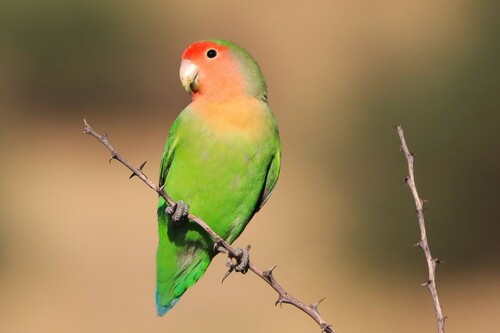


Rosy-Faced Lovebird
agapornis roseicollis
The Rosy-Faced Lovebird is a small, highly social parrot native to the arid regions of southwestern Africa. Famous for its vibrant coloration and affectionate pair-bonding behavior, this energetic bird is beloved by both wild birdwatchers and aviculturists worldwide. They are highly gregarious, often gathering in noisy flocks near water sources in their native dry woodland and semi-desert habitats. In their native range, they are known for their resourcefulness, nesting in rock crevices, communal nests built by other birds, or even human structures. Despite their small size, they possess a bold personality and a loud, metallic shriek. They have also established successful feral populations in urban areas outside of Africa, notably in Phoenix, Arizona, where they have adapted incredibly well to desert-scaped suburbs.
Habitat: Found in dry, open country, semi-deserts, and wooded savannas, typically staying close to reliable water sources.
This compact, short-tailed parrot is easily identified by its bright green body plumage, which contrasts beautifully with a peach-pink face and throat, giving them their common name. They feature a prominent blue rump, a horn-colored bill, and grey feet. Measuring around 15 cm in length, they have a stocky build with a relatively large head, and their wingspan ranges between 20 to 24 cm.
Category
BirdsRarity
Common
Danger
1/5 · Very low
Snaps
1
An introduced population has thrived in the hot desert of Phoenix, Arizona, since the 1980s, nesting in saguaro cacti and backyard birdhouses.
Females carry nesting materials by tucking strips of leaves, bark, or paper into their rump feathers, looking like they have a colorful tail extension.
They get their name 'lovebird' from the intense, lifelong monogamous bonds they form with their mates, often spending hours preening each other.
Females strip bark or leaves and tuck them into their rump feathers to carry them back to the nest site.
They are highly adapted to dry environments, obtaining much of their moisture from seeds and visiting waterholes daily.
They communicate using rapid, high-pitched contact calls that keep the flock tightly coordinated during flight.
Feeds primarily on seeds, grains, and buds, often foraging on the ground or in low bushes.
Philetairus socius
Frequently uses the nesting chambers of the massive colonial structures built by this bird in the wild.
.jpg&width=800)
Falco biarmicus
Preys on adult and juvenile lovebirds in their native African range.
No trait badges are assigned for this object yet.
No aliases listed yet.
Collections for this object will appear here as more themes are added.
Danger
1/5 · Very low
No special safety notes yet.
The easiest way to identify Rosy-Faced Lovebird is to use the Snappit nature identifier app.
15+ cm
20+ cm
0.046+ kg
10+ years
40 km/h
Feeds primarily on seeds, grains, and buds, often foraging on the ground or in low bushes.
Found in dry, open country, semi-deserts, and wooded savannas, typically staying close to reliable water sources.
Zoom in to split clusters and explore where this object has been snapped.

Arizona, US
You might spot Great-Tailed Grackle, Stinknet, and Northern Mockingbird.
View guide →

Arizona, US
You might spot Rosy-Faced Lovebird, Great-Tailed Grackle, and Stinknet.
View guide →

Arizona, US
You might spot Stinknet, Great-Tailed Grackle, and Rock Pigeon.
View guide →
Take the discovery with you
Snap it with Snappit to identify it, learn what makes it special, and add the discovery to your collection.







.jpg&width=800)









