





Ruby-crowned Kinglet
Corthylio calendula
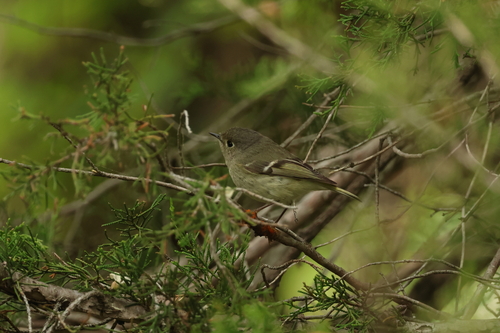
The Ruby-crowned Kinglet is a tiny bird with a bright red crown on its head. It loves to flit around trees and bushes, searching for tiny insects to eat. These little birds are very energetic and fun to watch!
Habitat: Forests
The Ruby-crowned Kinglet is a tiny, active songbird with olive-green plumage and a prominent white eye-ring. Males have a bright red crown patch, often concealed, which they can flash when excited. They are noticeably smaller than warblers and chickadees.
Category
BirdsRarity
Common
Danger
1/5 · Very low
Snaps
11
Baby kinglets hatch featherless and are completely helpless at birth!
Their song is remarkably loud for their size, making them easy to hear!
They build unique cup-shaped nests, held together with spider silk!
This tiny bird can migrate thousands of kilometers twice a year!
Ruby-crowned Kinglet can hover in mid-air with rapid wing beats, that helps them pluck tiny insects from leaves and bark.
Ruby-crowned Kinglet has a hidden red crown patch that helps them signal excitement or dominance to other kinglets.
Ruby-crowned Kinglet can hang upside down like an acrobat that helps them find hidden bugs on branches.
These tiny birds mostly eat small insects and spiders, but sometimes enjoy berries or tree sap!

Picea glauca
Nests are often built high in coniferous trees like spruce.

Accipiter striatus
Small birds like kinglets are common prey for this hawk.
Tetragnatha extensa
Kinglets consume many types of spiders found in their habitat.
Chironomus plumosus
They forage on small insects, including various midge species.
Social animals live in organized groups, cooperating for survival benefits such as foraging, defense, and raising offspring.
Singing animals produce complex vocalizations, often for purposes of attracting mates, defending territory, or communicating within their species.
Arboreal animals live primarily in trees, utilizing them for shelter, food, and protection from predators.
Colorful describes organisms or objects displaying a wide range of bright and distinct colors.

This trait identifies organisms whose diet primarily consists of insects and other small invertebrates.

Forest habitats are terrestrial environments dominated by dense tree cover, supporting a high diversity of plant and animal life.

Diurnal animals are primarily active during daylight hours, typically resting or sleeping at night.

Pertaining to species that are significantly smaller than typical or average for their kind.

Migratory animals undertake seasonal movements from one region to another, typically in response to changes in climate or food availability.
No aliases listed yet.
Danger
1/5 · Very low
Enjoy watching birds from a distance and be quiet so you don't scare them away.
The easiest way to identify Ruby-crowned Kinglet is to use the Snappit nature identifier app.
9-11 cm
14-18 cm
0.005-0.008 kg
1-6 years
45 km/h
These tiny birds mostly eat small insects and spiders, but sometimes enjoy berries or tree sap!
Forests
Zoom in to split clusters and explore where this object has been snapped.
Apr 26, 2026
Scottsville Historic DistrictPhoto attribution
(c) Andre Knocklein, some rights reserved (CC BY)
License: CC BY 4.0 ↗
Image may be shown cropped inside the card frame.

Alabama, US
You might spot Elephantear, Three-Ridge Mussel, and Rough Fatmucket.
View guide →

New Jersey, US
You might spot American Beech, Garlic Mustard, and Spotted Lanternfly.
View guide →

Wyoming, US
You might spot Moose, Arrowleaf Balsamroot, and Black Bear.
View guide →

Alaska, US
You might spot Steller Sea Lion, Harbor Seal, and Tufted Puffin.
View guide →

Washington, US
You might spot Red-Tailed Hawk and Colorado Checkered Whiptail.
View guide →

Florida, US
You might spot Resurrection Fern and Evans' Deer Moss.
View guide →
Take the discovery with you
Snap it with Snappit to identify it, learn what makes it special, and add the discovery to your collection.




.jpg&width=800)







