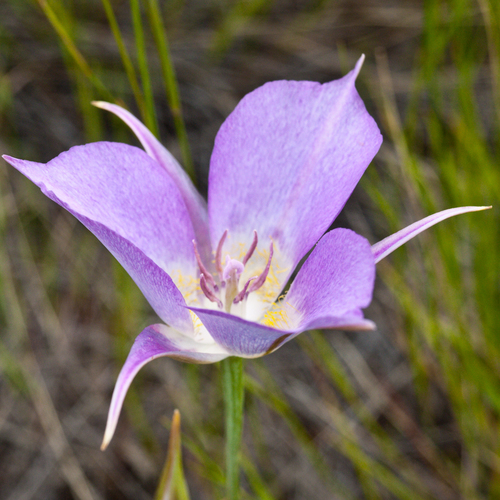


Sagebrush Mariposa Lily
calochortus macrocarpus
The Sagebrush Mariposa Lily (Calochortus macrocarpus) is a stunning perennial wildflower native to the arid interior of western North America. Renowned for its showy, tulip-like blooms, this resilient plant thrives in harsh, dry environments like sagebrush steppes and ponderosa pine forests. It plays a vital role in its ecosystem, providing nectar for various native pollinators and serving as a historical food source for Indigenous peoples who harvested its nutritious bulbs. This species is particularly celebrated for its striking visual appearance, which contrasts beautifully against the muted grays and greens of the sagebrush country. As a geophyte, it survives hot, dry summers and freezing winters by storing energy in an underground bulb. This adaptation allows it to re-emerge each spring, bringing a vibrant splash of lavender and purple to the rugged landscapes.
Habitat: Found in dry, open sagebrush grasslands and ponderosa pine forests on well-drained, sandy, or rocky soils.
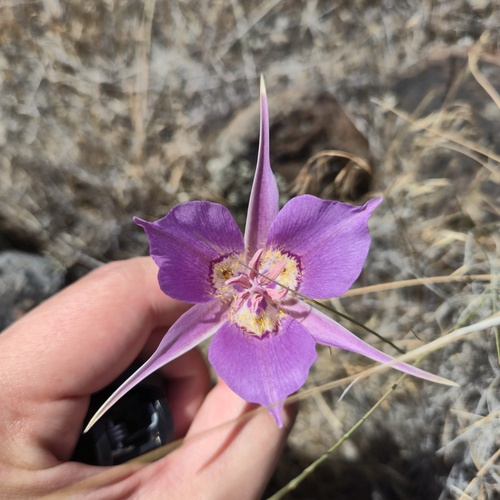
The lily features large, cup-shaped flowers that are typically three-lobed and range from pale lavender to deep purple. Each petal is marked with a distinctive green stripe running down the center of its outer surface, and the inner base of the petal is adorned with a band of bright yellow, beard-like hairs. The plant grows on an erect, unbranched stem reaching 20 to 60 centimeters in height, carrying narrow, grass-like leaves that often wither by the time the flower blooms.
Category
PlantsRarity
Common
Danger
1/5 · Very low
Snaps
1
Indigenous peoples of the Great Basin and Pacific Northwest traditionally harvested the sweet-tasting bulbs as a valuable source of carbohydrates.
The name 'Mariposa' means butterfly in Spanish, referring to the ornate patterns and delicate, winged appearance of the petals.
The seeds are wind-dispersed and require a cold winter period before they can successfully germinate in the spring.
The plant can survive intense summer heat and lack of water by dying back completely to its underground bulb, remaining dormant until the next spring.
Specialized roots pull the bulb deeper into the soil to protect it from freezing winter temperatures and wild fluctuations in surface moisture.
It partners with underground mycorrhizal fungi to enhance its uptake of water and essential nutrients in poor, rocky soils.
As a photosynthetic plant, the Sagebrush Mariposa Lily manufactures its own food using sunlight, water, carbon dioxide, and essential soil minerals.
No trait badges are assigned for this object yet.
No aliases listed yet.
Collections for this object will appear here as more themes are added.
Danger
1/5 · Very low
No special safety notes yet.
The easiest way to identify Sagebrush Mariposa Lily is to use the Snappit nature identifier app.
20-60 cm
5-15 years
As a photosynthetic plant, the Sagebrush Mariposa Lily manufactures its own food using sunlight, water, carbon dioxide, and essential soil minerals.
Found in dry, open sagebrush grasslands and ponderosa pine forests on well-drained, sandy, or rocky soils.
Zoom in to split clusters and explore where this object has been snapped.
Jun 7, 2026
Painted HillsPhoto attribution
(c) John Clonce, some rights reserved (CC BY)
License: CC BY 4.0 ↗
Image may be shown cropped inside the card frame.

Oregon, US
You might spot Blue Mountain Prairie Clover and Munro's Globemallow.
View guide →

Washington, US
You might spot Red-Tailed Hawk and Colorado Checkered Whiptail.
View guide →

Washington, US
You might spot Ring-Billed Gull, Cackling Goose, and Black-Bellied Plover.
View guide →

Oregon, US
You might spot Balkan Toadflax, Big Sagebrush, and Western Juniper.
View guide →
Take the discovery with you
Snap it with Snappit to identify it, learn what makes it special, and add the discovery to your collection.



.jpg&width=800)









.jpg&width=800)



_001.jpg&width=800)




