

Schoenoplectiella
schoenoplectiella
Schoenoplectiella is a genus of slender, tufted wetland sedges belonging to the Cyperaceae family. Often referred to as club-rushes, these resilient plants play a vital role in wetland ecosystems across the globe, stabilizing shorelines and providing essential nesting material and food for various aquatic species. Unlike some of their larger sedge relatives, Schoenoplectiella species are generally modest in size, making them a fascinating subject for botany enthusiasts exploring marshes, fens, and lake edges. These plants are highly adapted to saturated environments, thriving in places where water levels fluctuate. Their simplified, grass-like structures and compact inflorescences allow them to colonize mudflats and shallow waters quickly, especially in disturbed or seasonal wetland areas.
Habitat: Found in marshy shorelines, wet mudflats, and shallow waters of seasonal pools or lake edges.
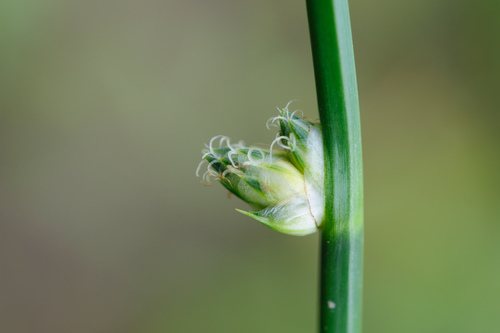
Schoenoplectiella sedges typically form dense, low-growing tufts of slender, cylindrical green stems that reach heights of 10 to 100 cm. The leaves are often reduced to simple, sheath-like structures at the base, leaving the smooth, photosynthetic stems to do most of the work. The most distinctive feature is the compact cluster of brownish, egg-shaped spikelets that appear to burst laterally from the side of the stem near the top; this illusion is caused by a single, erect bract that seamlessly continues upward, mimicking the stem itself.
Category
PlantsRarity
Common
Danger
1/5 · Very low
Snaps
Be the first to snap!
Despite looking like they have leaves, the photosynthesizing is almost entirely done by their round, hollow stems.
The name Schoenoplectiella is derived from Greek words meaning 'small braided reed,' referencing their historical use in weaving small mats and baskets.
The seeds have tiny backward-pointing bristles that help them hitch a ride on the feathers and muddy feet of migrating birds, allowing them to disperse to new wetlands.
The plant features a highly modified, erect bract that perfectly mimics the main stem, pushing the flower cluster to the side to optimize space and structural integrity in windy wetland conditions.
Its stems contain specialized internal air channels that transport oxygen from the exposed parts of the plant down to the roots submerged in oxygen-depleted mud.
Many species in this genus produce abundant, highly buoyant seeds that quickly establish on newly exposed mudflats when water levels drop.
As a photoautotrophic plant, it produces its own energy using chlorophyll to capture sunlight, absorbing water and essential soil minerals through its shallow root system.
Anas platyrhynchos
The seeds of Schoenoplectiella are a highly nutritious food source for migrating waterfowl during autumn.

Phragmites australis
Competes for space and nutrients on shallow wetland fringes, occasionally being shaded out by aggressive reed colonies.

Ondatra zibethicus
Muskrats occasionally harvest the roots and lower stems of these sedges for food and lodge construction.
No trait badges are assigned for this object yet.
No aliases listed yet.
Collections for this object will appear here as more themes are added.
Danger
1/5 · Very low
No special safety notes yet.
Compare seed heads, stem shape, how leaves attach, and the joint where leaf meets stem. A patch of mown lawn rarely shows enough for an exact ID. Grass Identifier: upload a photo and compare the visible details.
10-100 cm
0.01-0.2 kg
1-5 years
As a photoautotrophic plant, it produces its own energy using chlorophyll to capture sunlight, absorbing water and essential soil minerals through its shallow root system.
Found in marshy shorelines, wet mudflats, and shallow waters of seasonal pools or lake edges.
Zoom in to split clusters and explore where this object has been snapped.
Recent snaps will appear here as new observations are added.
Take the discovery with you
Snap it with Snappit to identify it, learn what makes it special, and add the discovery to your collection.