



seaside daisy
Erigeron glaucus
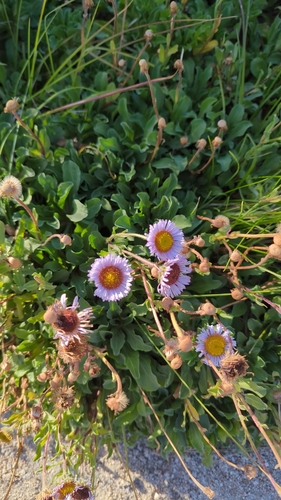
The seaside daisy is a cheerful flower that grows near the ocean. It has bright yellow centers and soft petals that can be white or purple. These flowers love sunny spots and can be found dancing in the breeze by the beach.
Habitat: Coastal areas
The seaside daisy has vibrant, purplish-pink to lavender ray petals surrounding a bright yellow center, forming a classic daisy shape. Its leathery, spoon-shaped leaves grow low to the ground, creating a dense mat of evergreen foliage.
Category
PlantsRarity
Common
Danger
1/5 · Very low
Snaps
6
Even though it loves the sun, it can grow right in the misty spray from ocean waves!
Its bright flowers are like a landing strip for thirsty bees and butterflies!
Seaside daisy blooms can change color slightly, sometimes appearing more purple or pink!
This tough plant can live for many years, bringing beauty to the same spot!
Seaside daisy can tolerate salty air and soil, thanks to its special adaptations that help it thrive close to the ocean.
Seaside daisy has thick, fleshy leaves that store water, helping it survive dry spells common in its coastal home.
Seaside daisy has a strong, deep root system that helps it anchor itself firmly in sandy or rocky coastal soils, preventing erosion.
Apis mellifera
Gathers nectar and pollen
Bombus vosnesenskii
An important native pollinator
Vanessa cardui
Sips nectar from its flowers
Ariolimax californicus
Occasionally browses its leaves
Flowering plants are any plants that produce flowers as part of their reproductive cycle.
Summer blooming plants produce their flowers during the summer season, often providing vibrant color when many other plants have finished.
Everblooming plants produce flowers continuously or in repeated flushes over a long period.
Salt tolerant plants can withstand and grow in conditions with elevated salinity levels in the soil or water.

Drought-tolerant plants can survive and flourish in conditions with limited water availability.

Describes plants that are particularly attractive and beneficial to a wide range of pollinating organisms.

Coastal habitats are dynamic environments located along the interface between land and sea, influenced by tides, waves, and saltwater.
No aliases listed yet.
Danger
1/5 · Very low
Enjoy looking at flowers, but don't pick them so everyone can enjoy their beauty!
The easiest way to identify seaside daisy is to use the Snappit nature identifier app.
15-30 cm
30-60 cm
2-4 cm
Spring to Fall
No
None
Perennial
Zoom in to split clusters and explore where this object has been snapped.
Jun 6, 2026
Aquarium of the BayPhoto attribution
(c) Daveozric, some rights reserved (CC BY)
License: CC BY 4.0 ↗
Image may be shown cropped inside the card frame.

California, US
You might spot Great Blue Heron, Western Gull, and Coyote.
View guide →

California, US
You might spot Harbor Seal, Ochre Sea Star, and Sea Thrift.
View guide →

US
You might spot Ochre Sea Star and Giant Green Anemone.
View guide →

California, US
You might spot Great Blue Heron, Anna's Hummingbird, and Red-Tailed Hawk.
View guide →

California, US
You might spot Douglas's Ground Squirrel and Button's Banana Slug.
View guide →

US
You might spot Button's Banana Slug, Ochre Sea Star, and Bat Star.
View guide →
Take the discovery with you
Snap it with Snappit to identify it, learn what makes it special, and add the discovery to your collection.








.jpg&width=800)



_001.jpg&width=800)




