


Series Candicantes
candicantes
Rubus candicantes, often referred to as a European blackberry or bramble species, is a robust and widespread plant belonging to the highly diverse genus Rubus. It is a perennial shrub known for its sprawling, arching canes that can form dense, impenetrable thickets. This species plays a significant ecological role by providing food and shelter for various wildlife, despite often being considered a weed in agricultural and disturbed areas. Its ability to thrive in a range of environments, coupled with its distinctive thorny structure and edible fruits, makes it a familiar and interesting component of many temperate landscapes.
Habitat: Found predominantly in disturbed sites such as woodland edges, hedgerows, clearings, abandoned fields, and along roadsides, often thriving in nutrient-rich and well-drained soils.
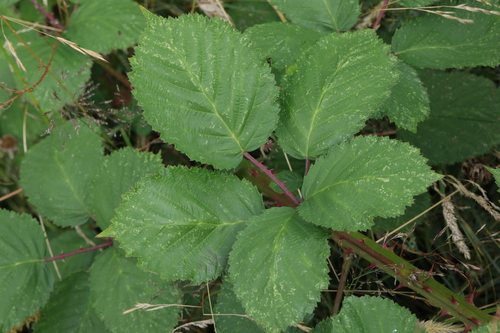
Rubus candicantes typically presents with sturdy, arching, often reddish or purplish stems covered in sharp, strong prickles. Its leaves are usually palmate, composed of 3 to 5 leaflets that are dark green above and often whitish or felted on the underside, giving it a 'candicans' or 'whitish' appearance, especially when young. White to pinkish flowers with five petals appear in clusters, developing into characteristic juicy, black aggregate fruits (drupelets) that ripen from late summer to early autumn. The overall plant can reach several meters in length, forming large, bushy mounds.
Category
PlantsRarity
Common
Danger
1/5 · Very low
Snaps
Be the first to snap!
Blackberry fruits, including those from Rubus candicantes, are a valuable food source for numerous birds and mammals, particularly in late summer and autumn.
Brambles in the Rubus genus, especially those in section Rubus (to which candicantes belongs), are notorious for their taxonomic complexity due to frequent hybridization and apomixis, making species identification challenging even for experts.
Historically, parts of bramble plants have been used in traditional medicine, particularly for their astringent properties.
The name "candicantes" refers to the whitish or felted underside of the leaves, a key distinguishing feature for this bramble.
This species rapidly produces long, arching canes that root at the tips upon contact with the ground, creating dense, tangled thickets that provide excellent shelter and defense against large herbivores.
Rubus candicantes commonly reproduces through apomixis, a form of asexual reproduction where seeds are produced without fertilization, allowing it to rapidly colonize new areas and maintain genetic consistency.
As a robust plant, it excels at absorbing and storing nutrients from the soil, contributing to soil stabilization and enrichment in often disturbed and degraded habitats.
As a photosynthetic plant, Rubus candicantes primarily produces its own food through photosynthesis, utilizing sunlight, carbon dioxide, and water. It absorbs essential minerals and nutrients from the soil through its root system.
Apis mellifera
Provides pollen and nectar for pollination.

Erithacus rubecula
Consumes the fruits and aids in seed dispersal.

Capreolus capreolus
Browses on young shoots and leaves.
Troglodytes troglodytes
Benefits from the plant's dense thickets for shelter and nesting.
No trait badges are assigned for this object yet.
No aliases listed yet.
Collections for this object will appear here as more themes are added.
Danger
1/5 · Very low
No special safety notes yet.
Start with the whole plant, then compare leaf arrangement, leaf edges, stems and any flowers or fruit. Opposite leaves grow in pairs; alternate leaves come one at a time along the stem. These details tell you far more together than a single green leaf does. Plant Identifier: upload a photo and compare the visible details.
100-300 cm
1-5 kg
5-15 years
As a photosynthetic plant, Rubus candicantes primarily produces its own food through photosynthesis, utilizing sunlight, carbon dioxide, and water. It absorbs essential minerals and nutrients from the soil through its root system.
Found predominantly in disturbed sites such as woodland edges, hedgerows, clearings, abandoned fields, and along roadsides, often thriving in nutrient-rich and well-drained soils.
Foraging (for Soil Nutrients And Water), Light Absorption
Zoom in to split clusters and explore where this object has been snapped.
Recent snaps will appear here as new observations are added.
Take the discovery with you
Snap it with Snappit to identify it, learn what makes it special, and add the discovery to your collection.


















