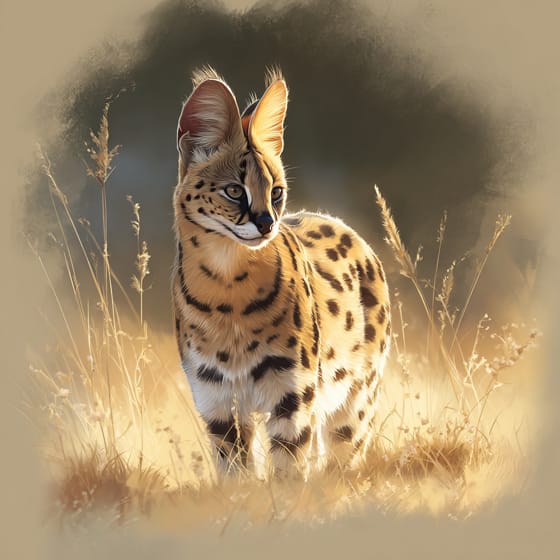





Serval
Leptailurus serval
The serval is a tall, slender wild cat from Africa. It has long legs and big ears, perfect for hearing its prey in the grass.
Habitat: Grasslands and savannas
The Serval is a slender, medium-sized cat with incredibly long legs and a short tail. It has a distinctive coat of large black spots and stripes on a golden-yellow to tawny background. Its most striking feature is its very large, oval ears.
Category
MammalsRarity
Common
Danger
2/5 · Low
Snaps
Be the first to snap!
Each serval's spotted coat pattern is unique, just like a human fingerprint!
Servals have the longest legs of any cat relative to their body size!
Some servals have a completely black coat, known as melanism or melanistic!
These amazing cats are surprisingly good swimmers and can even catch fish!
Serval can pinpoint tiny sounds of prey in tall grass or underground because of its massive, independently swiveling ears.
Serval can jump over 9 feet high because of its powerful leg muscles, helping it snatch birds mid-flight.
Serval has incredibly long legs that help them see over tall savanna grasses while hunting for small animals.
Servals mostly eat small rodents, birds, and insects, making them skilled savanna hunters!
Mastomys natalensis
Primary small mammal prey.
Ardeotis kori
May prey on large ground birds.
Python sebae
Young servals may be hunted.
Panthera leo
Apex predator that can kill servals.
Homo sapiens
Hunted for fur or bushmeat.
Furry describes animals possessing a dense covering of soft hair or fur.
Marked with parallel bands or lines of color.
Solitary animals live alone for most of their lives, only interacting with others for mating or parental care.
Grassland habitats are terrestrial biomes dominated by grasses and herbaceous plants, supporting a variety of grazing animals.

An ambush predator hunts by patiently waiting and concealing itself, then launching a sudden attack when unsuspecting prey comes within range.

This trait identifies organisms whose diet consists entirely or primarily of animal tissue.

This trait identifies organisms that exhibit exceptional swiftness in movement for hunting, escape, or travel.

Nocturnal animals are primarily active during the nighttime hours, typically resting or sleeping during the day.
No aliases listed yet.
Danger
2/5 · Low
Servals are wild animals and should be respected from a distance. Always enjoy watching them safely!
The easiest way to identify Serval is to use the Snappit nature identifier app.
60-100 cm
7-18 kg
10-12 years
80 km/h
Servals mostly eat small rodents, birds, and insects, making them skilled savanna hunters!
Grasslands and savannas
Pursuit
Zoom in to split clusters and explore where this object has been snapped.
Recent snaps will appear here as new observations are added.

New York, US
You might spot Giraffes, Kangaroos, Wallabies and Allies, and Capybara.
View guide →

Massachusetts, US
You might spot American Bison, Domestic Bactrian Camel, and Black Bear.
View guide →

England, UK
You might spot Ring-Tailed Lemur, Meerkat, and Red Panda.
View guide →
Kentucky, US
You might spot Kangaroos, Possums, Wombats, and Allies and Emu.
View guide →

North Carolina, US
You might spot Tiger, African Lion, and Bears.
View guide →
California, US
You might spot Black Bear, Brown Bear, and Cougar.
View guide →
Take the discovery with you
Snap it with Snappit to identify it, learn what makes it special, and add the discovery to your collection.




.jpg&width=800)



.JPG&width=800)


.jpg&width=800)
