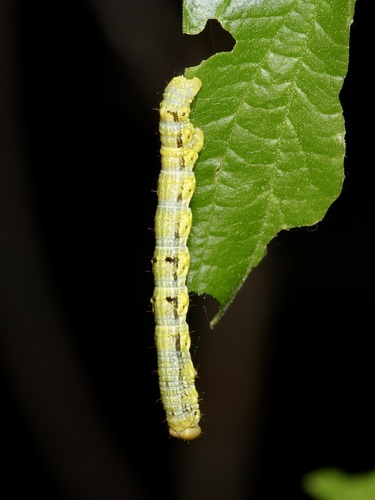


Small Phigalia Moth
phigalia strigataria
The Small Phigalia Moth (Phigalia strigataria) is a fascinating early-season member of the Geometridae family, renowned for emerging when winter's chill still lingers. While many insects wait for the warmth of late spring, this hardy moth can be seen braving chilly late winter and early spring nights across eastern North America. One of the most intriguing aspects of this species is its extreme sexual dimorphism: while males possess fully functional, beautifully patterned wings to search for mates, females are completely wingless and resemble small, fuzzy spiders. Larvae of the Small Phigalia, commonly known as inchworms, play a vital role in their forest ecosystems, serving as an important food source for nesting songbirds. They feed on the fresh foliage of deciduous trees before pupating in the soil. Observing a male resting on a tree trunk or finding a wingless female crawling upward is a delightful reward for early-season naturalists.
Habitat: Found in deciduous and mixed forests, woodlands, and suburban parks containing host trees like oaks and maples.
Male Small Phigalia Moths are characterized by light gray to brownish-gray forewings, marked with distinct, dark, wavy transverse lines and subtle speckling that provides excellent camouflage against tree bark. Their hindwings are paler and less intensely marked. They have a wingspan of approximately 2.8 to 3.8 cm and feather-like antennae used to detect female pheromones. In stark contrast, the females are completely wingless, featuring stout, hairy, grayish-brown bodies with dark bands, and long legs that give them a spider-like appearance as they crawl up tree trunks.
Category
InsectsRarity
Common
Danger
1/5 · Very low
Snaps
Be the first to snap!
Because the adults do not have functioning mouthparts, they cannot eat and live only a few days to reproduce.
Female Small Phigalia moths have no wings at all, looking more like six-legged spiders than traditional moths.
Males use their highly sensitive, feather-like antennae to track pheromone trails released by wingless females hiding on tree bark.
These moths are freeze-tolerant, often emerging in late winter when snow is still on the ground.
Females are completely wingless, conserving energy and resources for egg production, while males retain wings to actively search for mates.
Emerging in late winter and early spring, this moth possesses physiological adaptations to survive sub-freezing temperatures.
The male's mottled gray and brown wing patterns perfectly mimic tree bark and lichens, rendering them virtually invisible to predators.
Larvae are generalist feeders on the leaves of deciduous trees, whereas the short-lived adults have non-functional mouthparts and do not feed at all.
Age differences: Larvae feed voraciously on deciduous foliage, while adults have non-functional mouthparts and do not feed, relying entirely on stored energy.

Quercus alba
Larvae feed extensively on the leaves of this tree species.

Acer rubrum
Larvae feed on the leaves of this common deciduous tree.

Poecile carolinensis
This bird species preys on the caterpillars in late spring to feed its nestlings.

Vireo olivaceus
This foliage-gleaning bird feeds on caterpillars of various geometrid moths, including the Small Phigalia.
No trait badges are assigned for this object yet.
No aliases listed yet.
Collections for this object will appear here as more themes are added.
Danger
1/5 · Very low
No special safety notes yet.
Compare resting wing shape, forewing markings, antennae and body build. Small brown moths can hinge on fine details a phone photo can't always catch. Moth Identifier: upload a photo and compare the visible details.
1-2 cm
3-4 cm
0.0001-0.0003 kg
1 years
8 km/h
Larvae are generalist feeders on the leaves of deciduous trees, whereas the short-lived adults have non-functional mouthparts and do not feed at all.
Found in deciduous and mixed forests, woodlands, and suburban parks containing host trees like oaks and maples.
Zoom in to split clusters and explore where this object has been snapped.
Recent snaps will appear here as new observations are added.
Take the discovery with you
Snap it with Snappit to identify it, learn what makes it special, and add the discovery to your collection.