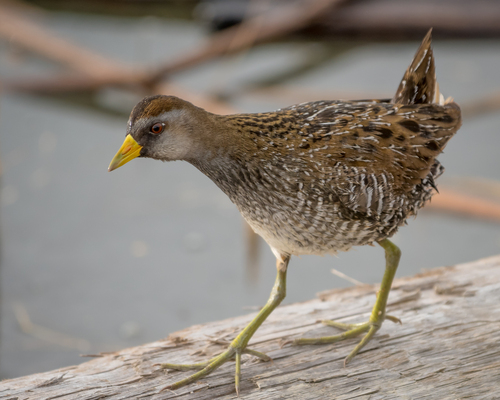


Sora
porzana carolina
The Sora is a small, secretive marsh bird belonging to the rail family, known for its elusive nature and distinctive calls that betray its presence in dense wetland vegetation. Often heard but rarely seen, this charming bird is a migratory species that breeds across much of North America and winters further south. Despite its plump body and relatively short wings, the Sora is a surprisingly strong flyer, undertaking long nocturnal migrations. It plays a role in wetland ecosystems by consuming a variety of insects and plant matter, contributing to seed dispersal and invertebrate control. Its adeptness at navigating through thick reeds and its camouflaged plumage make it a true ghost of the marsh.
Habitat: Found in freshwater marshes, bogs, and wet meadows with dense emergent vegetation such as cattails, sedges, and grasses.
The Sora is a small, chicken-like marsh bird, measuring about 20-25 cm in length with a compact body. Adults display a striking black face and throat, contrasting sharply with a slate-gray breast and neck. Its crown and back are mottled olive-brown with fine white streaking, providing excellent camouflage among reeds. The flanks are barred with black and white, and it has a short, bright yellow bill. Its legs are yellowish-green. In flight, its short, rounded wings reveal a brownish-grey underside, and its short tail is often cocked upwards. Juveniles lack the black face and have a duller, more brownish plumage.
Category
BirdsRarity
Common
Danger
1/5 · Very low
Snaps
Be the first to snap!
Despite being a wetland bird, Soras are not strong swimmers and prefer to walk or run through vegetation.
The name 'Sora' comes from one of its distinctive calls, a rising 'sora' note often heard in the marsh.
Their bodies are laterally compressed, meaning they are thin from side to side, allowing them to slip easily between dense marsh reeds.
Young Soras hatch with black down, which helps them absorb heat and remain camouflaged in their dark, marshy nests.
Soras are incredibly agile, using their strong legs and compressed bodies to move effortlessly through dense marsh vegetation, often walking on floating plants.
They possess a wide array of distinctive calls, including a whinnying 'ker-wee' and a rising 'sora' note, which are often the only indication of their presence.
Despite their seemingly weak flight, Soras are powerful migratory birds, undertaking long journeys between breeding and wintering grounds primarily under the cover of darkness.
The Sora's diet consists of a mix of small invertebrates, particularly insects, and various plant seeds and aquatic vegetation.
Age differences: Young chicks are fed primarily insects by their parents. Adults maintain a mixed diet.

Neovison vison
A common predator in wetlands that may prey on Sora eggs or chicks.

Ardea herodias
A large wading bird found in the same wetland habitats, known to prey on small birds.

Typha latifolia
Aquatic plants providing food and cover.
Anisoptera larvae
A primary food source for Soras.
No trait badges are assigned for this object yet.
No aliases listed yet.
Collections for this object will appear here as more themes are added.
Danger
1/5 · Very low
No special safety notes yet.
Compare the silhouette, bill shape, tail length, wing bars and markings around the eyes. The same small brown bird at your feeder can look quite different in breeding plumage, winter plumage or its first year. Bird Identifier: upload a photo and compare the visible details.
20-25 cm
30-35 cm
0.05-0.1 kg
2-5 years
The Sora's diet consists of a mix of small invertebrates, particularly insects, and various plant seeds and aquatic vegetation.
Found in freshwater marshes, bogs, and wet meadows with dense emergent vegetation such as cattails, sedges, and grasses.
Foraging
Zoom in to split clusters and explore where this object has been snapped.
Recent snaps will appear here as new observations are added.
Take the discovery with you
Snap it with Snappit to identify it, learn what makes it special, and add the discovery to your collection.