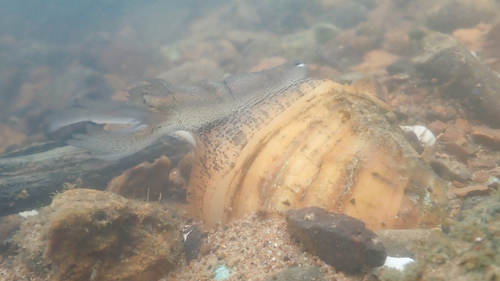


Southern Pocketbook
lampsilis ornata
The Southern Pocketbook (Lampsilis ornata) is a remarkable freshwater mussel endemic to the river systems of the southeastern United States. Playing a vital role in its ecosystem, this bivalve acts as a natural water filter, cleaning rivers and streams by consuming microscopic organic matter. Its name is derived from its inflated, pocketbook-like shell shape, which provides a sturdy anchor in sandy or gravelly riverbeds. What truly distinguishes the Southern Pocketbook is its sophisticated reproductive strategy. Female mussels employ an incredibly realistic mantle lure that mimics a small fish to attract predators. When a target fish strikes, the mussel releases its larval young, which temporarily attach to the fish's gills. This relationship ensures the wide dispersal of the offspring, highlighting the complex ecological connections within freshwater river networks.
Habitat: Found in medium to large rivers with moderate currents, typically nestled within sand, gravel, or mixed silty-sand substrates.
This species possesses a thick, solid, and highly inflated shell that is oval to sub-elliptical in shape. The exterior shell color typically ranges from yellow to yellowish-brown or green, and is adorned with distinctive dark green rays that often appear as broken spots, chevrons, or lines. Its nacre, the inner shell lining, is a lustrous white, occasionally tinged with pink or salmon. Mature individuals reach lengths of 7 to 15 centimeters, with females exhibiting a noticeably more swollen posterior than males to accommodate their brooding larvae.
Category
InvertebrateRarity
Common
Danger
1/5 · Very low
Snaps
Be the first to snap!
A healthy bed of Southern Pocketbooks can filter hundreds of gallons of river water daily, substantially reducing turbidity and beneficial to fish.
Freshwater mussels like the Southern Pocketbook are considered biological indicators; their absence is often the first sign of a river's declining health.
The realistic lure displayed by the female mussel mimics a swimming minnow, complete with false 'eyespots' and a waving 'tail'.
The female displays a specialized, fish-like mantle flap complete with eye-spots and a tail tail-fin, which she twitches to entice host fish.
Larvae attach harmlessly to the gills of specific host fish to gain nutrients and migrate upstream during early development.
Uses a powerful muscular foot to burrow deeply into riverbeds, resisting displacement by strong river currents.
As a suspension filter feeder, it siphons river water to extract microscopic organic particles, algae, and bacteria.
Age differences: Larvae absorb nutrients directly from host fish tissue, whereas adults filter feed suspended particles from the water.

Micropterus salmoides
Acts as the obligate parasite host required for the development of larval glochidia.

Ondatra zibethicus
Commonly preys upon adult mussels, collecting them from shallow riverbeds and creating shell piles called middens.

Lepomis macrochirus
Serves as an additional alternative host species for glochidia development and downstream transport.
No trait badges are assigned for this object yet.
No aliases listed yet.
Collections for this object will appear here as more themes are added.
Danger
1/5 · Very low
No special safety notes yet.
Compare body symmetry, shells, segments, legs, tentacles and how the animal moves. Invertebrates span many unrelated groups, so start with body structure. Invertebrate Identifier: upload a photo and compare the visible details.
0.1+ kg
As a suspension filter feeder, it siphons river water to extract microscopic organic particles, algae, and bacteria.
Found in medium to large rivers with moderate currents, typically nestled within sand, gravel, or mixed silty-sand substrates.
Filtering
Zoom in to split clusters and explore where this object has been snapped.
Recent snaps will appear here as new observations are added.
Take the discovery with you
Snap it with Snappit to identify it, learn what makes it special, and add the discovery to your collection.