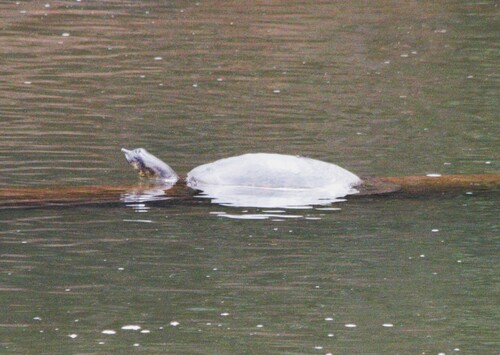




Spiny Softshell Turtle
Apalone spinifera
The Spiny Softshell Turtle has a flat, soft shell that helps it swim easily in the water. They are great at hiding in the sand or mud at the bottom of rivers!
Habitat: Rivers, lakes, and ponds
The Spiny Softshell Turtle has a unique flat, leathery shell that is olive to brown, often with dark spots, and lacks typical hard plates. It features small spiny projections near its head and a long, pig-like snorkel snout, making it visually distinct.
Category
ReptilesRarity
Common
Danger
2/5 · Low
Snaps
26
Their flat, leathery shell feels like tough skin, not hard bone!
Their unique spotted patterns beautifully change as they grow older.
These turtles are super fast, darting through water like a torpedo!
They often bury themselves completely in sand or mud, disappearing!
Spiny Softshell Turtle can stay underwater longer as special throat linings absorb oxygen directly from the water.
Spiny Softshell Turtle has a long snout it uses like a snorkel, letting it breathe air while hidden underwater.
These turtles are fierce hunters, eating fish, insects, and other small aquatic animals.
Age differences: Young turtles eat mostly insects, while adults hunt larger prey like fish and crayfish.

Procyon lotor
Raccoons frequently raid their nests for eggs.
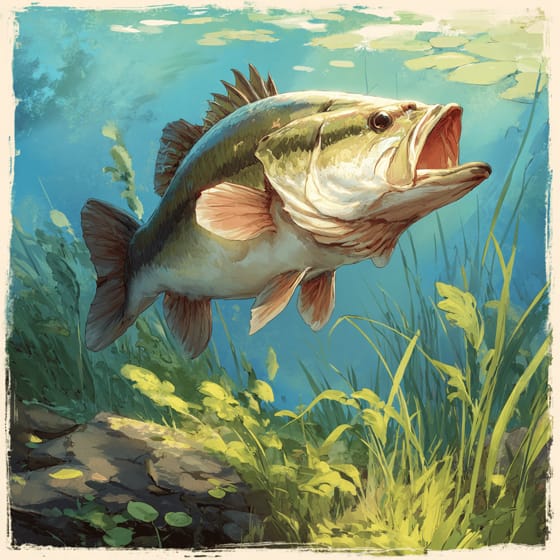
Micropterus salmoides
Actively hunts and preys on small fish, including bass.
Orconectes virilis
Feeds on crayfish, catching them with quick movements.
Anax junius
Eats aquatic insect larvae, like dragonfly nymphs.
Characterized by having toes connected by a membrane, typically aiding in swimming.
Solitary animals live alone for most of their lives, only interacting with others for mating or parental care.
This trait identifies organisms whose diet includes both plant and animal matter.
Camouflaged describes organisms that possess coloring or patterns that allow them to blend into their environment.

Thermoregulating organisms maintain a stable internal body temperature despite fluctuations in the external environment.

This trait signifies organisms belonging to a very old evolutionary group with ancestors dating back millions of years.

This trait characterizes organisms with an exceptionally long lifespan compared to others of their kind.

Possessing sharp, pointed projections or spines on the body or surface.

Armored describes animals protected by a hard, external covering or shell for defense.

Freshwater habitats include non-saline aquatic environments such as rivers, lakes, ponds, and wetlands, vital for numerous species.
Danger
2/5 · Low
Look but don’t touch. Keep a safe distance and wash hands after exploring.
The easiest way to identify Spiny Softshell Turtle is to use the Snappit nature identifier app.
13-46 cm
0.2-4.5 kg
20-50 years
These turtles are fierce hunters, eating fish, insects, and other small aquatic animals.
15 km/h
Rivers, lakes, and ponds
Ambush
Zoom in to split clusters and explore where this object has been snapped.
May 1, 2026
Columbia CanalPhoto attribution
(c) Raven Dandridge, some rights reserved (CC BY)
License: CC BY 4.0 ↗
Image may be shown cropped inside the card frame.

Illinois, US
You might spot Brown-Belted Bumble Bee and Eastern Gray Squirrel.
View guide →
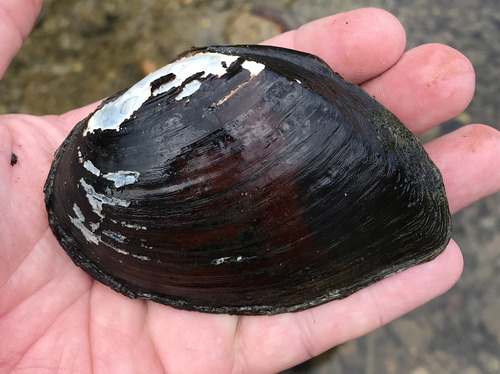
Alabama, US
You might spot Elephantear, Three-Ridge Mussel, and Rough Fatmucket.
View guide →

Indiana, US
You might spot Eastern Fox Squirrel, Duck, and Canada Goose.
View guide →
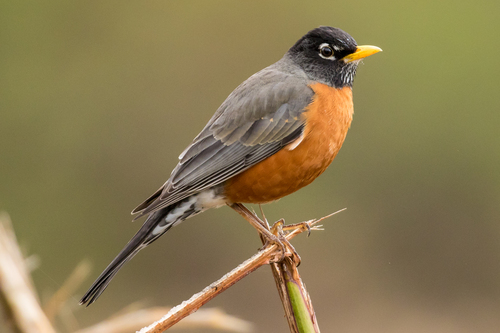
New Jersey, US
You might spot American Robin, Spotted Lanternfly, and Monarch.
View guide →

South Carolina, US
You might spot Great Blue Heron, Spanish Moss, and Cahaba Lily.
View guide →

California, US
You might spot Western Fence Lizard and Eastern Fox Squirrel.
View guide →
Take the discovery with you
Snap it with Snappit to identify it, learn what makes it special, and add the discovery to your collection.