

Texas Lignum-Vitae
guaiacum angustifolium
The Texas Lignum-Vitae, locally known as Guayacan, is a remarkably rugged, slow-growing evergreen shrub or small tree native to the arid brushlands of southern Texas and northern Mexico. Renowned for its incredibly dense, heavy wood and vibrant purple blooms, this resilient plant plays a vital ecological role in its harsh desert habitat by providing crucial shelter and nourishment for local wildlife. Historically, its tough, resinous wood was highly valued for industrial applications, and its medicinal properties earned it the name 'tree of life.' Today, it is appreciated both as a native survivor and an ornamental choice for low-water landscaping.
Habitat: Found in arid brushlands, rocky hillsides, and Tamaulipan thornscrub of South Texas and Northern Mexico.
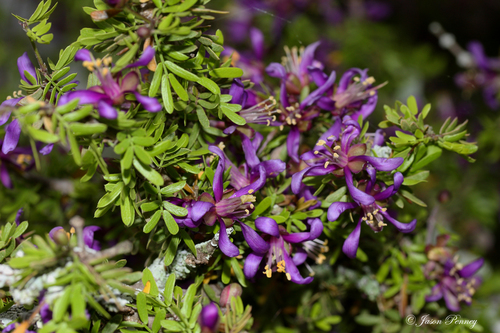
This species forms a gnarled, multi-branched shrub or small tree reaching 1 to 6 meters in height. It features small, dark green pinnate leaves with narrow, opposite leaflets that can fold up to conserve moisture. During spring or following heavy rains, the branches are adorned with clusters of five-petaled violet to blue-purple flowers with bright yellow anthers, which eventually give way to heart-shaped, orange-yellow seed pods containing shiny, scarlet-red seeds.
Category
PlantsRarity
Common
Danger
1/5 · Very low
Snaps
1
Due to its high resin content, the wood is naturally self-lubricating and was historically used to make bearings for marine propeller shafts.
Its wood is so dense and heavy that it cannot float, sinking immediately when placed in water.
The common name 'Lignum-Vitae' translates to 'wood of life' in Latin, earned due to historical medicinal uses of its bark and resin.
Produces incredibly dense, self-lubricating wood containing natural resins that protect it from boring insects and physical damage.
Folds its leaflets tightly together during the hottest parts of the day to minimize moisture loss from transpiration.
Can rapidly trigger mass flowering events immediately following sparse rainfall in dry environments.
Produces its own organic compounds using sunlight, carbon dioxide, water, and essential soil minerals through photosynthesis.

Kricogonia lyside
The caterpillars of this butterfly feed on the foliage of Guaiacum species.

Odocoileus virginianus
Forages on the evergreen leaves and twigs during dry seasons when other forage is scarce.
Apis mellifera
Collects nectar and pollen from the purple blossoms, helping to pollinate the flowers.
No trait badges are assigned for this object yet.
No aliases listed yet.
Collections for this object will appear here as more themes are added.
Danger
1/5 · Very low
No special safety notes yet.
The easiest way to identify Texas Lignum-Vitae is to use the Snappit nature identifier app.
100-600 cm
50-150 years
Produces its own organic compounds using sunlight, carbon dioxide, water, and essential soil minerals through photosynthesis.
Found in arid brushlands, rocky hillsides, and Tamaulipan thornscrub of South Texas and Northern Mexico.
Photosynthesis
Zoom in to split clusters and explore where this object has been snapped.
Take the discovery with you
Snap it with Snappit to identify it, learn what makes it special, and add the discovery to your collection.












.jpg&width=800)



_001.jpg&width=800)




