





Twenty-spotted Lady Beetle
Psyllobora vigintimaculata
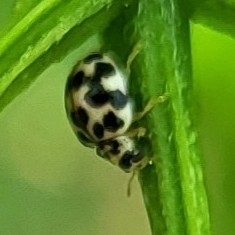
The Twenty-spotted Lady Beetle is a small, friendly bug with bright yellow wings and twenty black spots. They love to munch on tiny pests like aphids, helping plants stay healthy and happy!
Habitat: Grasslands
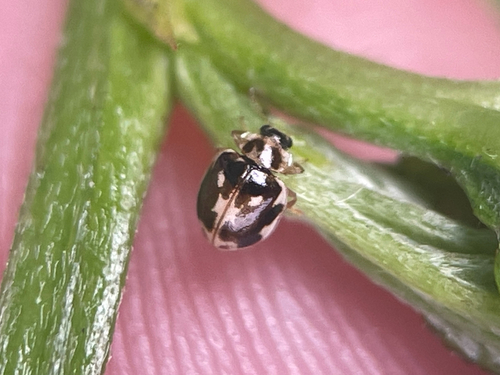
The Twenty-spotted Lady Beetle is a small, round insect, typically bright yellow to pale cream. It has twenty distinctive black spots across its wing covers. Its dome-shaped body helps differentiate it from flat-bodied beetles.
Category
InsectsRarity
Common
Danger
1/5 · Very low
Snaps
20
Baby twenty-spotted lady beetles look like tiny, spiky, walking alligators!
It's one of the few lady beetles that eats mold instead of pests!
Its spots aren't always exactly twenty; the number can vary slightly!
They sometimes gather in large groups to spend the winter months together!
Twenty-spotted Lady Beetle can release a bitter, toxic liquid from its legs that makes predators think twice.
Twenty-spotted Lady Beetle has bright yellow colors and black spots that warn hungry birds and insects to stay away.
Twenty-spotted Lady Beetle can pretend to be dead by tucking in its legs and dropping, surprising attackers.
Uniquely, these beetles munch on fungi like powdery mildew, keeping plants healthy!
Age differences: Larvae and adults share a similar diet, primarily fungi.
Erysiphe necator
Feeds on this fungal pathogen, helping plant health.
Podosphaera xanthii
Consumes this common powdery mildew on garden plants.

Cardinalis cardinalis
A common bird that preys on insects like lady beetles.
Formica exsectoides
Ants may prey on larvae or adults when opportunities arise.
Marked with spots or patches of a different color.
Solitary animals live alone for most of their lives, only interacting with others for mating or parental care.
Colorful describes organisms or objects displaying a wide range of bright and distinct colors.
Grassland habitats are terrestrial biomes dominated by grasses and herbaceous plants, supporting a variety of grazing animals.

This trait characterizes organisms whose diet consists entirely or primarily of plant material.

This trait identifies organisms whose diet primarily consists of insects and other small invertebrates.

Describes plants that are particularly attractive and beneficial to a wide range of pollinating organisms.

Diurnal animals are primarily active during daylight hours, typically resting or sleeping at night.

Pertaining to species that are significantly smaller than typical or average for their kind.

Describes organisms that transfer pollen, enabling the fertilization and reproduction of plants.
No aliases listed yet.
Danger
1/5 · Very low
These beetles are safe to watch, but don’t touch them too much to keep them happy.
The easiest way to identify Twenty-spotted Lady Beetle is to use the Snappit nature identifier app.
5-12 mm
2-4 mm
30-365 days
Uniquely, these beetles munch on fungi like powdery mildew, keeping plants healthy!
Grasslands
Foraging
6
Zoom in to split clusters and explore where this object has been snapped.
May 27, 2026
Pine Creek GorgePhoto attribution
(c) Ben Meredyk, some rights reserved (CC BY)
License: CC BY 4.0 ↗
Image may be shown cropped inside the card frame.
May 8, 2026
California Academy of SciencesPhoto attribution
no rights reserved
License: CC0 1.0 ↗
Image may be shown cropped inside the card frame.
Jul 19, 2025
SelleckPhoto attribution
(c) eebee, some rights reserved (CC BY)
License: CC BY 4.0 ↗
Image may be shown cropped inside the card frame.

California, US
You might spot Western Fence Lizard, Duck, and California Brittlebush.
View guide →

Washington, US
You might spot Great Blue Heron, Aggregating Anemone, and Ochre Sea Star.
View guide →

New Jersey, US
You might spot Eastern Gray Squirrel and Canada Goose.
View guide →

Ohio, US
You might spot Brown-Belted Bumble Bee and Eastern Carpenter Bee.
View guide →

Indiana, US
You might spot Monarch, Black Swallowtail, and American Pokeweed.
View guide →

Ohio, US
You might spot Spotted Lanternfly, Virginia Springbeauty, and Blue Phlox.
View guide →
Take the discovery with you
Snap it with Snappit to identify it, learn what makes it special, and add the discovery to your collection.






.jpg&width=800)



