.jpg&width=800)





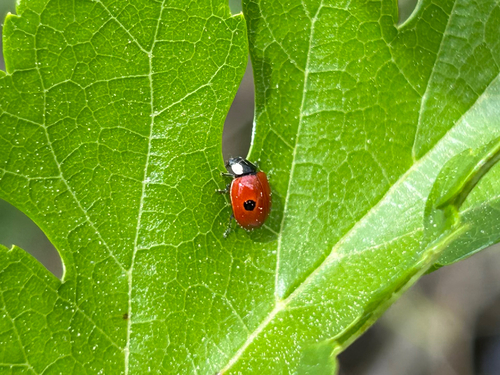
Two-spotted Lady Beetle
Adalia bipunctata
The Two-spotted Lady Beetle is a small, round bug with two black spots on its red back. These friendly beetles help gardens by eating pesky aphids and other tiny bugs.
Habitat: Gardens
The Two-spotted Lady Beetle is a small, domed insect, typically bright red or orange with two prominent black spots on its wing covers. Its head and thorax are black with white markings, distinguishing it from many multi-spotted or solid-colored lady beetles.
Category
InsectsRarity
Common
Danger
1/5 · Very low
Snaps
7
Some Two-spotted Lady Beetles are entirely black with two red spots!
The number of spots doesn't tell you how old a lady beetle is.
Their larvae look like tiny, spiky, black and orange crocodiles!
They use their antennae to smell for food and find other lady beetles.
Two-spotted Lady Beetle can ooze foul-smelling yellow liquid from its leg joints that helps them deter predators.
Two-spotted Lady Beetle can devour many garden pests because of its strong mandibles that helps them keep plants healthy.
Two-spotted Lady Beetle has a pair of hidden wings that helps them find new food sources and avoid danger.
Two-spotted Lady Beetle can survive cold winters because of its dormant state that helps them avoid freezing.
These beetles are insect predators, feasting mainly on soft-bodied plant pests like aphids.
Age differences: Larvae and adults both eat the same types of pests, making them helpful at all life stages.
Aphis gossypii
Primary food source for all active stages.
Myzus persicae
Controls populations of this common agricultural pest.
%2C_Parc_de_Woluw%C3%A9%2C_Brussels_(13042792905).jpg&width=800)
Parus major
Birds are common predators of larvae and adults.
Chrysoperla carnea
Larvae sometimes eat lacewing larvae in scarce conditions.
Marked with spots or patches of a different color.
Solitary animals live alone for most of their lives, only interacting with others for mating or parental care.
Colorful describes organisms or objects displaying a wide range of bright and distinct colors.
This trait identifies organisms whose diet primarily consists of insects and other small invertebrates.

Diurnal animals are primarily active during daylight hours, typically resting or sleeping at night.

Describes a species whose presence and role have a disproportionately large effect on its environment.

This habitat trait indicates species that can coexist with humans in urban and suburban environments, utilizing man-made structures and green spaces.

Describes organisms that transfer pollen, enabling the fertilization and reproduction of plants.
No aliases listed yet.
Danger
1/5 · Very low
Lady beetles are safe to touch, but it's best to observe them gently.
The easiest way to identify Two-spotted Lady Beetle is to use the Snappit nature identifier app.
10-14 mm
3.5-5.5 mm
30-365 days
8 km/h
These beetles are insect predators, feasting mainly on soft-bodied plant pests like aphids.
Gardens
Foraging
Zoom in to split clusters and explore where this object has been snapped.
Jun 2, 2026
Cato Hill Historic DistrictPhoto attribution
(c) Branson Khounvichith, some rights reserved (CC BY-SA)
License: CC BY-SA 4.0 ↗
Image may be shown cropped inside the card frame.

Massachusetts, US
You might spot Common Eastern Bumble Bee and Asian Lady Beetle.
View guide →

Illinois, US
You might spot Common Milkweed and Common Eastern Bumble Bee.
View guide →

New York, US
You might spot African Penguin, Sea Otter, and Harbor Seal.
View guide →

Colorado, US
You might spot Black-Billed Magpie, Fireweed, and Common Cowparsnip.
View guide →

Rhode Island, US
You might spot Pink Lady's Slipper and Asian Bittersweet.
View guide →

Nebraska, US
You might spot Mule Deer, House Sparrow, and Eurasian Collared-Dove.
View guide →
Take the discovery with you
Snap it with Snappit to identify it, learn what makes it special, and add the discovery to your collection.








.jpg&width=800)


