





Verdin
Auriparus flaviceps
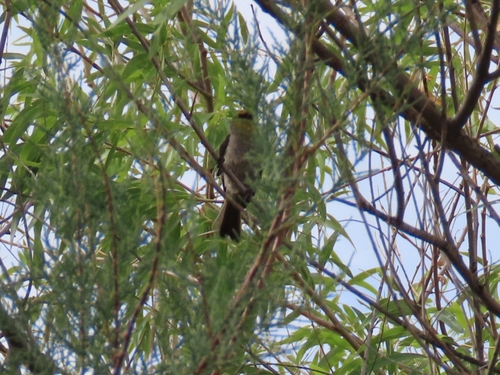
The Verdin is a small, cheerful bird with a bright yellow head and a gray body. They love to sing and can often be seen flitting around in bushes and trees, making their homes in the desert.
Habitat: Desert
The Verdin is a tiny songbird, mostly gray with a bright yellow head and a distinctive reddish-chestnut patch on its shoulder. Its fine, pointed bill helps distinguish it from similar small birds in arid regions.
Category
BirdsRarity
Common
Danger
1/5 · Very low
Snaps
14
Male Verdins sometimes build a special "bedroom nest" just for themselves to sleep in!
One of the smallest North American songbirds, barely bigger than a grown-up's thumb!
They can hang upside down like a tiny acrobat to snatch tiny insects from leaves!
Verdins build extra "dummy" nests to trick predators and keep their real nest safe!
Verdin builds sturdy, domed nests with a side entrance that helps them stay cool and safe from predators in harsh climates.
Verdin can sip nectar from flowers with its specialized tongue, helping to pollinate desert plants for new growth.
Verdin has a fine bill that helps them pluck insects from the spiniest desert plants without getting poked or harmed.
Verdins enjoy a tasty mix of insects, spiders, and the sweet nectar from desert flowers.
Feathered describes animals, primarily birds, possessing a covering of feathers.
Social animals live in organized groups, cooperating for survival benefits such as foraging, defense, and raising offspring.
Singing animals produce complex vocalizations, often for purposes of attracting mates, defending territory, or communicating within their species.
This trait identifies organisms whose diet primarily consists of insects and other small invertebrates.

Describes plants that are particularly attractive and beneficial to a wide range of pollinating organisms.

Desert habitats are arid regions characterized by extremely low precipitation and often extreme temperatures, supporting specialized flora and fauna.

Diurnal animals are primarily active during daylight hours, typically resting or sleeping at night.

Describes organisms that transfer pollen, enabling the fertilization and reproduction of plants.
No aliases listed yet.
Danger
1/5 · Very low
Enjoy watching birds from a distance and be quiet so you don't scare them away.
The easiest way to identify Verdin is to use the Snappit nature identifier app.
10-11 cm
15-17 cm
0.006-0.009 kg
2-7 years
30 km/h
Verdins enjoy a tasty mix of insects, spiders, and the sweet nectar from desert flowers.
Desert
Zoom in to split clusters and explore where this object has been snapped.
Jun 12, 2026
Mesilla PlazaPhoto attribution
(c) Suanne Pyle, some rights reserved (CC BY)
License: CC BY 4.0 ↗
Image may be shown cropped inside the card frame.

New Mexico, US
You might spot White-Winged Dove and Silverleaf Nightshade.
View guide →

Nevada, US
You might spot Engelmann's Hedgehog Cactus.
View guide →

Nevada, US
You might spot Barbary Macaque, Chimpanzee, and African Lion.
View guide →

Nevada, US
You might spot Creosote Bush, Brittlebush, and Beavertail Pricklypear.
View guide →

California, US
You might spot California Buckwheat and Common Side-Blotched Lizard.
View guide →

US
You might spot Creosote Bush, Great-Tailed Grackle, and Ocotillo.
View guide →
Take the discovery with you
Snap it with Snappit to identify it, learn what makes it special, and add the discovery to your collection.






.jpg&width=800)









