




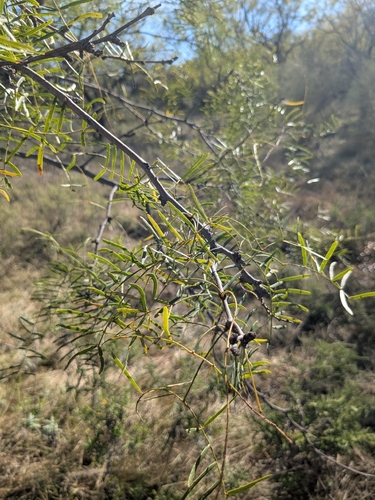
honey mesquite
Neltuma glandulosa
The honey mesquite is a special tree that grows in warm, dry places. It has long, feathery leaves and produces sweet pods that many animals love to eat!
Habitat: Desert
The honey mesquite is a thorny shrub or small tree with a often gnarled trunk and feathery, light green compound leaves. It produces distinctive yellowish-green flowers on slender spikes and long, sweet, yellowish-brown seed pods.
Category
PlantsRarity
Common
Danger
2/5 · Low
Snaps
12
Ancient people used mesquite for tools, shelter, medicine, and food for thousands of years!
It's a desert champion, capable of surviving extreme heat and long periods of drought!
Its sweet pods can be ground into flour to make delicious bread or desserts!
The dense, aromatic mesquite wood is a favorite for grilling and barbecuing!
Honey mesquite can grow incredibly deep taproots that help it find water far underground in dry desert lands.
Honey mesquite has sharp thorns on its branches that help it defend against hungry animals trying to eat its leaves.
Honey mesquite can fix nitrogen into the soil, helping enrich it and allowing other plants to grow nearby.
Honey mesquite can resprout quickly from its roots after fires, helping it survive and thrive in its habitat.
Apis mellifera
Bees collect nectar and pollen from its flowers.
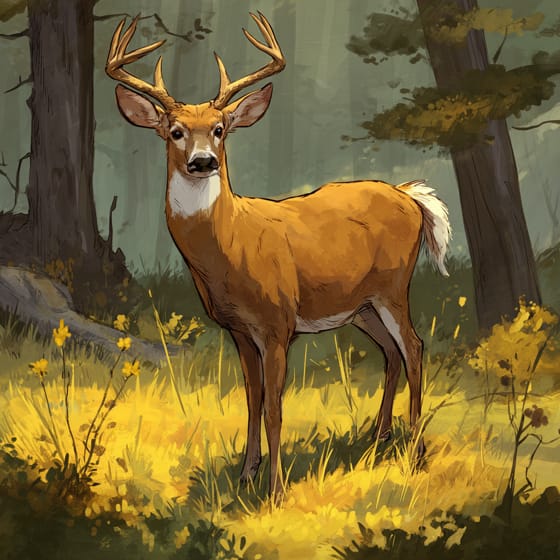
Odocoileus virginianus
Deer browse on its leaves and eat its sweet pods.
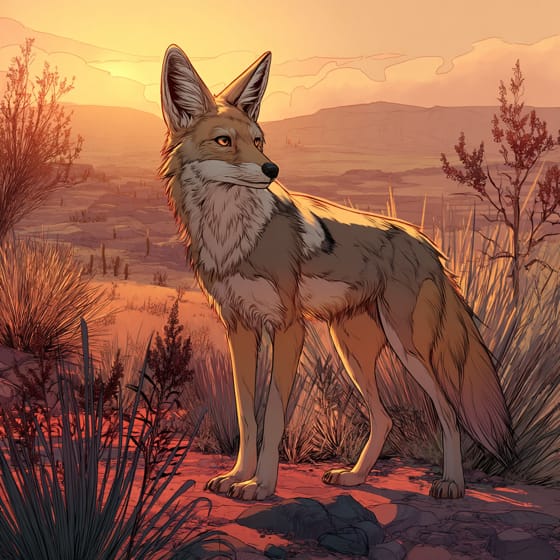
Canis latrans
Coyotes consume the nutritious pods, aiding seed dispersal.

Campylorhynchus brunneicapillus
Wrens build nests in its thorny branches for protection.
Deciduous plants periodically shed all their leaves, typically during autumn or dry seasons.
Describes organisms capable of converting atmospheric nitrogen into compounds usable by plants.
Shade tolerant plants are adapted to grow and thrive in areas with low light levels, requiring less direct sunlight.
Broadleaf trees are angiosperms characterized by flat, wide leaves that are typically shed annually in temperate climates.

Fruit-bearing plants produce fruits, which are the mature ovaries of flowering plants containing seeds.

Drought-tolerant plants can survive and flourish in conditions with limited water availability.

Edible plants are those parts of a plant that are considered safe for human consumption.

Desert habitats are arid regions characterized by extremely low precipitation and often extreme temperatures, supporting specialized flora and fauna.

This trait characterizes organisms with an exceptionally long lifespan compared to others of their kind.

Describes a species whose presence and role have a disproportionately large effect on its environment.
Danger
2/5 · Low
Be careful around trees and watch for sharp thorns on their branches.
The easiest way to identify honey mesquite is to use the Snappit nature identifier app.
500-900 cm
300-600 cm
0.2-0.5 cm
Spring to summer
Yes
None
Perennial
Zoom in to split clusters and explore where this object has been snapped.
Nov 25, 2025
ThurberPhoto attribution
(c) Jacob Saucier, some rights reserved (CC BY)
License: CC BY 4.0 ↗
Image may be shown cropped inside the card frame.

Texas, US
You might spot Silverleaf Nightshade and Green Comet Milkweed.
View guide →

Texas, US
You might spot Honey Mesquite, Anacua, and Alamo Vine.
View guide →

Texas, US
You might spot Christmas Cholla, Dakota Mock Vervain, and Honey Mesquite.
View guide →

New Mexico, US
You might spot Sunflower, Sideoats Grama, and Tree Cholla.
View guide →

Texas, US
You might spot Giraffes, African Lion, and Eastern Black Rhinoceros.
View guide →
New Mexico, US
You might spot Pyrrhuloxia, Curve-Billed Thrasher, and Great Blue Heron.
View guide →
Take the discovery with you
Snap it with Snappit to identify it, learn what makes it special, and add the discovery to your collection.








.jpg&width=800)


_001.jpg&width=800)

