





Warrior's Plume
Pedicularis densiflora
Warrior's Plume is a beautiful flower that grows in the mountains. Its unique shape and bright colors make it stand out in nature, like a little warrior in a field of green!
Habitat: Mountain regions
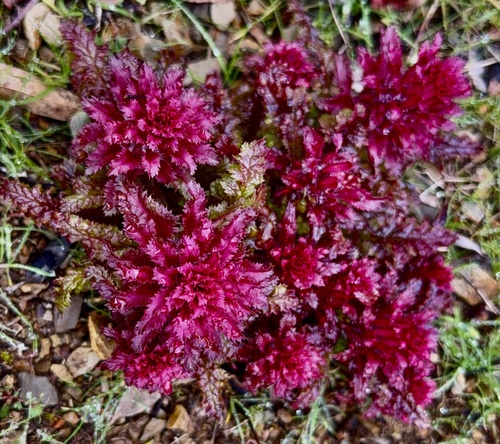
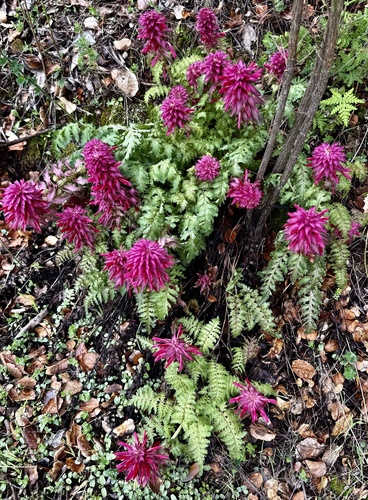
The Warrior's Plume has deep crimson to reddish-purple flowers tightly clustered into a dense, fuzzy spike, resembling a striking feathered helmet. Its stems and fern-like leaves often share a reddish hue, making it vividly stand out on green hillsides.
Category
PlantsRarity
Common
Danger
1/5 · Very low
Snaps
4
Certain bumblebees use "buzz pollination" to shake pollen from its unique flowers!
It often glows a deep crimson, making it stand out like a bright jewel on hillsides!
Its roots can secretly attach to other plants to steal food and water!
The name Pedicularis comes from a belief it caused lice in farm animals centuries ago!
Warrior's Plume can connect to other plants' roots, siphoning extra water and nutrients to help it thrive in tough spots.
This plant blooms in winter or early spring, giving it an early advantage to attract pollinators when few other flowers are available.
Its tall, dense spikes of vibrant red flowers create an irresistible visual beacon, guiding specific bumblebees to its nectar.
Bromus hordeaceus
Its roots tap into this grass for nutrients.
Festuca rubra
Parasitizes the roots of this common fescue.
Bombus californicus
This bumblebee is a primary visitor for pollination.
Bombus vosnesenskii
Buzz-pollinates its flowers to release pollen.
Flowering plants are any plants that produce flowers as part of their reproductive cycle.
Spring blooming plants produce their flowers during the spring season, often signifying the end of winter and the start of new growth.
Summer blooming plants produce their flowers during the summer season, often providing vibrant color when many other plants have finished.
Fragrant flowers emit a pleasant aroma, often to attract pollinators or for defense.

Colorful describes organisms or objects displaying a wide range of bright and distinct colors.

Describes plants that are particularly attractive and beneficial to a wide range of pollinating organisms.

This habitat trait identifies species found in mountainous regions, characterized by high elevation, steep slopes, and varying climate zones.

Describes organisms that transfer pollen, enabling the fertilization and reproduction of plants.
No aliases listed yet.
Danger
1/5 · Very low
Always look but don't pick flowers, so they can keep growing for everyone to enjoy!
The easiest way to identify Warrior's Plume is to use the Snappit nature identifier app.
10-50 cm
10-20 cm
1-2 cm
Winter to late Spring
No
Mild
Perennial
Zoom in to split clusters and explore where this object has been snapped.
Feb 20, 2026
El Sereno Open SpacePhoto attribution
no rights reserved
License: CC0 1.0 ↗
Image may be shown cropped inside the card frame.
Feb 20, 2026
El Sereno Open SpacePhoto attribution
no rights reserved
License: CC0 1.0 ↗
Image may be shown cropped inside the card frame.

California, US
You might spot Hoary Rock-Rose, Brittleleaf Manzanita, and Chaparral Pea.
View guide →

California, US
You might spot Northern Elephant Seal, Gumboot Chiton, and Ochre Sea Star.
View guide →
California, US
You might spot Pipevine Swallowtail and Western Fence Lizard.
View guide →

California, US
You might spot Pacific Hound's Tongue, Pacific Trillium, and Redwood.
View guide →

California, US
You might spot Warrior's Plume, Diogenes' Lantern, and Checker Lily.
View guide →
Take the discovery with you
Snap it with Snappit to identify it, learn what makes it special, and add the discovery to your collection.








.jpg&width=800)


_001.jpg&width=800)




