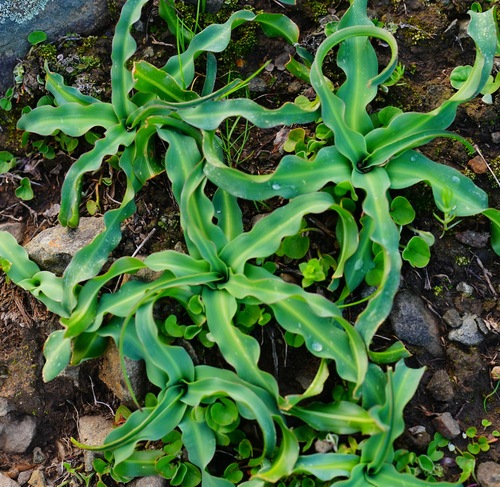


Wavy-Leafed Soap Plant
chlorogalum pomeridianum
The Wavy-Leafed Soap Plant is a fascinating perennial herb native to the hills, chaparral, and open woodlands of California and southwestern Oregon. Instantly recognizable by its rosette of long, crinkly-edged leaves that hug the ground, this resilient plant survives the hot, dry Mediterranean summer using a large, fibrous underground bulb. Historically, this species was one of the most culturally significant plants for Indigenous peoples, such as the Miwok and Pomo. The bulb is rich in natural compounds called saponins, which form a rich lather when crushed in water—making it a perfect natural soap and shampoo. It was also baked as food or used as a mild fish-stupefying agent. As evening falls, its tall, delicate flowering stalks come alive, showcasing a beautiful nocturnal display of starry white flowers that open for just a single night to welcome specialized native bee pollinators.
Habitat: Found primarily in dry open woodlands, chaparral, grasslands, and rocky slopes of California and southwestern Oregon.
This plant features a basal rosette of narrow, strap-like leaves up to seventy centimeters long with highly wavy, undulating margins. From the center of this rosette, a slender, widely branching flower stem emerges, rising up to two and a half meters tall. The flowers are small, star-shaped, and white with a distinct purple or green mid-vein down the center of each of the six petals. These blossoms open only in the late afternoon or evening. Below ground lies an elongated, egg-shaped bulb wrapped in a thick, coarse coat of dark brown, horsehair-like fibers.
Category
PlantsRarity
Common
Danger
1/5 · Very low
Snaps
3
Indigenous fishermen threw crushed fresh bulbs into quiet pools to stun fish, causing them to float to the surface for easy harvesting without poisoning the water permanently.
The thick, coarse fibers covering the bulb were traditionally harvested by Native Americans to make durable utility brushes and brooms.
When roasted in underground pits, the soapy compounds break down, transforming the bitter bulb into a sweet, nutritious, and caramelized food source.
The bulb contains high concentrations of toxic saponins, which lather like soap when wet to deter herbivores and underground pests.
Flowers open rapidly in the late afternoon and remain open only overnight to target crepuscular and nocturnal pollinators, conserving moisture during the heat of the day.
The underground bulb is encased in a thick, insulating layer of coarse, brown fibers that protect the storage organ from drought, burrowing animals, and low-intensity wildfires.
As a photosynthetic plant, it manufactures its own organic compounds using sunlight, carbon dioxide, water, and minerals absorbed from the soil.

Xylocopa sonorina
Pollinated by this large native carpenter bee, which is strong enough to easily pry open the freshly blooming evening flowers.

Odocoileus hemionus
The foliage is occasionally browsed by mule deer, particularly in late spring before the leaves wither.

Thomomys bottae
Gophers occasionally eat the starch-rich bulbs, though they must bypass the tough, fibrous outer coating.
No trait badges are assigned for this object yet.
No aliases listed yet.
Collections for this object will appear here as more themes are added.
Danger
1/5 · Very low
No special safety notes yet.
Start with the whole plant, then compare leaf arrangement, leaf edges, stems and any flowers or fruit. Opposite leaves grow in pairs; alternate leaves come one at a time along the stem. These details tell you far more together than a single green leaf does. Plant Identifier: upload a photo and compare the visible details.
30-250 cm
0.1-1.5 kg
5-20 years
As a photosynthetic plant, it manufactures its own organic compounds using sunlight, carbon dioxide, water, and minerals absorbed from the soil.
Found primarily in dry open woodlands, chaparral, grasslands, and rocky slopes of California and southwestern Oregon.
Zoom in to split clusters and explore where this object has been snapped.

California, US
You might spot Acorn Woodpecker and Western Fence Lizard.
View guide →

California, US
You might spot Redwood Sorrel, Redwood, and Button's Banana Slug.
View guide →

California, US
You might spot Checkerbloom and Fuchsiaflower Gooseberry.
View guide →
Take the discovery with you
Snap it with Snappit to identify it, learn what makes it special, and add the discovery to your collection.