

Wehrle'S Salamander
plethodon wehrlei
Wehrle's Salamander (Plethodon wehrlei) is a fascinating lungless salamander native to the forested slopes of the Appalachian Plateau in eastern North America. Lacking lungs entirely, this amphibian breathes through its moist skin and the lining of its mouth, which makes it highly dependent on cool, damp forest environments. They are typically found under rocks, rotting logs, or deep within damp crevices, and are known to occasionally inhabit the twilight zones of caves. During the night, especially after rain, Wehrle's Salamanders emerge to forage across the forest floor. They display a highly secretive lifestyle, spending much of the drier and colder months underground in deep soil fissures. Their evolutionary adaptation to a completely terrestrial lifecycle—bypassing the aquatic larval stage entirely—highlights their unique success in temperate deciduous forests.
Habitat: Found in mature, moist deciduous and mixed forests, typically sheltering beneath rotting logs, rocks, or inside rocky crevices and cave entrances on steep hillsides.
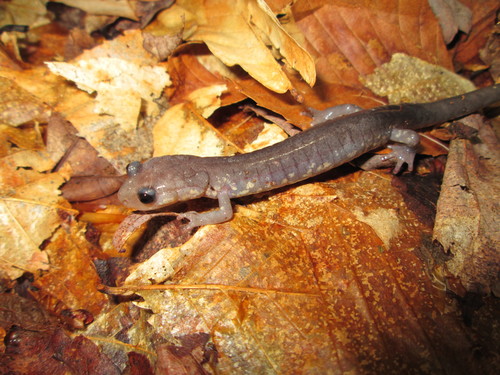
This medium-to-large woodland salamander typically measures between 10 to 17 centimeters in total length. It features a slender body with a long, rounded tail and a dark brown to bluish-black base coloration. A hallmark characteristic is the presence of scattered, irregular white or light-yellow spots or blotches along its sides, which sometimes extend onto the back. The throat and chest are generally a light gray or white, while the belly is a solid dark gray, helping to distinguish it from similar-looking species.
Category
AmphibiansRarity
Common
Danger
1/5 · Very low
Snaps
Be the first to snap!
Because they breathe entirely through their skin, they must remain in damp environments; dry air is quickly fatal to them.
They exhibit direct development, meaning mothers lay their eggs on land, and tiny, fully-formed salamanders hatch out, skipping the aquatic tadpole stage entirely.
Wehrle's Salamander is named after R.W. Wehrle, who first collected the species in Indiana, Pennsylvania, in 1911.
Lacking lungs, this species absorbs oxygen directly through its highly vascularized moist skin and mouth lining.
In response to predators, it can cleanly shed its tail, which continues to wiggle and distract the threat while the salamander escapes.
Its eggs are laid in moist terrestrial cavities and hatch directly into miniature adults, completely bypassing the aquatic tadpole stage.
It primarily feeds on a wide variety of small terrestrial invertebrates found in leaf litter and rotting wood, foraging actively at night.
Age differences: Juveniles consume smaller soil micro-arthropods like mites and springtails, transitioning to larger insects and earthworms as they grow.

Diadophis punctatus
This small woodland snake is a common predator of Wehrle's Salamander.

Plethodon cinereus
Competes directly for territory, nesting sites, and small invertebrate prey in shared forest floor habitats.
Carabus sylvosus
A forest floor beetle that is actively hunted and consumed by Wehrle's Salamander.
No trait badges are assigned for this object yet.
No aliases listed yet.
Collections for this object will appear here as more themes are added.
Danger
1/5 · Very low
No special safety notes yet.
Compare body shape, toes, markings, tail and skin texture. Tadpoles and larvae can look nothing like the adults they turn into. Amphibian Identifier: upload a photo and compare the visible details.
10-17 cm
0.003-0.01 kg
10-15 years
It primarily feeds on a wide variety of small terrestrial invertebrates found in leaf litter and rotting wood, foraging actively at night.
Found in mature, moist deciduous and mixed forests, typically sheltering beneath rotting logs, rocks, or inside rocky crevices and cave entrances on steep hillsides.
Foraging
8-22
Zoom in to split clusters and explore where this object has been snapped.
Recent snaps will appear here as new observations are added.
Take the discovery with you
Snap it with Snappit to identify it, learn what makes it special, and add the discovery to your collection.