

Western Azalea
rhododendron occidentale
The Western Azalea (Rhododendron occidentale) is a spectacular deciduous shrub renowned for its showy, aromatic blossoms and dramatic autumn foliage. Native to the western United States, it is celebrated as one of only two deciduous rhododendrons native to the region. This plant thrives in moist environments, often lining stream banks and wetlands where its sweet, spicy, clove-like fragrance fills the air during late spring and summer. Its ability to colonize post-fire landscapes and associate with beneficial soil fungi makes it a resilient and vital component of its ecosystem. Beyond its wild ecological value, the Western Azalea holds a special place in horticultural history. It was utilized heavily by European plant breeders in the 19th century to hybridize many of the famous deciduous azalea cultivars loved by gardeners today. Its nectar-rich flowers draw in a wide variety of native pollinators, including swallowtail butterflies and bumblebees, acting as a critical seasonal feeding station.
Habitat: Found in moist, shaded riparian zones, wetlands, coniferous forests, and mountain meadows, particularly along stream banks and seepages.
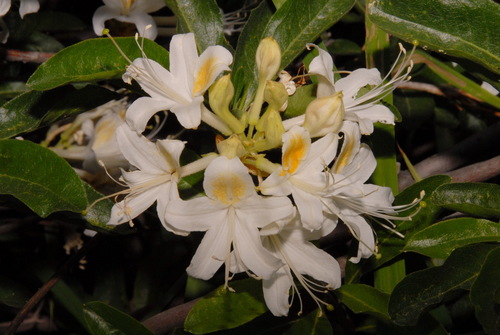
This deciduous shrub typically grows between 1 and 5 meters in height, featuring a spreading, multi-branched form. In late spring and early summer, it produces dense, rounded flower clusters containing 5 to 25 trumpet-shaped blossoms. Each individual flower is white to pale pink, accented by a striking, bright yellow-to-orange patch on the upper lobe and long, dramatically curving stamens that extend far beyond the petals. In autumn, its dark green, elliptical leaves transform into vibrant shades of yellow, orange, and red before dropping for the winter.
Category
PlantsRarity
Common
Danger
1/5 · Very low
Snaps
1
All parts of the Western Azalea are highly toxic to humans and animals due to the presence of grayanotoxins.
Its sweet scent is so strong that hikers can often navigate to stream crossings in dense forests just by following the aroma.
This species was historically used by early European botanists to create the world-famous Knap Hill and Ghent hybrid azaleas.
Emits an intense, sweet, clove-like scent that serves as a powerful long-distance chemical attractant for nocturnal moths and diurnal butterflies.
Forms symbiotic relationships with ericoid mycorrhizal fungi, allowing it to efficiently extract nitrogen and phosphorus from acidic, nutrient-deficient soils.
Capable of vigorously regenerating from its underground root crown after wildfires, allowing it to quickly reclaim canopy space.
As a photosynthetic plant, the Western Azalea manufactures its own food using sunlight, water, and carbon dioxide, while absorbing minerals through its specialized root system.

Papilio rutulus
Feeds on the rich flower nectar and serves as a major pollinator for the shrub.
Oidiodendron maius
Infects the roots to exchange hard-to-reach soil nutrients for plant-synthesized sugars.

Odocoileus hemionus
Browses on the leaves and tender woody twigs, despite the plant's natural toxicity.
No trait badges are assigned for this object yet.
No aliases listed yet.
Collections for this object will appear here as more themes are added.
Danger
1/5 · Very low
No special safety notes yet.
Start with the whole plant, then compare leaf arrangement, leaf edges, stems and any flowers or fruit. Opposite leaves grow in pairs; alternate leaves come one at a time along the stem. These details tell you far more together than a single green leaf does. Plant Identifier: upload a photo and compare the visible details.
100-500 cm
20-100 years
As a photosynthetic plant, the Western Azalea manufactures its own food using sunlight, water, and carbon dioxide, while absorbing minerals through its specialized root system.
Found in moist, shaded riparian zones, wetlands, coniferous forests, and mountain meadows, particularly along stream banks and seepages.
Zoom in to split clusters and explore where this object has been snapped.

California, US
You might spot Western Azalea, Pacific Trillium, and Western Columbine.
View guide →

California, US
You might spot Pacific Banana Slug, Redwood, and Elk.
View guide →
Take the discovery with you
Snap it with Snappit to identify it, learn what makes it special, and add the discovery to your collection.