





Western Flycatcher
Empidonax difficilis
The Western Flycatcher is a small bird that loves to catch insects in mid-air. With its cheerful song, it can be found flitting around trees and bushes, making it a delightful sight in nature.
Habitat: Forests
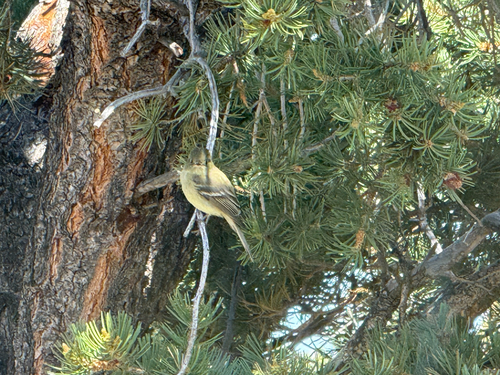
The Western Flycatcher has an olive-green back and a yellowish wash on its belly. It is distinguished by a prominent, pale, teardrop-shaped eye-ring and two buffy wing bars, making it blend well with leafy environments.
Category
BirdsRarity
Common
Danger
1/5 · Very low
Snaps
3
Despite their tiny size, Western Flycatchers make long migrations every year.
Some flycatchers return to the exact same nesting spot year after year.
Their nests are often so well-hidden, they might even be lined with soft spiderwebs!
They can twist and turn mid-air to catch the fastest flying insects with ease!
Western Flycatcher can snatch flying insects right out of the air because of its agile flight and quick reflexes.
Western Flycatcher has subtle olive-green and yellow feathers that help it blend perfectly into leafy forest canopies.
Western Flycatcher can use a distinctive 'ps-SEET' song to communicate with others and mark its territory in dense woodlands.
This little bird mostly eats flying insects that it catches skillfully in the air.
Pseudotsuga menziesii
Provides nesting sites and perches for hunting.
Vespula vulgaris
A common flying insect prey item.

Glaucidium gnoma
A small owl that preys on songbirds.
Formica rufa
Forages on ants found on tree branches.
Feathered describes animals, primarily birds, possessing a covering of feathers.
Aerial creatures spend a significant portion of their lives airborne, utilizing flight for various activities such as hunting, migration, or nesting.
Singing animals produce complex vocalizations, often for purposes of attracting mates, defending territory, or communicating within their species.
Camouflaged describes organisms that possess coloring or patterns that allow them to blend into their environment.

This trait identifies organisms whose diet primarily consists of insects and other small invertebrates.

Forest habitats are terrestrial environments dominated by dense tree cover, supporting a high diversity of plant and animal life.

Diurnal animals are primarily active during daylight hours, typically resting or sleeping at night.
No aliases listed yet.
Danger
1/5 · Very low
Always watch birds from a distance so they feel safe and happy.
The easiest way to identify Western Flycatcher is to use the Snappit nature identifier app.
13-17 cm
20-23 cm
0.008-0.012 kg
2-7 years
40 km/h
This little bird mostly eats flying insects that it catches skillfully in the air.
Forests
Zoom in to split clusters and explore where this object has been snapped.
May 21, 2026
Great Sand Dunes National Park and PreservePhoto attribution
(c) Coryn Fox Corvus, some rights reserved (CC BY)
License: CC BY 4.0 ↗
Image may be shown cropped inside the card frame.

California, US
You might spot Warrior's Plume and Purple Owl's-Clover.
View guide →

California, US
You might spot Western Fence Lizard and Canyon Sunflower.
View guide →

California, US
You might spot Western Fence Lizard, Eastern Fox Squirrel, and Duck.
View guide →

California, US
You might spot Western Fence Lizard, Eastern Fox Squirrel, and Duck.
View guide →

California, US
You might spot Western Fence Lizard, Eastern Fox Squirrel, and Duck.
View guide →

Colorado, US
You might spot Rocky Mountain Beeplant and Plains Pricklypear.
View guide →
Take the discovery with you
Snap it with Snappit to identify it, learn what makes it special, and add the discovery to your collection.




.jpg&width=800)








