





Blue-winged Teal
Spatula discors
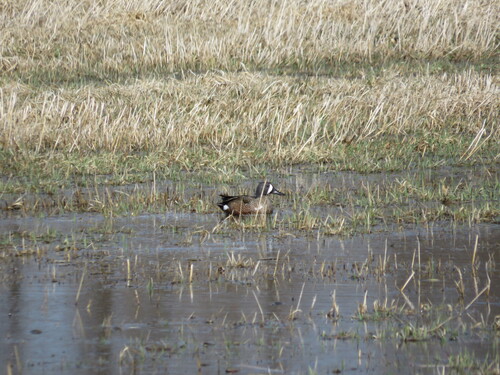
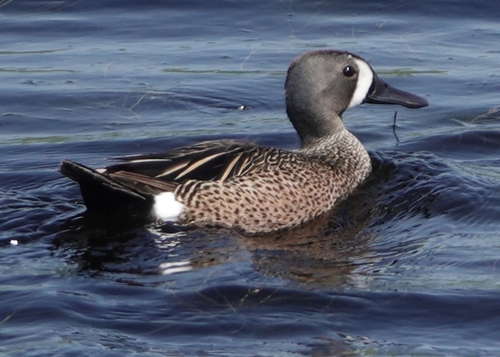
The Blue-winged Teal is a small duck with beautiful blue wings! They love to swim in ponds and marshes, and they often travel in groups called flocks.
Habitat: Wetlands
The Blue-winged Teal has a distinctive blue patch on its forewing, visible in flight and at rest, contrasting with iridescent green speculum feathers. Males display a prominent white crescent on their face in front of the eye, while females are mottled brown with a paler face.
Category
BirdsRarity
Common
Danger
1/5 · Very low
Snaps
10
Blue-winged Teals get their name from their amazing bright blue wing feathers!
Male blue-winged teals have a high-pitched whistling call, not a typical quack!
These ducks are among the last to migrate north in spring and first to leave in fall.
They migrate all the way to South America, one of the longest duck journeys!
Blue-winged Teal has strong leg muscles that allow for a quick, vertical take-off from the water, helping them escape predators.
Blue-winged Teal can skim the water surface, using specialized bill lamellae to filter tiny aquatic invertebrates and seeds.
Blue-winged Teal can migrate thousands of kilometers annually, guided by instinct to warm wintering grounds.
Blue-winged Teals dabble in shallow water to eat tiny plants, seeds, and aquatic insects.

Falco peregrinus
A fast raptor that preys on waterfowl, especially during migration.

Lemna minor
Consumes these tiny floating plants in slow-moving water.
Daphnia pulex
Filters these small crustaceans from the water.

Canis latrans
Raids nests for eggs and preys on ducklings near shorelines.
Feathered describes animals, primarily birds, possessing a covering of feathers.
Characterized by having toes connected by a membrane, typically aiding in swimming.
Social animals live in organized groups, cooperating for survival benefits such as foraging, defense, and raising offspring.
Colorful describes organisms or objects displaying a wide range of bright and distinct colors.

Filter feeders obtain nutrients by straining suspended food particles and small organisms from water.

This trait characterizes organisms whose diet consists entirely or primarily of plant material.

This habitat trait identifies species found in wetlands, which are areas of land saturated with water, either permanently or seasonally, including marshes, swamps, and bogs.

This trait identifies organisms that exhibit exceptional swiftness in movement for hunting, escape, or travel.

Aquatic habitats encompass environments where organisms live predominantly in water, including oceans, rivers, lakes, and wetlands.

Migratory animals undertake seasonal movements from one region to another, typically in response to changes in climate or food availability.
No aliases listed yet.
Danger
1/5 · Very low
Always watch ducks from a distance and don't feed them bread.
The easiest way to identify Blue-winged Teal is to use the Snappit nature identifier app.
35-46 cm
58-79 cm
0.28-0.57 kg
10-17 years
70 km/h
Blue-winged Teals dabble in shallow water to eat tiny plants, seeds, and aquatic insects.
Wetlands
Zoom in to split clusters and explore where this object has been snapped.
Apr 8, 2025
DanebodPhoto attribution
(c) Dani Alba, some rights reserved (CC BY)
License: CC BY 4.0 ↗
Image may be shown cropped inside the card frame.
Jun 8, 2019
Sheridan County CourthousePhoto attribution
(c) Colin Croft, some rights reserved (CC BY)
License: CC BY 4.0 ↗
Image may be shown cropped inside the card frame.

Texas, US
You might spot Silverleaf Nightshade and Green Comet Milkweed.
View guide →

Oregon, US
You might spot Belding's Ground Squirrel and Yellow-Headed Blackbird.
View guide →

Kansas, US
You might spot African Elephant, Gorilla, and Panthera Pardus Orientalis.
View guide →

Minnesota, US
You might spot Red-Tailed Hawk, Canada Goose, and Western Meadowlark.
View guide →

US
You might spot Tricolored Bumble Bee and Half-Black Bumble Bee.
View guide →

Florida, US
You might spot Pond Slider, Brown Anole, and Atala.
View guide →
Take the discovery with you
Snap it with Snappit to identify it, learn what makes it special, and add the discovery to your collection.




.jpg&width=800)







