_in_flight.jpg&width=800)





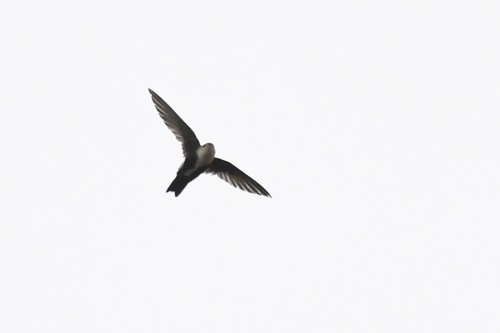
White-throated Swift
Aeronautes saxatalis
The White-throated Swift is a fast-flying bird known for its beautiful white throat and sleek body. It loves to zoom around in the sky, catching insects while flying high above mountains and cliffs.
Habitat: Mountain regions
The White-throated Swift is a slender bird with a sooty black body, striking white throat, and a white belly extending up its flanks. It has long, narrow, pointed wings and a short, squared tail, giving it a boomerang-like shape in flight.
Category
BirdsRarity
Common
Danger
1/5 · Very low
Snaps
4
Sticky homes! Swifts use their own saliva to glue nests to cliffs.
These birds cannot perch on branches; they only cling to vertical surfaces!
They drink water by skimming over lakes with open beaks in mid-flight!
Young swifts fly perfectly the first time they leave the nest, no lessons needed!
White-throated Swifts can catch tiny insects mid-air while flying at high speeds because of their agile wings and wide gape.
White-throated Swifts have strong claws and sticky saliva to cling to sheer rock faces and build nests on vertical cliffs.
White-throated Swifts can spend most of their lives airborne, even sleeping on the wing, due to their efficient aerodynamics.
Tiny flying insects are their main food, caught expertly in mid-air.
Feathered describes animals, primarily birds, possessing a covering of feathers.
Aerial creatures spend a significant portion of their lives airborne, utilizing flight for various activities such as hunting, migration, or nesting.
Gliding animals move through the air by launching themselves and maintaining flight with specialized body structures, without flapping wings.
This trait identifies organisms whose diet primarily consists of insects and other small invertebrates.

This habitat trait identifies species found in mountainous regions, characterized by high elevation, steep slopes, and varying climate zones.

Diurnal animals are primarily active during daylight hours, typically resting or sleeping at night.

This trait identifies organisms that exhibit exceptional swiftness in movement for hunting, escape, or travel.
No aliases listed yet.
Danger
1/5 · Very low
Watch these birds from a distance and enjoy their flying without getting too close.
The easiest way to identify White-throated Swift is to use the Snappit nature identifier app.
16-18 cm
40-45 cm
0.028-0.036 kg
4-6 years
160 km/h
Tiny flying insects are their main food, caught expertly in mid-air.
Mountain regions
Zoom in to split clusters and explore where this object has been snapped.
Jun 6, 2026
Mount EcclesiaPhoto attribution
(c) zr217, some rights reserved (CC BY)
License: CC BY 4.0 ↗
Image may be shown cropped inside the card frame.

Arizona, US
You might spot Northern Cardinal, Engelmann's Hedgehog Cactus, and Queen.
View guide →

California, US
You might spot Duck, Western Fence Lizard, and Dark-Eyed Junco.
View guide →

Colorado, US
You might spot Mule Deer, Woodhouse's Scrub-Jay, and Black-Billed Magpie.
View guide →

California, US
You might spot Brown Pelican, Western Gull, and Sea Lion.
View guide →

British Columbia, CA
You might spot Oregon Grape, Common Snowberry, and Black Locust.
View guide →
Take the discovery with you
Snap it with Snappit to identify it, learn what makes it special, and add the discovery to your collection.




.jpg&width=800)









