.jpg&width=800)





Whitebark Pine
Pinus albicaulis
The Whitebark Pine is a special tree that grows in high mountains. It has long needles and produces tasty seeds that many animals love to eat.
Habitat: Mountain regions
The Whitebark Pine has a tough, often gnarled and twisted trunk with reddish-brown bark, especially at high altitudes. Its needles are a deep green, growing in bundles of five, and it produces distinctive purplish-brown cones that stay on the tree.
Category
TreesRarity
Common
Danger
1/5 · Very low
Snaps
7
Clark's Nutcrackers can remember thousands of secret seed stashes they buried in the mountains!
Its seeds, called pine nuts, are a yummy, energy-rich snack for bears, squirrels, and birds!
Some Whitebark Pines can survive freezing temperatures as low as -50 degrees Celsius!
These super tough trees help save snowpack longer, giving animals water later in summer!
Whitebark Pine can grow in harsh, rocky, high-altitude environments where few other trees can survive, clinging to life near the timberline.
Whitebark Pine has large, wingless seeds that are expertly harvested and buried by Clark's Nutcrackers, helping the tree spread its seeds far and wide.
Whitebark Pine can withstand extreme cold and heavy snow because its flexible branches bend instead of breaking, and its needles are adapted for icy winds.
.jpg&width=800)
Nucifraga columbiana
collects and buries seeds, aiding tree dispersal
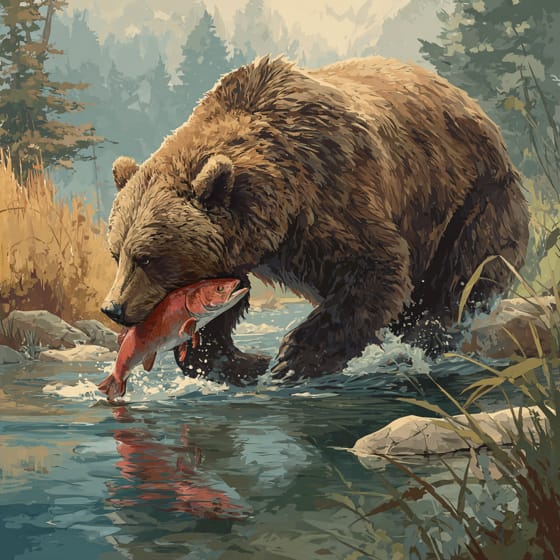
Ursus arctos
relies on cached seeds as a vital food source
Dendroctonus ponderosae
larvae bore into and kill weakened trees
.jpg&width=800)
Martes americana
uses mature trees for cover and den sites
Cold hardy plants are able to withstand low temperatures and freezing conditions without significant damage.
Coniferous plants are typically evergreen, bearing needles or scales and reproductive cones.
Evergreen plants retain their foliage throughout the year, never shedding all their leaves at once.
Nut bearing plants produce hard-shelled fruits, commonly known as nuts, which contain a single seed and are a valuable food source.

Edible plants are those parts of a plant that are considered safe for human consumption.

This habitat trait identifies species found in mountainous regions, characterized by high elevation, steep slopes, and varying climate zones.

This trait signifies organisms belonging to a very old evolutionary group with ancestors dating back millions of years.

This trait characterizes organisms with an exceptionally long lifespan compared to others of their kind.

Describes a species whose presence and role have a disproportionately large effect on its environment.
No aliases listed yet.
Danger
1/5 · Very low
Stay on trails and don't climb trees without adult supervision.
The easiest way to identify Whitebark Pine is to use the Snappit nature identifier app.
5-20 m
5-10 m
Yes
50-150 cm
500-1000 years
Mountain regions
Cone
Zoom in to split clusters and explore where this object has been snapped.

Wyoming, US
You might spot Elk, Killdeer, and Black-Billed Magpie.
View guide →

Oregon, US
You might spot White Pasqueflower and Clark's Nutcracker.
View guide →

Montana, US
You might spot Black Bear, Moose, and Lodgepole Pine.
View guide →

Wyoming, US
You might spot Elk, Killdeer, and Black-Billed Magpie.
View guide →

Wyoming, US
You might spot Elk, American Bison, and Killdeer.
View guide →

California, US
You might spot Purple Mountain-Heath, Mountain Hemlock, and Satin Lupine.
View guide →
Take the discovery with you
Snap it with Snappit to identify it, learn what makes it special, and add the discovery to your collection.













