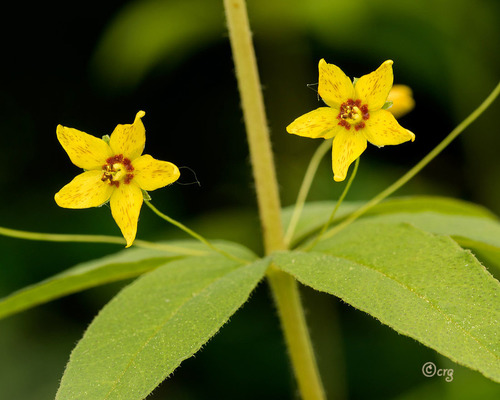


Whorled Loosestrife
lysimachia quadrifolia
Whorled Loosestrife (Lysimachia quadrifolia) is a charming herbaceous perennial native to the open woods, clearings, and sandy shores of eastern North America. Rising on slender, upright stems, this member of the primrose family is renowned for its architectural elegance and bright summer blooms. In late spring and summer, delicate star-like yellow flowers emerge from the leaf axils, creating a delightful contrast against the deep green foliage. It plays a critical role in local ecosystems, forming intricate relationships with specialized insects. Spotting this plant in a dappled woodland clearing is a highlight for hikers and native plant enthusiasts alike, as its presence often signals a healthy, undisturbed understory ecosystem.
Habitat: Typically found in open, dry to moist deciduous woodlands, forest edges, clearings, and sandy or gravelly soils.
This upright perennial typically grows between 30 and 90 centimeters tall, featuring unbranched stems. Its most defining characteristic is the whorled arrangement of its lance-shaped leaves, which typically grow in groups of four, though whorls of three to six are occasionally seen. The small, star-shaped flowers are bright yellow, measuring about 1 to 1.5 centimeters across. Each blossom features five pointed petals, a reddish center or streaks, and is supported by a thin, thread-like stalk emerging from the leaf axils.
Category
PlantsRarity
Common
Danger
1/5 · Very low
Snaps
7
The common name 'loosestrife' comes from an ancient belief that placing these plants on the yokes of oxen would 'loose' their 'strife' and keep them calm.
Unlike most flowering plants that offer nectar, this species produces fatty oils to reward its highly specialized evolutionary partners, the oil-collecting bees.
While the species name 'quadrifolia' means 'four leaves', individuals can frequently be found with leaves arranged in whorls of three, five, or six.
Instead of producing sugary nectar, it secretes energy-rich floral oils from specialized glands to attract specific pollinating bees.
Its unique leaf arrangement maximizes sunlight capture in the dappled light of woodland understories.
It utilizes underground rhizomes to spread vegetatively, allowing it to colonize forest clearings and survive seasonal disturbances.
As a photosynthetic plant, it produces its own energy using sunlight, water, carbon dioxide, and essential soil minerals.
Melitta americana
A highly specialized bee that collects floral oils and pollen from the flowers to feed its larvae.

Monostegia abdominalis
Larvae of this sawfly feed on the foliage of Lysimachia species.
No trait badges are assigned for this object yet.
No aliases listed yet.
Collections for this object will appear here as more themes are added.
Danger
1/5 · Very low
No special safety notes yet.
The easiest way to identify Whorled Loosestrife is to use the Snappit nature identifier app.
30-90 cm
3-10 years
As a photosynthetic plant, it produces its own energy using sunlight, water, carbon dioxide, and essential soil minerals.
Typically found in open, dry to moist deciduous woodlands, forest edges, clearings, and sandy or gravelly soils.
Zoom in to split clusters and explore where this object has been snapped.

Connecticut, US
You might spot Common Mugwort and Canada Goose.
View guide →

US
You might spot Pink Lady's Slipper and Canada Mayflower.
View guide →

Pennsylvania, US
You might spot Downy Rattlesnake Plantain and Striped Wintergreen.
View guide →

US
You might spot Common Eider and American Herring Gull.
View guide →
Connecticut, US
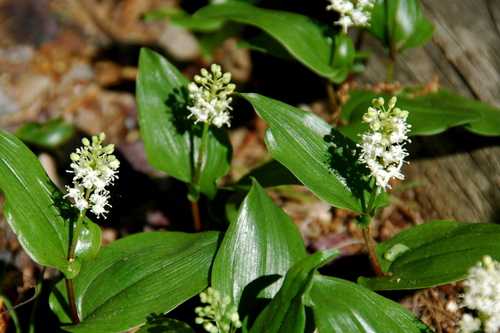
You might spot Canada Mayflower and Eastern White Pine.
View guide →

New Jersey, US
You might spot Green Frog, Spongy Moth, and American Toad.
View guide →
Take the discovery with you
Snap it with Snappit to identify it, learn what makes it special, and add the discovery to your collection.











.jpg&width=800)



_001.jpg&width=800)




