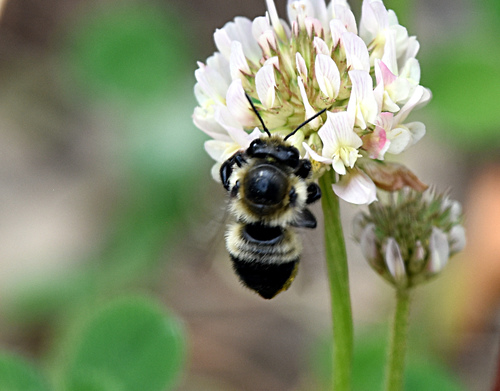





Xanthosarus
xanthosarus
"Xanthosarus" is a fascinating subgenus of leafcutter bees within the diverse Megachile genus. These solitary marvels are renowned for their meticulous architectural skills, using their powerful mandibles to snip perfect circular or oval pieces from plant leaves. Instead of producing honey in a bustling hive, each female acts as a single mother, building intricate, cigar-shaped nests in hollow stems, rotting wood, or ground cavities to raise her young. Beyond their incredible nesting habits, Xanthosarus bees are exceptional pollinators. Because they lack the pollen baskets on their hind legs typical of honeybees, they carry pollen in a dense brush of specialized hairs under their abdomen, known as a scopa. This unique carrying method causes more pollen to fall off as they visit flowers, making them highly efficient at pollinating native wildflowers and important agricultural crops.
Habitat: Typically found in sunlit open habitats like prairies, meadows, open woodlands, and domestic gardens where both fibrous leaves and diverse flowering plants are abundant.
Xanthosarus bees are robust, stout-bodied insects that generally measure between 1 and 2 centimeters in length, often appearing slightly larger and hairier than the common honeybee. They are typically dark-colored but are covered in dense bands of pale, yellowish, or golden-brown hairs, especially around the thorax and abdomen. A key visual identifier for females is the "scopa"—a thick, brush-like mat of stiff hairs on the underside of their abdomen that often gleams bright yellow or orange when loaded with pollen. When at rest, their wings fold flat over their backs, and their large, prominent mandibles, which are perfectly evolved for cutting leaves, can often be seen upon close inspection.
Category
InsectsRarity
Common
Danger
1/5 · Very low
Snaps
Be the first to snap!
Because they carry pollen on their bellies instead of their legs, a single leafcutter bee can do the pollination work of up to 20 honeybees.
Leafcutter bees are like nature's hole-punchers; they can snip a perfect circle out of a leaf in just a few seconds.
They don't produce honey or live in hives; every female is a 'single mom' who does all the work of building nests and gathering food herself.
When constructing a nest, the mother bee creates a 'bee loaf'—a sticky ball of pollen and nectar—lays an egg on it, and seals it in a snug leaf wrapper.
Uses razor-sharp mandibles to snip perfectly circular pieces of leaves and petals in seconds to construct their nests.
Carries pollen on the underside of the abdomen rather than the legs, making them exceptionally efficient pollinators as the pollen easily brushes off onto other flowers.
Constructs complex, multi-chambered nests inside hollow stems or burrows by intricately folding leaf pieces into protective, waterproof capsules for their larvae.
Adults feed exclusively on floral nectar for energy and gather pollen to provision their nest cells for developing larvae.
Age differences: Larvae consume a solid mixture of pollen and nectar provisioned by the mother, while adults primarily consume liquid nectar.

Rosa acicularis
Provides essential nesting materials.

Medicago sativa
Relies on these bees for critical pollination.
Coelioxys spp.
Lays its eggs in the nests of leafcutter bees to steal their provisions.
Marked with spots or patches of a different color.
Solitary animals live alone for most of their lives, only interacting with others for mating or parental care.
Arboreal animals live primarily in trees, utilizing them for shelter, food, and protection from predators.
Colorful describes organisms or objects displaying a wide range of bright and distinct colors.
This trait identifies organisms whose diet consists entirely or primarily of animal tissue.
Collections for this object will appear here as more themes are added.
Danger
1/5 · Very low
No special safety notes yet.
Look for six legs, antennae, three body sections and the shape of the wings. Beetles have hardened front wings; flies have just one working pair. Tiny insects may need a close view before their group is clear. Insect Identifier: upload a photo and compare the visible details.
1-2 cm
1-3 cm
0.0001-0.0003 kg
1 years
32 km/h
Adults feed exclusively on floral nectar for energy and gather pollen to provision their nest cells for developing larvae.
Typically found in sunlit open habitats like prairies, meadows, open woodlands, and domestic gardens where both fibrous leaves and diverse flowering plants are abundant.
Zoom in to split clusters and explore where this object has been snapped.
Recent snaps will appear here as new observations are added.
Take the discovery with you
Snap it with Snappit to identify it, learn what makes it special, and add the discovery to your collection.