





Yellow-legged Mud-dauber Wasp
Sceliphron caementarium
The Yellow-legged Mud-dauber Wasp is a small, shiny insect that builds mud nests. These wasps are helpful because they catch spiders to feed their babies, making them great little helpers in nature!
Habitat: Urban areas
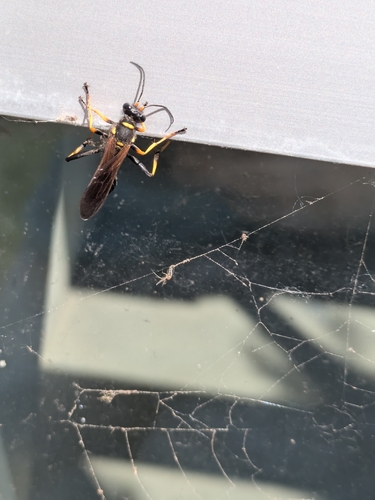
The Yellow-legged Mud-dauber Wasp has a slender, black body with a distinctive long, narrow waist (petiole) connecting its thorax and abdomen. Its legs are bright yellow, contrasting sharply with its dark body, and its wings have a smoky, iridescent blue tint.
Category
InsectsRarity
Common
Danger
2/5 · Low
Snaps
32
Each female mud-dauber wasp is a solo builder, creating her own unique mud nursery!
Mud-dauber babies wake up to a pantry full of fresh, paralyzed spider snacks!
Their super-thin 'waist' helps them zip and zoom with incredible agility!
They use water like a super-glue to mix mud into strong, weather-proof homes!
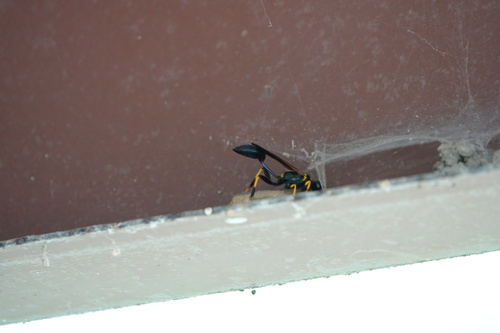
Yellow-legged Mud-dauber Wasps can construct sturdy nests from mud and water, providing a safe nursery for their young.
Yellow-legged Mud-dauber Wasps can paralyze spiders with a precise sting, keeping them fresh for their larvae to eat.
Yellow-legged Mud-dauber Wasps have keen senses that help them locate and hunt various types of spiders.
Adult wasps drink nectar, but their young feast on paralyzed spiders stored in mud nests!
Age differences: Adults drink nectar, while larvae consume paralyzed spiders.
Argiope aurantia
Main prey for larvae
Araneus diadematus
Another common spider prey
Chrysis ignita
Lays eggs in mud-dauber nests
.jpg&width=800)
Tyrannus tyrannus
Adult wasps can be prey
Solitary animals live alone for most of their lives, only interacting with others for mating or parental care.
This trait characterizes organisms that construct elaborate silken webs for catching prey, shelter, or reproduction.
Colorful describes organisms or objects displaying a wide range of bright and distinct colors.
This trait identifies organisms whose diet consists entirely or primarily of animal tissue.

Diurnal animals are primarily active during daylight hours, typically resting or sleeping at night.

This habitat trait indicates species that can coexist with humans in urban and suburban environments, utilizing man-made structures and green spaces.

Describes organisms that transfer pollen, enabling the fertilization and reproduction of plants.
No aliases listed yet.
Danger
2/5 · Low
Watch them from a distance; they are usually not dangerous but can sting if threatened.
The easiest way to identify Yellow-legged Mud-dauber Wasp is to use the Snappit nature identifier app.
25-40 mm
18-28 mm
20-40 days
18 km/h
Adult wasps drink nectar, but their young feast on paralyzed spiders stored in mud nests!
Urban areas
Pursuit
Zoom in to split clusters and explore where this object has been snapped.
Jun 17, 2026
Haskell-Baker WetlandsPhoto attribution
(c) Lydia Dexter, some rights reserved (CC BY)
License: CC BY 4.0 ↗
Image may be shown cropped inside the card frame.
May 11, 2023
Pomme de Terre Wildlife Management AreaPhoto attribution
(c) Jacob Saucier, some rights reserved (CC BY)
License: CC BY 4.0 ↗
Image may be shown cropped inside the card frame.

Texas, US
You might spot Anole, Monarch, and Pinkladies.
View guide →

Tennessee, US
You might spot American Robin, Northern Cardinal, and Eastern Chipmunk.
View guide →

Colorado, US
You might spot Common Starlily and Wholeleaf Paintbrush.
View guide →
Illinois, US
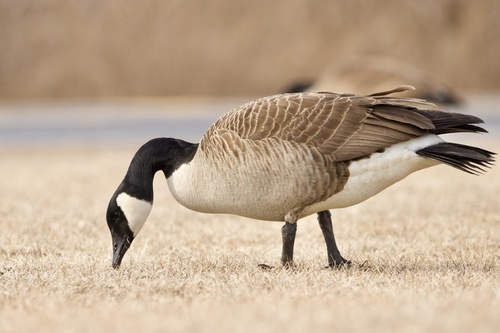
You might spot Canada Goose, House Sparrow, and Rock Pigeon.
View guide →

Alabama, US
You might spot Muscovy Duck and Gulf Longear Sunfish.
View guide →

Kansas, US
You might spot American Robin, Monarch, and Italian Wall Lizard.
View guide →
Take the discovery with you
Snap it with Snappit to identify it, learn what makes it special, and add the discovery to your collection.








.jpg&width=800)



