





Yerba Mansa
Anemopsis californica
Yerba Mansa is a special plant that grows in wet areas. Its leaves are big and green, and it has pretty white flowers that smell nice. This plant is great for helping the environment!
Habitat: Wetlands
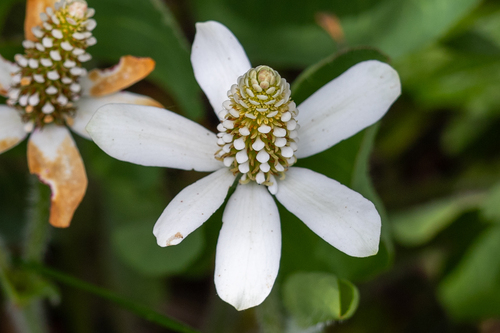
The Yerba Mansa is a low-growing plant with broad, green leaves and reddish stems. It features a distinctive cone-shaped central flower cluster surrounded by 4-8 brilliant white, petal-like bracts, making it appear as a single large bloom.
Category
PlantsRarity
Common
Danger
1/5 · Very low
Snaps
18
It is the only plant in its entire genus, making it truly unique!
It's sometimes called 'Lizard Tail' because its flower stalks resemble a lizard's tail!
Its roots can grow deep into the mud, sometimes over 3 feet long!
The spicy taste of its roots is a clue to its medicinal properties!
Yerba Mansa can thrive in extremely wet, even soggy, soils thanks to its special root system that allows it to 'breathe'.
Yerba Mansa has compounds in its roots and leaves that Indigenous peoples traditionally used for healing various ailments.
Yerba Mansa has large, white, petal-like leaves called bracts that powerfully attract insects to its tiny, true flowers hidden within.
Yerba Mansa can tolerate salty soils, which helps it survive in places where many other plants cannot grow.
Apis mellifera
Attracted to its nectar and pollen.
Syrphus ribesii
Visits the flowers for nectar.
Bombus vosnesenskii
A frequent pollinator in its range.
Aromatic plants produce and emit fragrant volatile organic compounds, often for defense or to attract pollinators.
Flowering plants are any plants that produce flowers as part of their reproductive cycle.
A shrub is a woody plant smaller than a tree, typically with multiple stems branching from or near the ground.
Fragrant flowers emit a pleasant aroma, often to attract pollinators or for defense.

Medicinal plants possess chemical compounds that can be used for therapeutic purposes to treat illnesses or maintain health.

Edible plants are those parts of a plant that are considered safe for human consumption.

Describes plants that are particularly attractive and beneficial to a wide range of pollinating organisms.

This habitat trait identifies species found in wetlands, which are areas of land saturated with water, either permanently or seasonally, including marshes, swamps, and bogs.

Describes a species whose presence and role have a disproportionately large effect on its environment.
No aliases listed yet.
Danger
1/5 · Very low
Always look but don't touch plants unless an adult says it's okay.
The easiest way to identify Yerba Mansa is to use the Snappit nature identifier app.
15-60 cm
30-90 cm
2-3 cm
Spring-fall
Yes
None
Perennial
Zoom in to split clusters and explore where this object has been snapped.
Jun 6, 2026
Venice Canal Historic DistrictPhoto attribution
(c) Roberto Daniel Avila, some rights reserved (CC BY)
License: CC BY 4.0 ↗
Image may be shown cropped inside the card frame.

New Mexico, US
You might spot Duck, Greater Roadrunner, and American Robin.
View guide →

Nevada, US
You might spot Engelmann's Hedgehog Cactus.
View guide →

New Mexico, US
You might spot Wood Duck, Duck, and Canada Goose.
View guide →

California, US
You might spot Western Gull, Sea Lion, and Great Blue Heron.
View guide →

California, US
You might spot Iodinebush, Yerba Mansa, and Golden Gilmania.
View guide →

California, US
You might spot Eastern Fox Squirrel and Red-Tailed Hawk.
View guide →
Take the discovery with you
Snap it with Snappit to identify it, learn what makes it special, and add the discovery to your collection.








.jpg&width=800)


_001.jpg&width=800)



