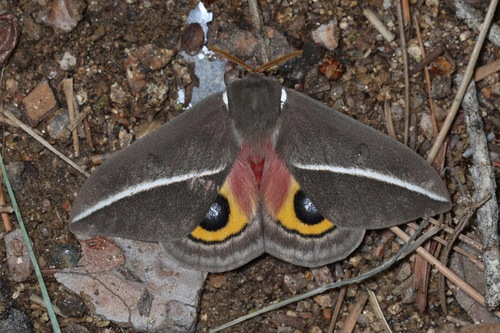





Zephyr Eyed Silkmoth
Automeris zephyria
The Zephyr Eyed Silkmoth is a beautiful moth with big, colorful eyes on its wings. These eyes help scare away predators! They are mostly active at night and love to flutter around gardens.
Habitat: Forests
The Zephyr Eyed Silkmoth has broad wings, typically yellowish to reddish-brown, often with faint lines. Its most striking feature is the pair of large, vivid eyespots on its hindwings, which are black with a blue or white center and often rimmed with red. Its body is robust and covered in dense, soft hairs.
Category
InsectsRarity
Common
Danger
1/5 · Very low
Snaps
Be the first to snap!
Adult silkmoths live for only a few days; their main goal is to find a mate!
Before becoming a moth, its caterpillar spins a strong, silk cocoon for protection!
It belongs to the 'Giant Silkmoth' family, known for making huge, beautiful cocoons!
Its caterpillars are often brightly colored with spines, warning predators not to touch them!
Zephyr Eyed Silkmoth can flash its hindwings to reveal large, fake eyes because this sudden display can startle predators away.
Zephyr Eyed Silkmoth has forewings that blend with tree bark, helping them hide perfectly during the day.
Zephyr Eyed Silkmoth can fly at night, guided by moonlight and scents, to find mates and avoid daytime predators.
Adult moths do not eat; caterpillars munch on tree and shrub leaves.
Age differences: Adult moths do not feed, relying on energy stored from their caterpillar stage. Caterpillars are voracious leaf-eaters.

Bubo virginianus
Nocturnal owl preys on adult moths.
Archytas analis
Lays eggs on caterpillars, which are then eaten from inside.

Quercus virginiana
Caterpillars feed on its leaves for growth.

Salix nigra
Caterpillars feed on its leaves for growth.
Furry describes animals possessing a dense covering of soft hair or fur.
Solitary animals live alone for most of their lives, only interacting with others for mating or parental care.
Colorful describes organisms or objects displaying a wide range of bright and distinct colors.
This trait characterizes organisms whose diet consists entirely or primarily of plant material.
Describes plants that are particularly attractive and beneficial to a wide range of pollinating organisms.
Forest habitats are terrestrial environments dominated by dense tree cover, supporting a high diversity of plant and animal life.
Nocturnal animals are primarily active during the nighttime hours, typically resting or sleeping during the day.
Describes organisms that transfer pollen, enabling the fertilization and reproduction of plants.
No aliases listed yet.
Danger
1/5 · Very low
Always watch moths from a distance and don't try to catch them.
Compare resting wing shape, forewing markings, antennae and body build. Small brown moths can hinge on fine details a phone photo can't always catch. Moth Identifier: upload a photo and compare the visible details.
50-100 mm
25-45 mm
5-14 days
15 km/h
Adult moths do not eat; caterpillars munch on tree and shrub leaves.
Forests
6
Zoom in to split clusters and explore where this object has been snapped.
Recent snaps will appear here as new observations are added.
Take the discovery with you
Snap it with Snappit to identify it, learn what makes it special, and add the discovery to your collection.