





Promethea Silkmoth
Callosamia promethea
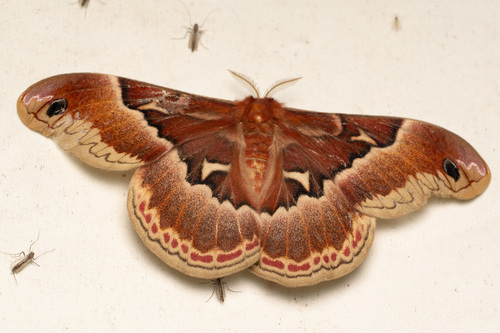
The Promethea Silkmoth is a beautiful insect with big, colorful wings. It starts its life as a caterpillar and transforms into a moth, showing off its amazing patterns!
Habitat: Forests
The Promethea Silkmoth is a large moth with distinct dark brown to black wings, bordered by creamy tan or yellowish bands. Females tend to be more reddish-brown, while males are darker, often resembling a Pipevine Swallowtail. Each wing features a small, white crescent spot and faint eye-like patterns.
Category
InsectsRarity
Common
Danger
1/5 · Very low
Snaps
11
A Promethea Silkmoth cocoon hangs like a dead leaf, expertly camouflaged to hide the developing pupa!
Its large, green caterpillar has orange and black spines, looking very different from the adult moth!
Male moths fly during the day to find mates, while females are usually active after sunset!
The Promethea Silkmoth is named after Prometheus from Greek myth, who stole fire for humanity!
Promethea Silkmoth caterpillars can change color to blend perfectly with twigs and leaves, helping them hide from hungry birds.
Female Promethea Silkmoths release special scents called pheromones that attract males from far away in the dark.
Adult Promethea Silkmoths don't eat; they live off the stored energy from their caterpillar days, allowing them to focus on finding a mate.
Male Promethea Silkmoths can mimic the toxic Pipevine Swallowtail butterfly, making predators think twice before trying to eat them.
Adults don't eat, but their hungry caterpillars munch on leaves from many different trees.
Age differences: Adult moths do not feed, relying on energy stored from their caterpillar stage to reproduce.
Solitary animals live alone for most of their lives, only interacting with others for mating or parental care.
Camouflaged describes organisms that possess coloring or patterns that allow them to blend into their environment.
Colorful describes organisms or objects displaying a wide range of bright and distinct colors.
This trait characterizes organisms whose diet consists entirely or primarily of plant material.

Forest habitats are terrestrial environments dominated by dense tree cover, supporting a high diversity of plant and animal life.

Regenerative organisms possess the ability to regrow lost or damaged body parts, tissues, or organs.

Nocturnal animals are primarily active during the nighttime hours, typically resting or sleeping during the day.

Describes organisms that transfer pollen, enabling the fertilization and reproduction of plants.

Endangered status indicates a species is at a very high risk of extinction in the wild in the near future.
No aliases listed yet.
Danger
1/5 · Very low
Don't touch moths; they are delicate and can be easily hurt.
The easiest way to identify Promethea Silkmoth is to use the Snappit nature identifier app.
75-100 mm
30-40 mm
7-14 days
20 km/h
Adults don't eat, but their hungry caterpillars munch on leaves from many different trees.
Forests
6
Zoom in to split clusters and explore where this object has been snapped.
Jun 4, 2026
CheshamPhoto attribution
(c) Jack Forrester, some rights reserved (CC BY)
License: CC BY 4.0 ↗
Image may be shown cropped inside the card frame.

Virginia, US
You might spot Eastern Box Turtle and White-Tailed Deer.
View guide →

New Hampshire, US
You might spot Eastern Red-Backed Salamander and Eastern Newt.
View guide →
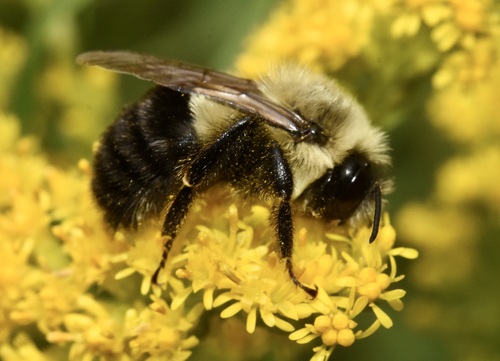
Ohio, US
You might spot Common Eastern Bumble Bee, Sensitive Fern, and Mayapple.
View guide →

Massachusetts, US
You might spot Red Trillium, Round-Leaved Sundew, and Pitch Pine.
View guide →

West Virginia, US
You might spot Virginia Bluebells, Bloodroot, and Maidenhair Spleenwort.
View guide →

West Virginia, US
You might spot Asian Lady Beetle, Eastern Box Turtle, and American Robin.
View guide →
Take the discovery with you
Snap it with Snappit to identify it, learn what makes it special, and add the discovery to your collection.









.jpg&width=800)


