Snappit logo
Snappit
Get App
Generic illustration, not a photograph of this venueIllustration
ParkCataluña, Spain

Montseny Natural Park

Montseny changes character as you climb.

About

Montseny changes character as you climb. Mediterranean woodland gives way to cooler, damper forests, while the highest ground feels like a different world again. For a first visit, resist the temptation to cover the whole massif. Santa Fe offers a satisfying small piece of it: a visitor centre, a short interpreted walk and time to notice the forest.

Start at Can Casades. The old summer house is a useful place to get your bearings before following La Font del Frare, a signed circuit through the garden and woodland beside the Santa Fe stream. Let the walk set a gentle pace. Look at the smooth beech trunks, listen from a bridge and leave time for a pause rather than treating the fountain as a finish line.

The natural park is also a working and inhabited landscape. Its woods have supplied fuel, its open land has supported livestock, and its houses and paths carry traces of those uses. A film at the centre or a separate visit to Masia Mariona helps connect the scenery with the people who have shaped it.

There are much longer mountain walks here, including routes towards Turó de l’Home and Matagalls. They need their own weather, equipment and timing decisions. This guide’s main outing stays around Can Casades; the longer Empedrat de Morou walk is an optional alternative for a group ready for more uneven ground. Eager to name that creature? Identify any animal you find during your visit using the Snappit app.

Montseny’s forests are not separate from its social history. Charcoal making once supplied urban fuel markets and helped shape extensive holm-oak woodland. Grazing, farming and forestry also left their mark; changes in those activities continue to affect the balance between woods and open ground. Protection developed in stages. The provincial administrations adopted special protection plans in 1977 and 1978, UNESCO designated the massif a biosphere reserve in 1978, and the Generalitat declared the natural park in 1987. A 2021 decree set out the park’s legal boundary. The biosphere reserve has a wider role in linking conservation with life and work in the surrounding municipalities.

What to do here

Ask for the current route advice at Can Casades, walk La Font del Frare slowly and choose a film or a quiet nature-observation stop to round out the morning. On a longer walking day, choose Empedrat de Morou instead of adding several routes together.

Seasonal info

Carry an extra layer and waterproofs even if the lowlands are warm. Fog can change the feel of the woods quickly; rain, ice and snow make bridges and stone surfaces slippery. In hot or windy weather, check fire-risk restrictions before travelling. Keep a shorter plan ready.

Accessibility

La Font del Frare is officially listed as an adapted route, with paved sections and a bridge. Contact Can Casades about current surfaces, slopes, toilets and the assistance your group needs. Its lift was still listed as out of service when checked on 17 October 2026, so confirm which indoor spaces you can reach before travelling. Expect uneven stone sections on the longer Morou route; it does not carry the same adapted-route designation.

Don't miss

1

The short La Font del Frare circuit beside the Santa Fe stream

2

Beech woodland and the change from Mediterranean to cooler mountain habitats

3

Films and practical advice at Can Casades

4

A separate woodland-and-viewpoint walk to Empedrat de Morou

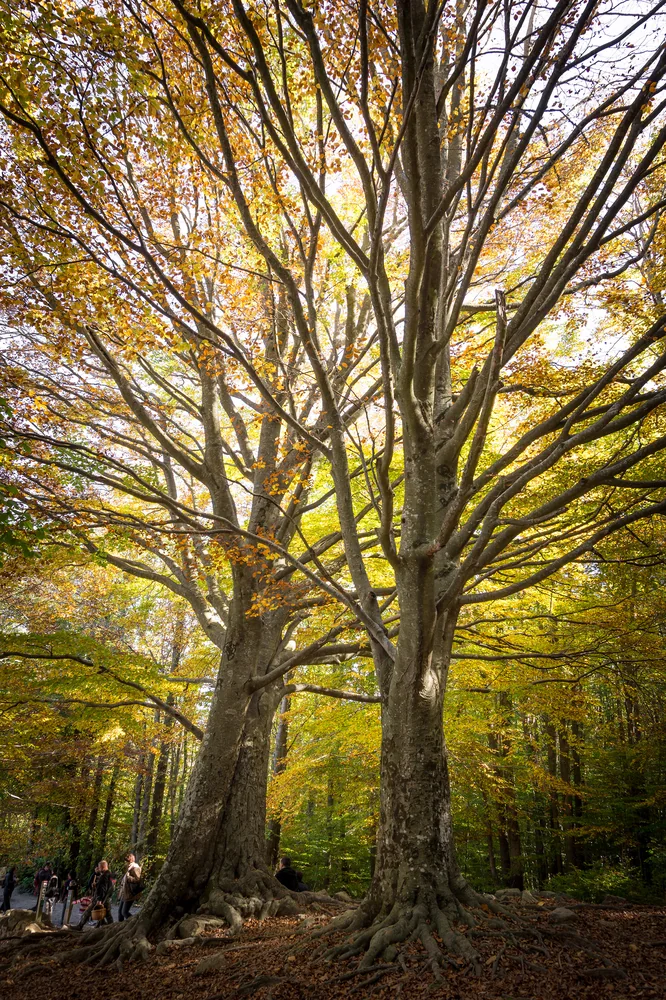
Large branching trees with exposed roots rise into a canopy of yellow and green leaves, with a few visitors beside the woodland path below.

Woodland around Santa Fe del Montseny in October 2017.

Árboles del Montseny.jpg — Dbascones / Wikimedia Commons / CC BY-SA 4.0 · Creative Commons

Walks and routes

La Font del Frare: the first-choice short circuit

A 1.1 km circuit from Can Casades, with a published walking estimate of 30 minutes. It links the garden, a stream crossing and beech woodland before returning to the centre. Allow 45–60 minutes to stop and look; the aim is a relaxed introduction, not a brisk lap.

The park lists this as adapted. Paved sections and the wooden bridge still need a current condition check, especially after rain or freezing weather. Ask staff whether it suits your wheelchair or pushchair.


La Font del Frare: the first-choice short circuit

L’empedrat de Morou: a longer forest walk

The official route record gives 6 km and about 2 hours, starting at Can Casades and following orange markers. Beech woods lead towards the rocky Empedrat viewpoint. Allow 2½–3 hours with pauses and choose this as the main walk of the day; the separate Turó de Morou variant is not included here.

This is a walking trail with stone sections. A low difficulty label does not make it step-free or suitable for every pushchair. Wet, snowy or icy rock increases the challenge; keep back from the viewpoint edge. Braille route materials are listed, subject to availability.

L’empedrat de Morou: a longer forest walk

Masia Mariona: a separate garden-and-exhibition visit

At Mosqueroles, choose the 700 m garden circuit, officially estimated at 30 minutes, and the Univers Patxot exhibition. This is a separate starting point lower in the park’s visitor network, not a footpath continuation from Santa Fe. Allow 1–1½ hours for a relaxed combination.

The garden circuit is listed as adapted and begins at an adapted parking area. Ask the information point about the current paved route, toilets and exhibition access for your needs.

Masia Mariona: a separate garden-and-exhibition visit

An unhurried Santa Fe morning

Fit your arrival to Can Casades opening, ask for route advice, and give La Font del Frare up to an hour with stops. Add one film if it suits the group. Leave a generous margin for the bus or car journey home instead of squeezing in another walk.

A longer walking day

In settled weather, make Empedrat de Morou the main outing. Carry lunch and water, leave time for the uneven ground and viewpoint, and plan the return before departure. If the group is tiring at the centre, choose the short circuit instead.

A quieter cultural alternative

Choose Masia Mariona and its garden on another morning, or as an alternative when Santa Fe is too busy. Check opening and access first; allow time to enjoy the exhibition rather than treating it as a rushed extra stop.

Things to try

Give the forest ten quiet minutes

Choose a safe place on the path and compare what each person notices: a sound, a bark texture, a leaf shape or a change in light. Sketch or photograph your finds without collecting them. This works just as well on the short circuit as on a longer walk.

See a whole year in half an hour

Ask Can Casades for Les quatre estacions al Montseny, the 30-minute film about the changing landscape. L’home i el Montseny adds the human story. The 2026 programme lists both as free and shown on request; groups should book ahead.

Connect nature with curiosity at Masia Mariona

The Univers Patxot exhibition follows Rafael Patxot’s interests in science and cultural heritage. It is a useful choice for a group whose interests run from clouds and astronomy to traditional songs, especially when a long outdoor walk is not the best plan.

Shorten the outing at Can Casades

If roads are safe and the centre is open, a film and a brief outdoor look can be enough. Check the lift situation if needed. Heavy rain, thunderstorms or dangerous travel conditions are reasons to postpone, not simply to swap a trail for an exhibition.

Choose the Univers Patxot exhibition

Masia Mariona offers an indoor cultural visit at a different starting point. Confirm the visitor-point hours and access before travelling, and only add the garden if conditions are comfortable.

Wildlife and habitats

European beech

The smooth grey trunks and seasonal canopy make beech a useful tree to get to know at Santa Fe. Compare a leaf or fallen husk in place; let the woodland floor stay undisturbed.

Holm oak

Look for this evergreen tree in the park’s Mediterranean woodland. Its presence helps explain why a journey through Montseny can reveal such different forest types.

Black alder

A tree to learn for understanding riparian woodland. Use the park’s flora guide to compare features from an authorised path, without pushing through bankside vegetation.

Fire salamander

The park’s monitoring records this amphibian in its damp habitats. If one appears on your path, give it space and let it pass; do not pick it up or move it for a photograph.

European common frog

A documented member of Montseny’s amphibian fauna. Its conservation is a good reason to enjoy water from a bridge or path rather than enter it or search beneath stones.

European robin

Try a quiet listening pause in the woodland and use the park’s bird guide to identify what you notice. A robin is one of the species recorded here; observation works best without calls played from a phone or food put out to attract birds.

Stories and discoveries

A forest with a working past

Charcoal making helped shape Montseny’s holm-oak woods. Remembering that history changes the walk: woodland patterns can reflect generations of management as well as climate and soil.

The garden tells a different tree story

The large sequoias at Can Casades were planted by former owners. They belong to the history of the garden and should not be mistaken for native Montseny woodland.

A small animal, a large conservation responsibility

The Montseny newt, Calotriton arnoldi, is endemic to this massif. Its story is best explored through interpretation rather than searching its habitat. Keeping water clean and undisturbed is part of a good visit.

When to visit

Spring: notice change at a small scale

Take the short circuit slowly as the woodland comes into leaf. A cool, damp morning calls for waterproofs and grippy footwear. Watch amphibians only if they happen to appear; keep out of their water and refuges.

Summer: shade helps, but prepare for heat

Carry drinking water and choose a modest outing. Check heat, storm and fire-risk advice before travelling. Streams are habitats to observe, not a way to turn the walk into a paddling trip.

Autumn: colour comes with crowds

Leave room in the plan for traffic management and a bus connection. Leaf colour varies with the year, so enjoy what is there. Photograph fungi and fallen leaves in place, and avoid trampling the forest floor for a better picture.

Winter: let conditions choose the walk

Snow or ice can turn a straightforward circuit into a poor choice. Ask about road and path conditions and postpone if needed; do not let a short distance persuade you that winter footing will be easy.

Getting there and practical advice

Can Casades: information and toilets

The published opening is 10:00–15:00 daily, excluding 25 and 26 December and 1 and 6 January. The centre lists toilets and personalised information. Contact it on +34 938 475 113 or [email protected] before a visit that depends on a particular service.

Adapted equipment by arrangement

Can Casades lists free loans of handbikes, wheelchair attachments, adapted route materials and directional bars. Ask in advance which item is available, whether it suits your route and what the loan process involves.

Plan food and drinking water before arrival

Bring enough for your outing and use designated rest areas without leaving waste. Do not depend on a fountain running or being drinkable. If you want a restaurant meal, check that business’s opening and booking arrangements separately.

Masia Mariona visitor point

The current visitor-point listing gives 09:30–15:30 daily, except 25 and 26 December and 1 and 6 January, with parking and toilets. Call +34 938 475 102 to confirm the exhibition and access arrangements; the park’s administration-office hours are a different listing.

Train and Bus Parc to Santa Fe

Connect at Sant Celoni station with Sagalés line 573 to Santa Fe. The park promotes weekend and public-holiday service, except Christmas and New Year’s Day. The Bus Parc page currently lists a €2.65 special ticket valid for the day and cash payment on the bus; check the fare, any child conditions and your train or combined ticket separately. Confirm outward and return departures with Sagalés.

Driving to the Santa Fe starting point

Can Casades is on the BV-5114 at km 21. Use the designated Santa Fe parking and follow signs distinguishing ordinary spaces, short-stay centre spaces, bus stops and reserved mobility parking. The roadworks notice at km 21–22 needs checking before the trip; allow for managed traffic rather than planning a tight arrival.

Autumn 2026: use the welcome point

On weekends and public holidays from 10 October to 8 December 2026, the park lists a Fogars de Montclús welcome point with free parking and an onward bus connection. It can be a more practical choice than joining the queue for Santa Fe spaces. Follow staff directions and check the programme again for any later visit.

Tell the operator about access needs or a group

Sagalés labels line 573 as adapted, but contact it about boarding, wheelchair space and the particular departure you need. The park asks groups of more than ten to contact the operator in advance. Ordinary pets must fit the stated carrier rules; assistance dogs have separate provision.

Discuss the whole visit, not just the path

Tell staff your mobility device, assistance and rest needs when asking about La Font del Frare. Include parking, the route, toilets and indoor interpretation in that conversation. An adapted-route label is a useful starting point rather than a guarantee for every person or weather condition.

Check the Can Casades lift before travelling

The current centre listing warns that the lift is temporarily out of service. Ask which exhibits and screenings are reachable without it, and plan around the answer. A listed adapted entrance does not remove this specific barrier.

Ask for interpretation that suits your group

The park provides audio-route information and lists adapted printed materials and directional bars at Can Casades. Morou has Braille route copies listed. Arrange the material you need ahead of time, and check whether the actual walking route suits you as well.

Sources and useful links

Wildlife you might spot

6

Each card links to a full Explore page with photos, traits, and fun facts.

Snap map for this place

Start with the big picture, then zoom in to explore individual wildlife observations around this place.

Loading map…

Good to know before you go

Check the park’s alerts and the weather before leaving. An expected end date for works does not mean a road or path has reopened.

Plan the return journey before starting a walk. Save the current bus timetable and an official route description for use without a signal.

Bring drinking water, snacks, shoes with grip, layers and rain protection. Treat fountains as scenic stops unless drinking-water safety is explicitly indicated.

Stay on signed paths and respect private property, forestry work and livestock. Keep children close beside water, roads and exposed rock.

Leave streams, pools and the reservoir undisturbed. Do not wade, move stones or handle amphibians; watch quietly from the path and never feed wildlife.

Keep dogs on a lead and out of the water. Check the bus’s pet-carrier rules before choosing public transport with an animal.

Use designated parking and follow staff directions when spaces fill. Do not park on verges, block a track or improvise a roadside picnic spot.

Take all rubbish home, leave natural material where it is and never light a fire. Photograph mushrooms and leave them in place.

Frequently asked questions

At Can Casades in Santa Fe del Montseny, on the BV-5114 at kilometre 21, in Fogars de Montclús. Use its official listing and the current access notices to plan the final approach.
The recommended walks are published as self-guided routes. The centre’s 2026 listings make both films free, with screenings on request and advance booking for groups. Guided events have their own conditions. Check transport fares and any parking arrangements separately.
Start by discussing La Font del Frare with the centre. The adapted designation is useful, but your chair, assistance needs and current surfaces still matter. Ask specifically about the lift outage and indoor access. Do not assume the Morou walk has the same access standard.
Yes: the park promotes a train connection at Sant Celoni with Bus Parc line 573 to Santa Fe on weekends and public holidays. Check the operator’s actual timetable and incident notices for your date, including the last return. Do not assume this is a daily weekday service.
Choose a different destination for swimming. Keep this visit on the paths and bridges; the park’s aquatic habitats need protection, and swimming and boating in its reservoirs are prohibited. Keep dogs out of streams too.
It is an important conservation species, not a target for a casual stream search. Learn about it through the park’s interpretation, and leave amphibians and their habitat undisturbed. No wildlife sighting is guaranteed.
Treat a summit as a separate mountain outing. A short woodland walk does not establish the fitness, daylight or weather margin needed higher up. Ask for current advice and choose an official route suited to the whole group.
They overlap, but their boundaries and purposes differ. The biosphere reserve also includes surrounding inhabited and working land. Santa Fe is a manageable starting point for exploring the natural park.

Recent snaps at this place

Recent snaps will appear here as new observations are added.

View all ›

Take the discovery with you

Exploring Montseny Natural Park?

Identify the wildlife you spot, learn as you go, and keep a collection of the adventure.

  1. 1Spot it
  2. 2Snap it
  3. 3Keep the discovery