One world, properly explored
Choose Alaska for bears and underwater sea-lion watching, Africa for savanna views and the seasonal boat, or Asia for orangutans and indoor stops. Add a play break without making the remaining worlds a checklist.
 Illustration
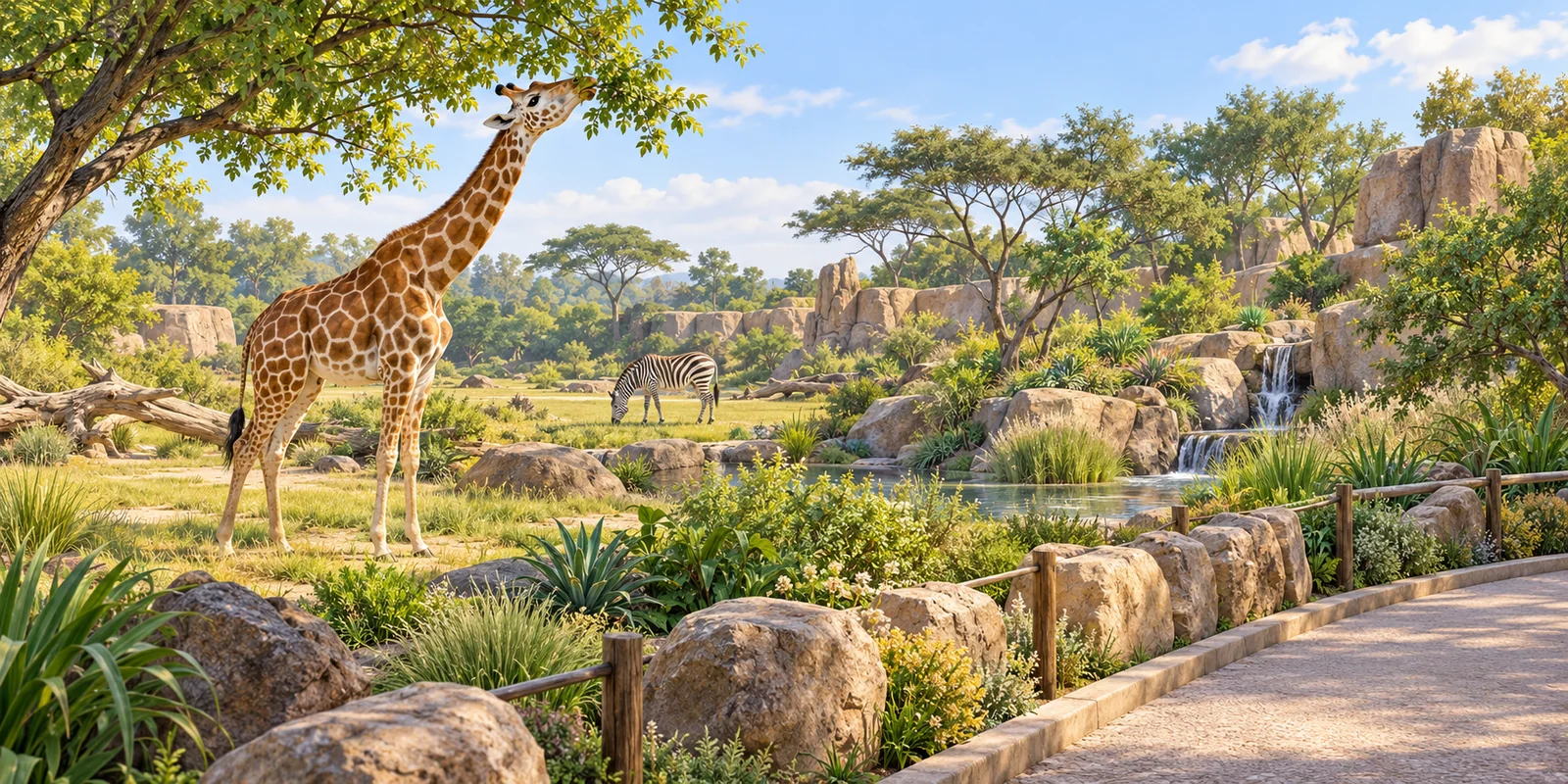
Visit ZOOM for a day of changing landscapes, from sea lions passing an underwater tunnel to orangutans climbing above a tropical setting.
Visit ZOOM for a day of changing landscapes, from sea lions passing an underwater tunnel to orangutans climbing above a tropical setting. Alaska, Africa and Asia each have their own entrance and circuit. Start with the expedition plan and choose the world your family most wants to see; doing one slowly is more rewarding than hurrying through all three.
Water is part of the experience throughout: waterfalls beside the bears, an African lake and humid indoor planting in Asia. The paths lead between carefully designed viewing points, so an animal hidden from one window may be visible farther along. Give the sea-lion tunnel and penguin underwater window time, rather than treating them as walk-through corridors. These are zoo animals in managed enclosures. Even in the open-looking landscapes, barriers remain important and animals can retreat from view. Wondering what that bird or insect is? Find out on your visit using the Snappit nature app.
Gelsenkirchen’s Ruhr Zoo opened on 14 April 1949 after less than five months of construction. A city decision in 1996 secured its future through a complete redesign. The three landscape worlds followed in stages: Alaska in 2005, Africa in 2006 and Asia in 2010. Today’s routes are the result of that rebuilding, rather than a traditional row of small animal houses.
Alaska’s published circuit is 2 km, Africa’s is 2.2 km and Asia’s is over 1.3 km, with additional walking around the entrance and between areas. In Alaska, link the bear windows and sea-lion tunnel; in Africa, take time at the giraffe viewpoints, penguins and ELE Dschungel Abenteuer. Asia brings orangutans, red pandas and the new AGG Gelsenkanal Philippinenhaus, with crocodile views above and below water. Choose a keeper talk from the daily programme, then leave room for play at Grimberger Hof or Sparkassen Drachenland. Use the zoo’s signs and plan for each circuit.
The zoo opens every day, with shorter winter hours. Cold weather can move animals into indoor quarters that visitors cannot see; giraffes can be watched in their house. Pelicans normally move to their off-show winter quarters from October. African Queen is seasonal and weather-dependent, so check its own operating calendar. The ZOOM Shop is scheduled to close from 3 to 5 November 2026.
Most paths are unpaved, with uneven sections and slopes; allow extra effort with a wheelchair or pushchair. Reserve a loan wheelchair ahead through the Service Center. Gelsenkirchen Zoo railway station is not step-free. African Queen has special ramped boats for manual wheelchairs, one wheelchair per boat; powered wheelchairs are excluded. You or your companion must manage boarding and leaving, and a companion must be able to help across rough ground in an evacuation. Discuss your needs with the zoo before relying on the boat.
A 2 km circuit with bear viewing windows and a glass tunnel through the sea-lion pool
A 2.2 km circuit linking giraffe views, penguins and the seasonal African Queen boat ride
Over 1.3 km of paths, orangutans, tropical houses and the new Philippinenhaus
Allow 5–7 hours for all three worlds; use Grimberger Hof and indoor Drachenland for play breaks
Choose Alaska for bears and underwater sea-lion watching, Africa for savanna views and the seasonal boat, or Asia for orangutans and indoor stops. Add a play break without making the remaining worlds a checklist.
Start with your family’s favourite world, fit lunch and one keeper talk around the next, then decide whether the third still appeals. Leave enough time to enter each area before its gate closes, and keep a playground break in reserve.
Compare a sea lion swimming, a penguin walking and an orangutan climbing. Ask each person to choose the body part that seems most useful for that movement, then sketch it before checking a photograph.
If everyone still has energy, finish near the entrance with the tortoise garden behind the ZOOM Shop or the farm at Grimberger Hof. Slow down for the tortoises rather than expecting constant movement.
Try both the land view and underwater window. A bear may remain on land or out of sight, so look quietly before deciding to return later. Notice the broad paws if it walks past.
Look between rocks, resting places and the water’s edge. Alaska includes European and Kamchatka brown bears; both belong to the brown-bear species. Watching a resting bear can be as revealing as waiting for a swim.
These are California sea lions. Pause in the tunnel and follow one animal’s turn through the water, watching how it uses its front flippers. Leave the passage clear for other visitors.
Scan the quieter parts of the enclosure before looking for antlers. A bull’s antlers change through the year and are shed, so their absence does not mean you have missed the animal.
Use the underwater window, then compare how a penguin moves on land. If one faces you, look at the dark chest band and spot pattern; the pattern can help distinguish individuals.
Look for ears, eyes and nostrils at the water’s surface before expecting a whole body. Those high-set features let a hippo keep much of itself submerged. A slow look is more useful than a quick scan.
At the raised viewpoints, watch a Nubian giraffe browse or turn its long neck. If feeding is underway, try to notice the tongue working around leaves. Use the marked viewing areas and never offer food.
Watch the West African chimpanzees’ hands, faces and social interactions as well as their climbing. Give the group a little time: the interesting moment may be a gesture between neighbours rather than a big movement.
These are Sumatran orangutans. Look up along the climbing structures and notice how hands and feet share the work. Outdoor viewpoints and the Canopy Walk offer different perspectives when the animals are using that part of the habitat.
Look high into the branches for a reddish body or a hanging tail. In warm weather a panda may be stretched along a shaded branch. The tail helps with balance, but does not grip branches.
Search the vegetation and shaded resting places, then give the viewing point time. The zoo keeps Amur tigers, whose thick winter coat suits cold conditions. A quiet animal can blend surprisingly well into its planted surroundings.
Try the land and underwater views in the new house. A still crocodile is worth studying: look at the position of its eyes and nostrils without tapping the glass. These are freshwater crocodiles from the Philippines.
All listed targets are captive zoo animals. Some spend part of the day out of sight; use a second look rather than trying to attract their attention.
The Philippinenhaus links captive breeding of Philippine crocodiles with conservation work in their home country. Read about that connection while visiting; the animals here are part of a managed zoo population.
The Service Center handles loan wheelchairs and handcart hire. Paid lockers beside the parking machines in the entrance area take card payment. Use the expedition plan to locate toilets, accessible toilets, baby-changing facilities and picnic spots.
Each card links to a full Explore page with photos, traits, and fun facts.
Start with the big picture, then zoom in to explore individual wildlife observations around this place.
Arrival
Use Bleckstraße 64, 45889 Gelsenkirchen. Tram 301 runs to ZOOM Erlebniswelt from Gelsenkirchen Hauptbahnhof or Buer Rathaus; check current connections.
Driving
Parking is paid. On busy days the zoo recommends P3, reached using Grimbergstraße in your navigation app. The site lies in the Ruhrgebiet low-emission zone.
Tickets
Online tickets scan from your phone. The ticket desk adds a service charge; compare the family-ticket options before buying. Keep your ticket during the visit.
Ground underfoot
Wear comfortable shoes for unpaved paths, slopes and several kilometres of walking. Wheelchair users should reserve any loan chair ahead and plan help where needed.
Closing times
Area entrance gates normally close 30 minutes before the zoo. On 30–31 October 2026, the zoo closes at 17:00 and Alaska and Africa at 16:00; check the current calendar before travel.
Rides
Check African Queen’s seasonal timetable and boarding rules. Alaska Ice Adventure is a motion simulator with a minimum height of 1.20 m; it is optional if your child dislikes intense effects.
Dogs
A ticketed dog must stay on a short lead, with one per handler and at most three per group. Dogs cannot enter the petting area, farm interior, Drachenland, rides or shops, and cannot be tied up unattended.
Animal manners
Do not feed or disturb the animals, including the farm animals, and stay on visitor paths. Leave balance bikes, scooters, balls and balloons at home.
Recent snaps will appear here as new observations are added.

North Carolina, US
You might spot American Robin and Eastern Gray Squirrel.
View guide →

Florida, US
You might spot Anhinga, American Alligator, and Wood Duck.
View guide →

New Mexico, US
You might spot Wood Duck, Duck, and Canada Goose.
View guide →

Michigan, US
You might spot African Lion, Komodo Dragon, and Brown Bear.
View guide →
Take the discovery with you
Identify the wildlife you spot, learn as you go, and keep a collection of the adventure.