Snappit logo
Snappit
Get App
Doñana National Park photo
National ParkAndalusia, Spain

Doñana National Park

Doñana rewards looking closely.

About

Doñana rewards looking closely. The national park protects a meeting of Atlantic dunes, marshland and the sandy woodland and scrub known locally as cotos. Water links these landscapes, but each responds differently to rainfall and groundwater. A wet marsh elsewhere in Doñana does not tell you whether the lagoon beside your hide has water.

For a first visit, make El Acebuche your base. Its exhibition explains the landscape before you step onto the signed public paths. Give one hide time rather than hurrying between all of them; on a quieter day, the woodland, plants and changing edges of the lagoon still make a worthwhile walk. This is an approachable introduction to the wider Espacio Natural de Doñana, which includes both the national park and the adjoining natural park. It is not unrestricted walking access to the national park's interior.

Keep the scale of the day modest. Start with the centre and a short section of Laguna del Acebuche, then decide whether to continue towards Huerto y las Pajas. For the national park's dunes and interior landscapes, a separately booked authorised guided trip is the practical alternative. Enhance your adventure: download the Snappit app to identify the local species you encounter.

Doñana's landscape carries centuries of human use, from hunting estates to woodland work and grazing. Its modern conservation story gathered momentum in 1963, when the Spanish state and WWF helped secure land for the biological reserve. The national park was declared in 1969, enlarged and reclassified in 1978, and extended again in 2004. UNESCO recognised it as World Heritage in 1994. At El Acebuche, the exhibition helps connect that history with the practical question running through a visit today: how can a living, changing wetland be protected?

What to do here

Explore the exhibition, ask which lagoon paths and hides are available, and take a relaxed out-and-back from the courtyard. Spend time watching from one hide before choosing a longer walk or a picnic. Book a guided national-park excursion separately if you want to go farther.

Seasonal info

Summer heat and drying wetlands can change the experience substantially. Rain can bring water but also damaged or unavailable paths. El Rocío pilgrimage dates and winter holidays affect opening; confirm the centre schedule and current notices before setting out.

Accessibility

El Acebuche and its lagoon trail are listed with accessibility provision, including boardwalk walking and adapted viewing facilities. Ask reception about the exact open section, boardwalk condition, toilet access and any assistance you need. Do not assume every branch or tour vehicle suits the same mobility needs.

Don't miss

1

A manageable first encounter with Doñana at El Acebuche

2

Unhurried birdwatching from public hides

3

The contrast between lagoon edges, scrub and pine woodland

4

Understanding how water shapes a protected landscape

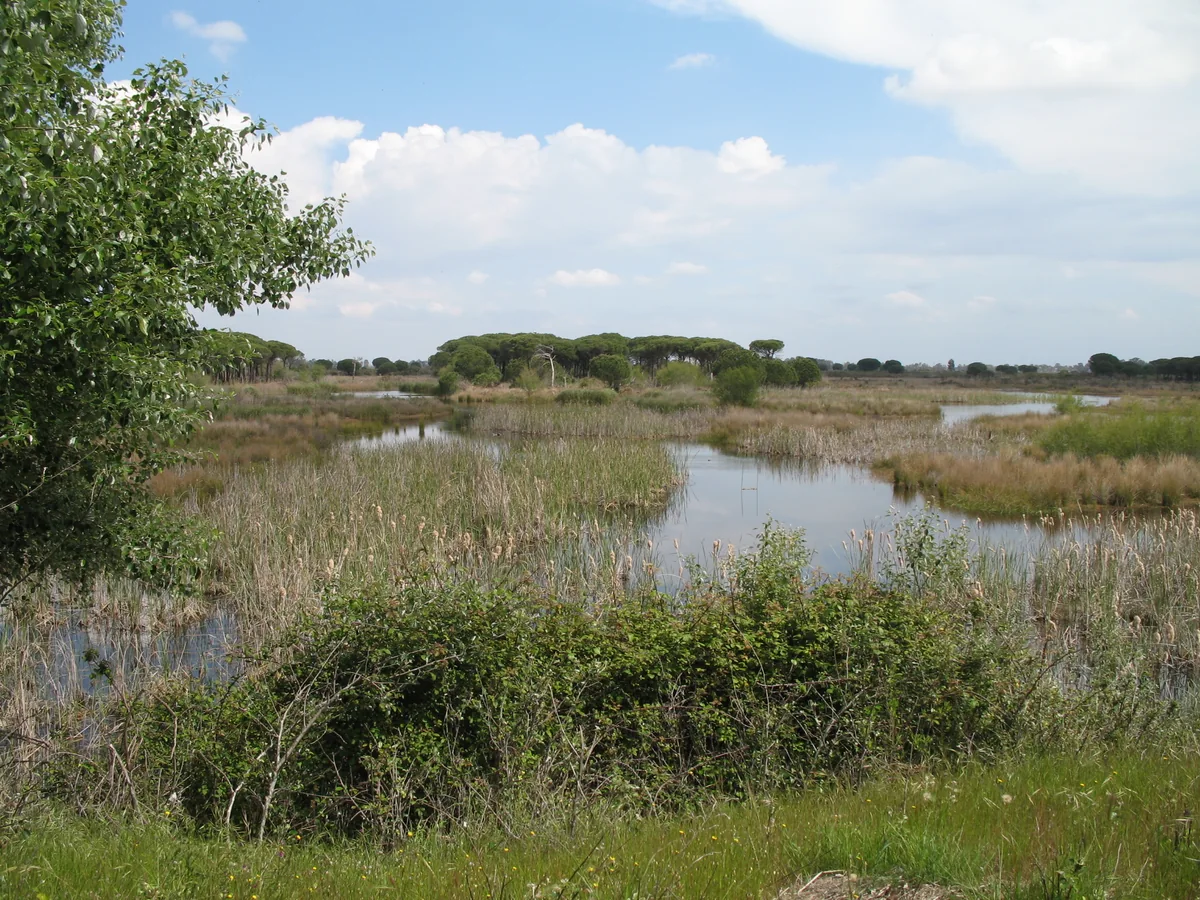
Pools among reeds and grasses, with rounded pine crowns on the horizon.

Wetland habitat near El Acebuche in April 2007. Water levels and vegetation change with season and conditions.

El Acebuche 03.jpg — Marc Ryckaert / Wikimedia Commons / CC BY 2.5 · Creative Commons

Walks and routes

Laguna del Acebuche: start short

From the visitor-centre courtyard, follow the signed Laguna del Acebuche path towards an open hide and return the same way. Allow 45–75 minutes for a deliberately short walk with watching stops; reception can suggest a suitable turning point. Check the branch distance before setting off, particularly if you want to complete the full trail.


Huerto y las Pajas: optional extension

The signed connection on the left-hand side of the Laguna del Acebuche trail leads towards a network of circuits, boardwalk crossings and hide branches through the cotos. Add this only after confirming the open route, return distance and closing time. It suits a longer, unhurried half-day better than a rushed add-on; the reserved lynx observatory has its own entry arrangements.

A gentle 2–3-hour visit

Begin with 20–30 minutes in the exhibition and a conversation at reception. Take 45–75 minutes for your chosen short lagoon walk, allowing a generous pause at a hide. Return for a picnic or café stop and another look at the displays. If the group is still keen, ask about a modest extension; if it is hot, windy or the water is low, a shorter visit is a perfectly sensible choice.

Things to try

Make one hide your observation stop

Try a quiet five-minute watch before moving on. Notice whether birds are swimming, diving or staying close to cover, and use the interpretation signs to compare what you see. With children, looking for three different ways animals use the habitat can work better than chasing a long species list.

Ask about the lynx interpretation visit

The park-run observatory visit is advertised as free with advance reservation. Morning sessions are listed Tuesday to Sunday; the observatory closes on Mondays. Confirm a slot with El Acebuche on +34 959 439 629. A company-arranged activity may have its own price. Keep this separate from the captive-breeding screen inside the centre and from any chance of meeting a wild lynx.

Optional: the southern national-park tour

The authorised Acebuche–La Plancha–Acebuche vehicle visit is a separate way to explore the national-park interior. The operator advertises roughly 4 hours and asks visitors to arrive 30 minutes early. On 16 October 2026 its listed fares were €35 for adults, €20 for ages 4–8 and free for ages 0–3. Check the booking calendar, departure, price, mobility arrangements and child restraints before paying; published seasonal calendars are not entirely consistent.

If the weather turns

Make the exhibition and audiovisuals your first choice while the centre is open. Ask staff whether a short section is sensible after rain; do not cross flooded or closed paths. If severe weather or an official warning closes the site, postpone the outing rather than substituting an unchecked nearby trail.

Wildlife and habitats

Mallard

Mallard is among the ducks named for El Acebuche. Use the hide to compare swimming and feeding behaviour without approaching the banks.

Little grebe

The official trail description includes little grebe among the lagoon birds. Watch the water patiently rather than moving along the edge for a closer view.

Common pochard

Common pochard is another bird listed for the lagoon. Compare birds from the hide with its identification panels or a field guide.

White poplar

Look for the white poplars described along the lagoon-side walk. Take a moment with the trees as well as the birds; leave leaves and branches where they are.

Red deer

The cotos are deer habitat. If you notice tracks from the path, ask staff about them; never follow an animal into the scrub.

Wild boar

Wild boar are part of the woodland-and-scrub community. Give any animal ample room, keep food packed away and stay on the signed route.

Iberian lynx

Use El Acebuche to learn about lynx conservation. The centre’s advertised live screen concerns captive-breeding animals; a chance sighting in the wild is a different experience.

These are locally supported species to learn about, not a checklist of promised sightings. Water, weather, season and the animals’ own movements shape each visit. Watch from public paths and hides, keep quiet and give wildlife space.

Stories and discoveries

The cotos are a landscape of subtle changes

Within the sandy woodland-and-scrub landscape, wetter ground supports darker, denser vegetation known as monte negro, while drier ground supports paler monte blanco. On the Huerto y Pajas walk, compare the vegetation from the path instead of expecting one uniform forest.

A flooded marsh does not mean every lagoon has recovered

CSIC’s report published in February 2026 describes the 2024–2025 hydrological year: abundant rain helped the marsh and wildlife breeding, while many ponds still failed to flood. It is useful background to the landscape, rather than a water-level report for your visit.

A hide can tell a human story too

The Laguna del Acebuche interpretation describes how the shelters echo traditional huts made with wetland vegetation. Looking at their materials adds another layer to a birdwatching stop.

When to visit

Autumn and winter

Make the public paths and patient birdwatching your main plan, with a warm or windproof layer for pauses. Winter visitors change the bird mix; the amount and timing of water still matter. Leave enough daylight and time before closing for the return.

Spring

Enjoy the contrast between the centre’s interpretation and what is changing outdoors. Keep especially quiet around cover and any breeding birds, and stay on the path. If your date is near the Romería del Rocío, confirm closures before arranging travel.

Summer

Choose a short visit in the cooler part of the day and keep water, shade breaks and an easy return in mind. Do not expect the lagoons to match the April 2007 photograph. Summer Sunday hours are shorter, and extreme conditions can alter access.

Getting there and practical advice

Information and indoor displays

Use the reception desk, exhibition and audiovisual displays to get oriented. The exhibition connects migration, seasonal landscape change and the main habitats of Doñana; ask which audiovisuals and the captive-lynx screen are operating during your visit.

Parking, toilets and refreshments

Parking, toilets, a shop and café/restaurant are listed at El Acebuche. Confirm toilet access and food-service hours on arrival, particularly if these determine your plans. Bring your own drinking water and a snack rather than relying on every service being open.

Picnic area

The recreational area has tables and benches for a picnic. No fire is permitted for picnicking; leave the space clean and keep food away from wildlife.

Arriving at El Acebuche

Approach on the A-483 between El Rocío and Matalascañas and follow signs for Centro de Visitantes El Acebuche. A paved access road of about 2 km leads to the centre and parking. Official pages use different kilometre references, so use the named destination and signs rather than relying on a kilometre marker alone.

Without a car

Arrange the final journey to the visitor centre and the return pickup before travelling. A direct public-transport service to the centre is not confirmed here; ask the centre or your transport provider. Do not assume a bus to El Rocío or Matalascañas also reaches the visitor-centre door.

Plan the exact accessible visit

For a wheelchair or pushchair visit, start by discussing the centre-to-hide route with staff. The municipality identifies Laguna del Acebuche as an adapted trail, and the national-park guidance describes wooden walkways and viewing adaptations. Ask specifically about current surfaces, passing space, access to a chosen hide and toilets. The longer Huerto y Pajas network and vehicle tours need their own checks.

Information and sensory needs

Much of the park information is offered in Spanish and English. Ask which accessible interpretation materials are available at El Acebuche and whether audiovisuals meet your needs; park-wide references to Braille materials do not confirm a particular item is available at this centre today.

Sources and useful links

Wildlife you might spot

6

Each card links to a full Explore page with photos, traits, and fun facts.

Snap map for this place

Start with the big picture, then zoom in to explore individual wildlife observations around this place.

Loading map…

Good to know before you go

Call El Acebuche on +34 959 439 629 before travelling, then ask reception which paths and hides are usable that day.

Bring binoculars, drinking water, a hat and comfortable shoes. Carry enough water even if you intend to use the café.

Choose a turning point before leaving the centre. Published trail lengths differ, and side branches can make your walk longer.

Keep to signed routes and obey barriers. The public footpaths do not give permission to walk or drive into restricted areas.

Sit quietly in a hide and let movement reveal the birds. Do not feed wildlife or use calls to attract it.

For young children, keep the walk flexible. Before buying a vehicle tour, ask about suitable child restraints; the operator says its vehicles do not provide them.

Book the lynx interpretation session or a commercial tour separately; neither is included automatically in a casual centre visit.

Use picnic tables without lighting a fire, take rubbish away and photograph wildlife from a respectful distance.

Frequently asked questions

Yes. Ordinary visits to the centre and its open public footpaths are free and can be self-guided. Reserved activities have separate arrangements, and all access remains subject to opening hours and restrictions.
No. It introduces the wider protected landscape from a visitor gateway. The adjoining natural park has its own boundary, and the Huerto y Pajas lynx observatory is explicitly located there. Restricted national-park interiors require the appropriate authorised visit.
Treat a wild lynx as an exceptional possibility, not a plan. The centre describes a screen showing animals in its captive-breeding programme, and a separate guided interpretation observatory can be reserved. Ask staff what is available.
Ask the centre for conditions close to your visit. Seasonal cycles and longer-term groundwater pressures both matter; a historic photograph or a wet year elsewhere in Doñana cannot tell you what El Acebuche looks like today.
Check the exact path and activity with reception before bringing one. Public-use rules require pets to be leashed and identified, while guided tours and particular facilities can have additional restrictions. Never leave an animal in a hot vehicle.
No. It is a separately sold, guided visit with a fixed departure, limited places and its own vehicle arrangements. Choose it for wider landscapes, rather than as a shortcut for the short El Acebuche walk.

Recent snaps at this place

View all ›

Take the discovery with you

Exploring Doñana National Park?

Identify the wildlife you spot, learn as you go, and keep a collection of the adventure.

  1. 1Spot it
  2. 2Snap it
  3. 3Keep the discovery