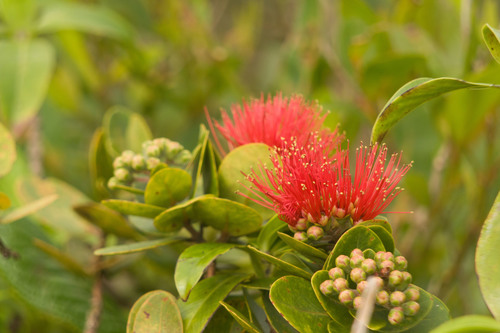


ʻōHiʻA Lehua
metrosideros polymorpha
The ʻōhiʻa lehua is the most abundant and ecologically significant native tree in the Hawaiian archipelago. A true master of adaptation, it can thrive as a towering forest canopy tree, a stunted bog shrub, or even a pioneering plant sprouting directly from barren, newly hardened lava flows. Its scientific name perfectly captures this extraordinary morphological diversity, translating to 'many forms.' Deeply woven into Hawaiian culture, the ʻōhiʻa is revered as a sacred symbol of Pele, the goddess of volcanoes and fire. Its vibrant, brush-like blossoms provide a crucial nectar source for native honeycreepers, while its sturdy root systems form the structural foundation of Hawaii's unique watershed ecosystems. Today, it remains a resilient yet vulnerable emblem of the islands' unique natural heritage.
Habitat: Found across Hawaiian islands, often thriving on barren volcanic lava flows or within dense tropical rainforests.
The ʻōhiʻa lehua is highly variable in appearance, ranging from a creeping prostrate shrub to a 30-meter-tall tree. Its most iconic feature is the 'lehua' blossom, a spectacular, powder-puff-like inflorescence made up of numerous brightly colored stamens. These flowers are most commonly striking crimson red, but can occasionally be brilliant yellow, orange, or pale pink. The leaves are typically thick, leathery, and oval-shaped, arranged in opposite pairs along the stems, with colors ranging from pale grayish-green to dark, glossy green. Young leaves often display beautiful reddish or purplish hues. The bark is usually rough, flaky, and grayish-brown, frequently cloaked in native mosses and epiphytic ferns in wet forest environments.
Category
PlantsRarity
Common
Danger
1/5 · Very low
Snaps
3
According to Hawaiian mythology, picking a lehua blossom from an ʻōhiʻa tree will cause it to rain, as it represents the tears of the separated lovers ʻŌhiʻa and Lehua.
Its incredibly dense, strong wood was traditionally used by Native Hawaiians to carve weapons, kapa cloth beaters, and statues of protective deities.
The scientific species name 'polymorpha' means 'many forms,' highlighting its ability to adapt its physical structure drastically based on its immediate environment.
ʻŌhiʻa trees are known as pioneer species, often being the very first forms of life to take root on a freshly cooled, barren lava flow.
It possesses the remarkable ability to sprout from seemingly barren, fresh basaltic lava flows, breaking down the rock and initiating ecological succession.
The tree can tightly close its leaf pores during periods of severe drought or high volcanic gas exposure, allowing it to survive in incredibly harsh or toxic conditions.
It exhibits extreme morphological variation, capable of growing as a massive tree in rainforests or a tiny shrub in bogs without any underlying genetic divergence.
As an autotrophic plant, the ʻōhiʻa lehua produces its own energy through photosynthesis, utilizing sunlight, carbon dioxide, and water.
Drepanis coccinea
Provides a primary nectar source and is heavily pollinated by this specialized native Hawaiian honeycreeper.
Himatione sanguinea
Relies on the tree's abundant blossoms for food and acts as a key pollinator across its range.
Ceratocystis lukuohia
A devastating invasive fungal pathogen that causes Rapid ʻŌhiʻa Death (ROD), severely threatening native tree populations.
No trait badges are assigned for this object yet.
No aliases listed yet.
Collections for this object will appear here as more themes are added.
Danger
1/5 · Very low
No special safety notes yet.
Start with the whole plant, then compare leaf arrangement, leaf edges, stems and any flowers or fruit. Opposite leaves grow in pairs; alternate leaves come one at a time along the stem. These details tell you far more together than a single green leaf does. Plant Identifier: upload a photo and compare the visible details.
15-3000 cm
50-1000 years
As an autotrophic plant, the ʻōhiʻa lehua produces its own energy through photosynthesis, utilizing sunlight, carbon dioxide, and water.
Found across Hawaiian islands, often thriving on barren volcanic lava flows or within dense tropical rainforests.
Zoom in to split clusters and explore where this object has been snapped.

Hawaii, US
You might spot ʻōhiʻa Lehua and Stinking Passionflower.
View guide →

Hawaii, US
You might spot ʻōhiʻa Lehua, Red Junglefowl, and Red-Crested Cardinal.
View guide →

Hawaii, US
You might spot 'āhinahina, Jackson's Chameleon, and Sea Turtle.
View guide →

Hawaii, US
You might spot White-Rumped Shama, Koster's Curse, and Red Button Ginger.
View guide →

Hawaii, US
You might spot 'āhinahina, Jackson's Chameleon, and Hawaiʻi ʻamakihi.
View guide →

Hawaii, US
You might spot Spathoglottis Plicata, Thatch Screwpine, and Brown Anole.
View guide →
Take the discovery with you
Snap it with Snappit to identify it, learn what makes it special, and add the discovery to your collection.