.jpg&width=800)




American searocket
Cakile edentula
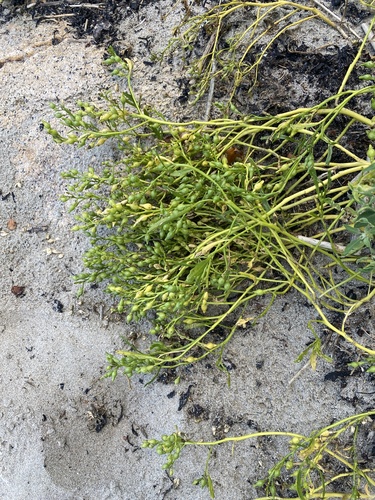
The American searocket is a fun plant that grows near the beach! It has long, green leaves and pretty purple flowers. This plant loves salty air and can even survive in sandy soil.
Habitat: Coastal areas
The American searocket is a sprawling or erect plant with thick, fleshy stems and deeply lobed, succulent leaves. Its small, four-petaled flowers range from white to pale pink or lavender, producing unique, segmented, rocket-shaped seed pods.
Category
PlantsRarity
Common
Danger
1/5 · Very low
Snaps
5
Its 'rocket' name comes from its segmented seed pods, which are shaped like tiny rockets!
Its peppery leaves are edible, tasting like a spicy salad green right from the beach!
The American searocket is a true beach pioneer, often the first plant to sprout on new sand!
These plants protect fragile coastlines by catching sand, helping to build up new dunes!
American searocket has fleshy leaves that store water, helping it survive salty ocean spray and dry coastal winds.
Its strong root system quickly anchors in loose sand, preventing erosion and helping it colonize new dunes.
American searocket produces unique seed pods that can float on water, spreading its seeds far along coastlines.
Apis mellifera
Gathers nectar and pollen from its flowers.
Bombus impatiens
Visits its blooms for nectar and pollen.
Pieris rapae
Its caterpillars feed on the leaves.
Flowering plants are any plants that produce flowers as part of their reproductive cycle.
A shrub is a woody plant smaller than a tree, typically with multiple stems branching from or near the ground.
Salt tolerant plants can withstand and grow in conditions with elevated salinity levels in the soil or water.
Drought-tolerant plants can survive and flourish in conditions with limited water availability.

Edible plants are those parts of a plant that are considered safe for human consumption.

Describes plants that are particularly attractive and beneficial to a wide range of pollinating organisms.

Rapid growing plants exhibit accelerated growth rates, quickly increasing in size and biomass within a short period.

Coastal habitats are dynamic environments located along the interface between land and sea, influenced by tides, waves, and saltwater.
No aliases listed yet.
Danger
1/5 · Very low
Always look but don't touch plants unless you know they are safe.
The easiest way to identify American searocket is to use the Snappit nature identifier app.
10-60 cm
20-50 cm
0.5-1.5 cm
Late spring to fall
Yes
None
Annual
Zoom in to split clusters and explore where this object has been snapped.
Aug 14, 2025
Coolidge ReservationPhoto attribution
(c) Sheila Collins Bourgoin, some rights reserved (CC BY)
License: CC BY 4.0 ↗
Image may be shown cropped inside the card frame.

New Jersey, US
You might spot Brant, Laughing Gull, and Great Black-Backed Gull.
View guide →

US
You might spot Firewheel, Domestic Horse, and Atlantic Horseshoe Crab.
View guide →

New York, US
You might spot African Penguin, Sea Otter, and Harbor Seal.
View guide →

US
You might spot Striped Maple, Sassafras, and Roundleaf Greenbrier.
View guide →

Rhode Island, US
You might spot Rugosa Rose, Chicory, and Northern Bayberry.
View guide →

Delaware, US
You might spot Atlantic Horseshoe Crab and Laughing Gull.
View guide →
Take the discovery with you
Snap it with Snappit to identify it, learn what makes it special, and add the discovery to your collection.








.jpg&width=800)



_001.jpg&width=800)



