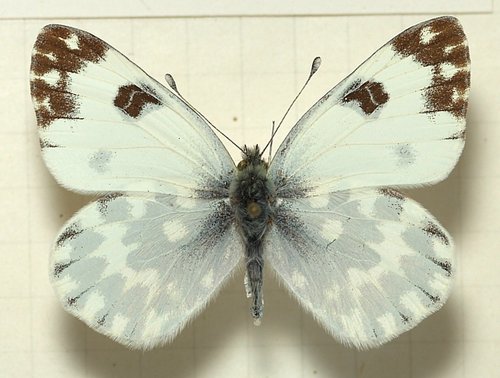


Bath White
pontia daplidice
The Bath White (Pontia daplidice) is a striking and highly mobile butterfly belonging to the family Pieridae. Renowned for its impressive migratory behaviors, this resilient insect often journeys from its primary range in southern Europe, North Africa, and Asia all the way to northern Europe during the summer months. First famously recorded in the English city of Bath in the 18th century, it has captivated naturalists with its beautifully mottled underwings and erratic, fast-paced flight. As a multivoltine species, the Bath White produces several generations per year, quickly populating dry, flowery landscapes before the onset of winter pushes their survivable boundaries back south. This butterfly serves as a fantastic indicator of seasonal shifts and warming climates, making it a fascinating subject for both amateur butterfly watchers and seasoned lepidopterists.
Habitat: Found in dry, warm, and open habitats such as rocky slopes, dry meadows, agricultural margins, and coastal wastelands.
The Bath White features a wingspan of roughly 4.5 to 5 centimeters. Its upperside wings are predominantly white, adorned with bold black or dark grey markings, particularly noticeable on the wingtips and as a prominent block near the center of the forewings. Females are generally more heavily marked than males. The butterfly's most distinctive feature is the underside of its hindwings, which displays a beautiful, mottled olive-green and white pattern. Fascinatingly, this "green" coloration is actually a brilliant optical illusion created by an intricate, microscopic intermingling of yellow and black scales.
Category
InsectsRarity
Common
Danger
1/5 · Very low
Snaps
Be the first to snap!
Despite being a famous migrant to the UK and northern Europe, this butterfly lacks a diapause stage suited for extreme cold and cannot survive the harsh northern winters.
It earned its English name 'Bath White' after a young woman famously captured a rare migrant specimen in Bath, England, in 1795.
Male Bath Whites possess specialized scent scales (androconia) on their wings, which release pheromones to attract females during their intricate courtship flights.
When examined under a microscope, the beautiful 'green' patches on its underwings are revealed to be a mosaic of pure black and yellow scales.
Capable of traveling hundreds of miles, crossing seas and mountain ranges to expand its geographic range northward during the summer.
Creates a camouflaging green pattern on its underwings not through green pigment, but via a dense, microscopic mix of yellow and black scales.
Employs a multivoltine reproductive strategy, allowing it to complete several lifecycles in a single warm season to rapidly exploit seasonal flora.
As caterpillars, they feed voraciously on the leaves of specific host plants, while adults primarily consume floral nectar.
Age differences: Larvae chew and consume solid plant matter (leaves, flowers, and stems), whereas adult butterflies use their proboscis to siphon liquid nectar.
Reseda lutea
Primary larval host plant where females lay their eggs.

Misumena vatia
Ambush predator that hunts adult butterflies resting on flowers.

Hirundo rustica
Aerial predator that catches flying adults on the wing.
No trait badges are assigned for this object yet.
No aliases listed yet.
Collections for this object will appear here as more themes are added.
Danger
1/5 · Very low
No special safety notes yet.
Compare the wing outline, spots, bands, eyespots and wing edges. The underside can look completely different from the top. Check for tails, the antennae and where the markings sit instead of relying on color alone. Butterfly Identifier: upload a photo and compare the visible details.
1-2 cm
4-5 cm
0.0001-0.0005 kg
0-1 years
15 km/h
As caterpillars, they feed voraciously on the leaves of specific host plants, while adults primarily consume floral nectar.
Found in dry, warm, and open habitats such as rocky slopes, dry meadows, agricultural margins, and coastal wastelands.
Zoom in to split clusters and explore where this object has been snapped.
Recent snaps will appear here as new observations are added.
Take the discovery with you
Snap it with Snappit to identify it, learn what makes it special, and add the discovery to your collection.