





Black-legged Kittiwake
Rissa tridactyla
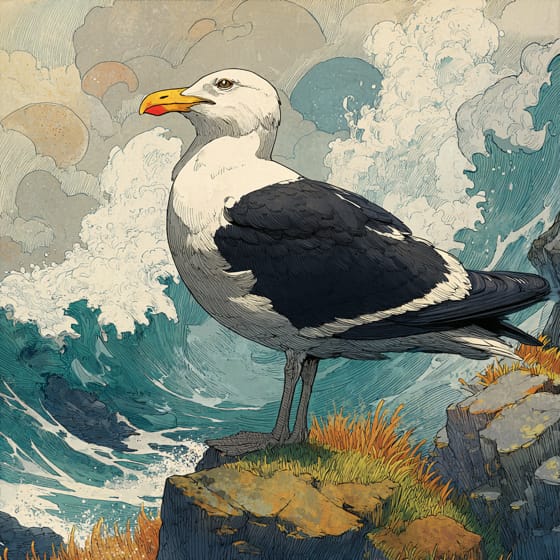
The Black-legged Kittiwake is a small, cheerful seabird that loves to live near the ocean. With its white body and black legs, it can often be seen flying over the waves or resting on rocky cliffs.
Habitat: Coastal areas
The Black-legged Kittiwake is a medium-sized gull with a bright white head and body, a grey back, and striking black wingtips that look 'dipped in ink'. Its legs are jet black, contrasting with its small yellow bill. This sets it apart from many paler-legged gulls.
Category
BirdsRarity
Common
Danger
1/5 · Very low
Snaps
1
Baby kittiwakes have a cool black 'W' shape across their wings when they're young.
Kittiwakes 'cry out' excess salt from seawater using special glands above their eyes!
Kittiwakes spend winters far at sea, sometimes not touching land for 7-8 months!
They have a small, almost absent hind toe, making their feet look quite different!
Black-legged Kittiwake can build sturdy nests on narrow cliff ledges because of their strong grip, keeping eggs safe from predators.
Black-legged Kittiwake has special glands that help them drink seawater, allowing them to live far out in the vast ocean.
Black-legged Kittiwake can swiftly dive from the air into the water to catch fish, thanks to their quick wings and keen eyesight.
Black-legged Kittiwake has waterproof feathers that help them stay dry and warm even in stormy ocean weather.
These ocean birds mostly eat small fish and tiny marine creatures found near the surface.
Mallotus villosus
A key fish in their ocean diet.
Ammodytes marinus
A favorite small fish snack.
Larus marinus
Might steal eggs or chicks.
Feathered describes animals, primarily birds, possessing a covering of feathers.
Social animals live in organized groups, cooperating for survival benefits such as foraging, defense, and raising offspring.
Aerial creatures spend a significant portion of their lives airborne, utilizing flight for various activities such as hunting, migration, or nesting.
Gliding animals move through the air by launching themselves and maintaining flight with specialized body structures, without flapping wings.

Piscivorous organisms are animals that primarily subsist on a diet of fish.

Coastal habitats are dynamic environments located along the interface between land and sea, influenced by tides, waves, and saltwater.

Diurnal animals are primarily active during daylight hours, typically resting or sleeping at night.

Describes a species whose presence and role have a disproportionately large effect on its environment.

Marine habitats encompass all saltwater environments of the Earth's oceans, supporting an immense diversity of aquatic life.

Migratory animals undertake seasonal movements from one region to another, typically in response to changes in climate or food availability.
No aliases listed yet.
Danger
1/5 · Very low
Always watch birds from a distance and do not try to touch or feed them.
The easiest way to identify Black-legged Kittiwake is to use the Snappit nature identifier app.
37-41 cm
91-105 cm
0.3-0.525 kg
15-20 years
60 km/h
These ocean birds mostly eat small fish and tiny marine creatures found near the surface.
Coastal areas
Zoom in to split clusters and explore where this object has been snapped.
Take the discovery with you
Snap it with Snappit to identify it, learn what makes it special, and add the discovery to your collection.





.jpg&width=800)








