

Blacksburg Salamander
plethodon jacksoni
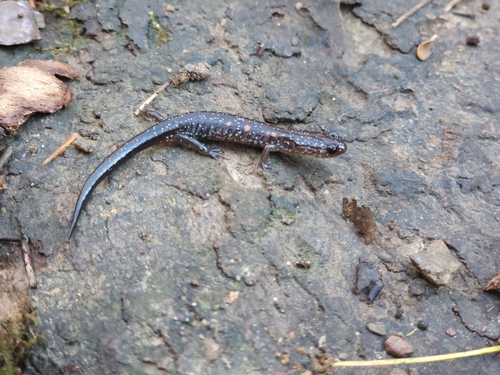
The Blacksburg Salamander (Plethodon jacksoni) is a fascinating and elusive woodland amphibian that calls the damp, forested slopes of the Appalachian Mountains home. As a member of the lungless salamander family (Plethodontidae), this remarkable creature breathes entirely through its moist skin and the lining of its mouth, completely lacking lungs or gills in its adult stage. This unique physiological adaptation ties it permanently to high-humidity microhabitats, making the damp undersides of decaying logs and mossy rocks its perfect sanctuary. Although it spends much of its life hidden from human eyes, catching a glimpse of the Blacksburg Salamander is a special treat for nature lovers exploring eastern North American forests. Their secretive nature and strict reliance on pristine, undisturbed woodlands make them excellent indicators of forest health, reminding us of the delicate, hidden ecosystems that thrive beneath the forest floor.
Habitat: Found primarily in moist, mature deciduous and mixed forests of the Appalachian region, typically hiding beneath decaying logs, thick leaf litter, and moss-covered rocks.
This medium-sized, slender salamander typically features a dark brown to blackish base coloration, elegantly speckled with white, silver, or faint brassy flecks along its back and sides. Its belly is usually lighter, often exhibiting a mottled or solid grayish hue. Like most Plethodon species, it has smooth, moist skin, distinct vertical costal grooves running down its flanks, and prominent, slightly bulging eyes adapted for low-light vision. It lacks the bright red or orange dorsal stripes seen in some of its close relatives, relying instead on its dark, starry pattern to camouflage perfectly against dark, wet soil and shadowy leaf litter.
Category
AmphibiansRarity
Common
Danger
1/5 · Very low
Snaps
Be the first to snap!
Because they breathe entirely through their skin, Blacksburg Salamanders will quickly suffocate if their skin dries out, which is why they rarely venture out on warm, sunny days.
During extreme summer droughts, they can migrate vertically deep underground, utilizing root channels and rock crevices to find stable moisture levels.
They bypass the aquatic tadpole stage completely; females lay eggs in moist, hidden terrestrial nests, and fully formed miniature salamanders hatch directly from the eggs.
This salamander belongs to an ancient evolutionary lineage that survived the brutal Pleistocene ice ages by taking refuge in the deep, unglaciated valleys of the Appalachian Mountains.
Lacking lungs completely, this salamander absorbs oxygen and releases carbon dioxide entirely through its highly permeable, moist skin.
It utilizes specialized nasolabial grooves—tiny slits running from its nostrils to its upper lip—to detect chemical cues from prey and potential mates.
When threatened or grabbed by a predator, it can voluntarily drop its tail to create a wriggling distraction, eventually regenerating a new one.
It feeds entirely on a diverse array of small invertebrates found on the forest floor, actively hunting them during humid, wet nights.
Age differences: Juveniles consume much smaller micro-invertebrates like tiny mites and springtails, shifting to larger prey such as beetles and spiders as they grow.

Diadophis punctatus
A common predator that actively hunts small woodland salamanders under leaf litter.
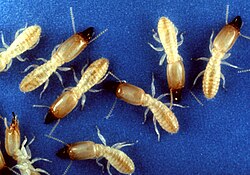
Reticulitermes flavipes
An abundant invertebrate prey hunted by the salamander within rotting logs.

Plethodon cinereus
Competes for similar invertebrate prey and premium cover objects on the forest floor.
No trait badges are assigned for this object yet.
No aliases listed yet.
Collections for this object will appear here as more themes are added.
Danger
1/5 · Very low
No special safety notes yet.
Compare body shape, toes, markings, tail and skin texture. Tadpoles and larvae can look nothing like the adults they turn into. Amphibian Identifier: upload a photo and compare the visible details.
10-16 cm
0.005-0.015 kg
10-20 years
It feeds entirely on a diverse array of small invertebrates found on the forest floor, actively hunting them during humid, wet nights.
Found primarily in moist, mature deciduous and mixed forests of the Appalachian region, typically hiding beneath decaying logs, thick leaf litter, and moss-covered rocks.
Foraging
10-30
Zoom in to split clusters and explore where this object has been snapped.
Recent snaps will appear here as new observations are added.
Take the discovery with you
Snap it with Snappit to identify it, learn what makes it special, and add the discovery to your collection.