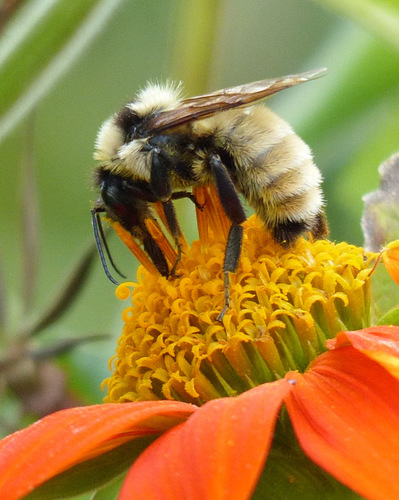


Bombus Fervidus
bombus fervidus
The Golden Northern Bumble Bee (Bombus fervidus) is a vibrant and industrious insect native to North America. Known for its striking golden-yellow coloration, this bumble bee is an essential pollinator of wildflowers and agricultural crops alike. They are unique among bumble bees for their surface-nesting habits, often weaving intricate nests of dry grass and moss in open fields, meadows, and even suburban gardens. Unlike many other bumble bee species that nest deep underground, Bombus fervidus colonies are highly sensitive to their immediate environment, making them key indicators of ecological health. Despite their gentle appearance, they are fierce defenders of their nests, using coordinated buzzing and stinging to ward off intruders, showing a highly cooperative social structure within their small colonies.
Habitat: Found in open grassy areas, such as meadows, agricultural fields, prairies, and suburban parks where diverse flowering plants are abundant.
Bombus fervidus is easily distinguished by its dense, bright yellow hair covering almost the entirety of its thorax and abdomen, interrupted by a distinct black band between the wing bases. Its face, legs, and underside are predominantly black. It is a long-tongued bee, typically measuring between 1 and 2 centimeters in length, with queens being significantly larger than the worker class and males.
Category
InsectsRarity
Common
Danger
1/5 · Very low
Snaps
2
They possess an incredibly long tongue relative to their body size, allowing them to specialize in extracting nectar from deeply tubed flowers like clovers.
This species is known to actively defend its nest by dabbing honey or regurgitated liquid onto invading intruders, like ants, to disable them.
Unlike many bumble bees that nest deep underground, the Golden Northern Bumble Bee often constructs its nests on the surface of the soil beneath dense, matted grass.
The bee grabs a flower's anthers and rapidly vibrates its flight muscles to dislodge tightly packed pollen that other insects cannot reach.
Equipped with an exceptionally long proboscis, this bee can extract nectar from deep-tubed flowers that are inaccessible to short-tongued competitors.
They can shiver their flight muscles to generate body heat, allowing them to fly and forage in chilly early morning temperatures.
Feeds exclusively on floral nectar for energy and collects pollen to feed developing larvae in the colony.
Age differences: Larvae are fed a mixture of regurgitated nectar and pollen by worker bees, while adults feed directly on nectar for flight energy.

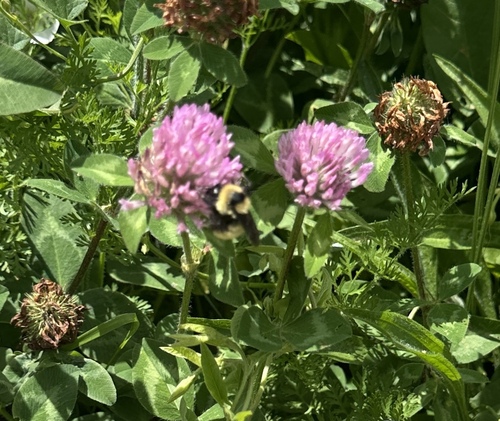
Trifolium pratense
Serves as a primary food source for nectar and pollen, while the bee acts as an essential pollinator.
Bombus citrinus
An obligate brood parasite that invades the nest of Bombus fervidus, killing or subduing the queen to force the workers to raise its own offspring.
_Misumena_vatia_male.jpg&width=800)
Misumena vatia
An ambush predator that waits on flowers to capture foraging bumble bees.
No trait badges are assigned for this object yet.
No aliases listed yet.
Collections for this object will appear here as more themes are added.
Danger
1/5 · Very low
No special safety notes yet.
The easiest way to identify Bombus Fervidus is to use the Snappit nature identifier app.
1200+ cm
2200+ cm
0.0001+ kg
0+ years
15 km/h
Feeds exclusively on floral nectar for energy and collects pollen to feed developing larvae in the colony.
Found in open grassy areas, such as meadows, agricultural fields, prairies, and suburban parks where diverse flowering plants are abundant.
Zoom in to split clusters and explore where this object has been snapped.
Jun 15, 2026
Mitchell Park Horticultural ConservatoryPhoto attribution
no rights reserved
License: CC0 1.0 ↗
Image may be shown cropped inside the card frame.

New York, US
You might spot Bald Eagle, Common Eastern Bumble Bee, and Red-Tailed Hawk.
View guide →

New York, US
You might spot Monarch and Common Eastern Bumble Bee.
View guide →

Michigan, US
You might spot Eastern Box Turtle, Autumn Olive, and Common Watersnake.
View guide →

Wisconsin, US
You might spot Common Eastern Bumble Bee, Red-Belted Bumble Bee, and Duck.
View guide →

Colorado, US
You might spot Bee, Great Spreadwing, and Duck.
View guide →

Illinois, US
You might spot Common Eastern Bumble Bee and Brown-Belted Bumble Bee.
View guide →
Take the discovery with you
Snap it with Snappit to identify it, learn what makes it special, and add the discovery to your collection.












.jpg&width=800)




