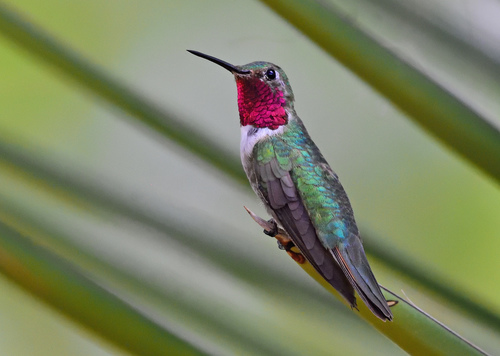


Broad-Tailed Hummingbird
selasphorus platycercus
The Broad-Tailed Hummingbird is a vibrant jewel of the high-altitude mountain meadows in western North America. Renowned for the distinct, metallic trilling sound produced by the wings of breeding males, this energetic bird brings alpine and subalpine zones to life with its rapid aerial maneuvers. During the breeding season, they can be seen darting between wildflowers or nesting in pine and fir forests, serving as critical pollinators for their high-elevation ecosystems. As long-distance migratory birds, they travel thousands of miles between their northern nesting grounds and wintering habitats in Mexico, relying on an intense feeding regimen to fuel their exceptionally high metabolic rates.
Habitat: Typically found in high-elevation montane forests, open woodlands, and subalpine meadows dominated by pine, fir, and spruce trees.
This medium-sized hummingbird has a compact, slender build with a metallic bronze-green back and crown, a clean white breast, and green-washed flanks. Adult males are instantly recognizable by their brilliant rose-magenta gorget (throat patch) and a rounded tail. Females and juveniles lack the iridescent throat, featuring a white throat speckled with grey or bronze and rusty-rufous edges on their outer tail feathers. They typically measure about 9 to 10 centimeters in length, with a wingspan of approximately 13 centimeters.
Category
BirdsRarity
Common
Danger
1/5 · Very low
Snaps
3
Because they nest at freezing high altitudes, females select nesting spots directly beneath sheltering branches that act as heat-trapping blankets.
The metallic wing whistle of the male is so loud and distinct that humans can often easily identify their presence by sound alone.
Their hearts can beat over 1,200 times per minute when actively flying and foraging in alpine meadows.
Males possess specialized flight feathers that vibrate in the wind, producing a loud, high-pitched metallic whistle to signal territorial ownership.
To survive freezing mountain nights, they can drop their body temperature to near-ambient levels and slow their metabolic rate by up to 90 percent.
With wingbeat rates of up to 50 times per second, they can hover in mid-air, fly backwards, and even fly upside down with incredible precision.
Relies primarily on energy-rich flower nectar supplemented by small insects and spiders to provide essential protein.
Age differences: Chicks are fed a protein-dense slurry of regurgitated insects and nectar by their mother to support rapid growth.

Ipomopsis aggregata
Provides critical pollination services while extracting energy-rich nectar from the plant's tubular blooms.

Sphyrapicus nuchalis
Frequently feeds on tree sap from wells maintained by sapsuckers, particularly in early spring before flowers bloom.

Accipiter striatus
A swift aerial predator that actively hunts adult hummingbirds in forest margins.
No trait badges are assigned for this object yet.
No aliases listed yet.
Collections for this object will appear here as more themes are added.
Danger
1/5 · Very low
No special safety notes yet.
The easiest way to identify Broad-Tailed Hummingbird is to use the Snappit nature identifier app.
9+ cm
12+ cm
0.003+ kg
3+ years
48 km/h
Relies primarily on energy-rich flower nectar supplemented by small insects and spiders to provide essential protein.
Typically found in high-elevation montane forests, open woodlands, and subalpine meadows dominated by pine, fir, and spruce trees.
Zoom in to split clusters and explore where this object has been snapped.
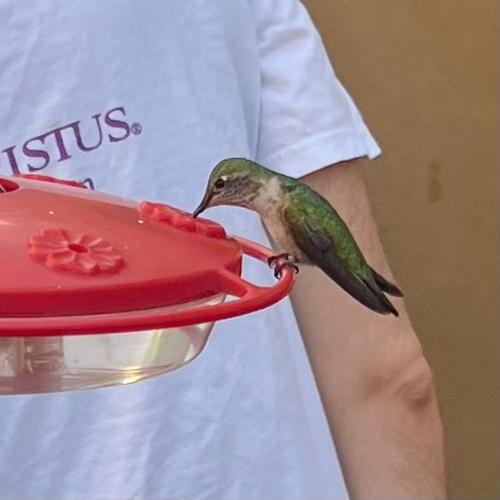
Jun 13, 2026
Barrio De Analco Historic DistrictPhoto attribution
no rights reserved
License: CC0 1.0 ↗
Image may be shown cropped inside the card frame.

New Mexico, US
You might spot Tree Cholla, Colorado Pinyon, and House Finch.
View guide →

Colorado, US
You might spot Common Starlily and Wholeleaf Paintbrush.
View guide →

Wyoming, US
You might spot Moose, Uinta Ground Squirrel, and American Bison.
View guide →

Wyoming, US
You might spot Moose, Arrowleaf Balsamroot, and Black Bear.
View guide →

Colorado, US
You might spot Black-Billed Magpie, Fireweed, and Common Cowparsnip.
View guide →

Colorado, US
You might spot Elk, Mule Deer, and Black-Billed Magpie.
View guide →
Take the discovery with you
Snap it with Snappit to identify it, learn what makes it special, and add the discovery to your collection.







.jpg&width=800)









