





butterfly milkweed
Asclepias tuberosa
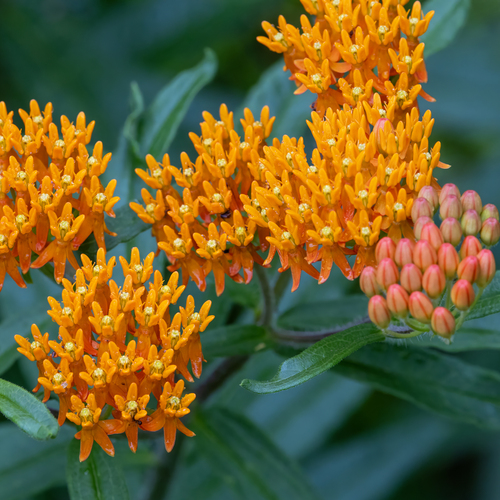
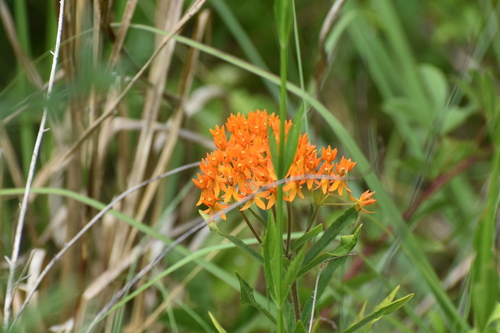
Butterfly milkweed is a bright orange flower that attracts butterflies and other pollinators. It grows in sunny places and has long, narrow leaves that look like little swords.
Habitat: Grasslands
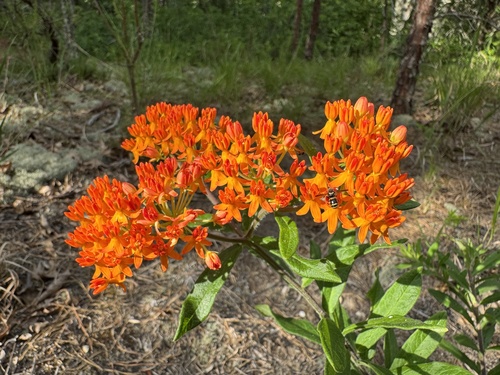
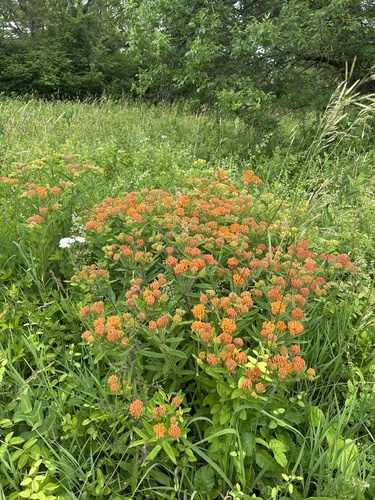
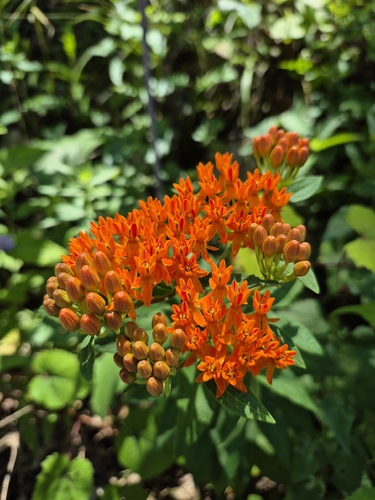
The butterfly milkweed has clusters of vibrant orange to yellow-orange flowers that form flat-topped domes. Unlike many other milkweeds, its stems and leaves do not produce milky sap. Its narrow, lance-shaped leaves are usually bright green.
Category
PlantsRarity
Common
Danger
1/5 · Very low
Snaps
99
Its fluffy seeds are carried by the wind like tiny parachutes, traveling far distances!
Native Americans used its roots for medicine, even to treat various illnesses!
The flowers have tiny 'traps' to help insects carry pollen packets away!
Unlike other milkweeds, this one doesn't produce milky white sap!
Butterfly milkweed can feed monarch caterpillars, which are immune to its mild toxins, helping them grow into butterflies.
This plant has bright, clustered flowers that act as a visual target, attracting many different pollinators.
Butterfly milkweed produces seeds with silky parachutes that catch the wind, allowing them to spread far and wide.
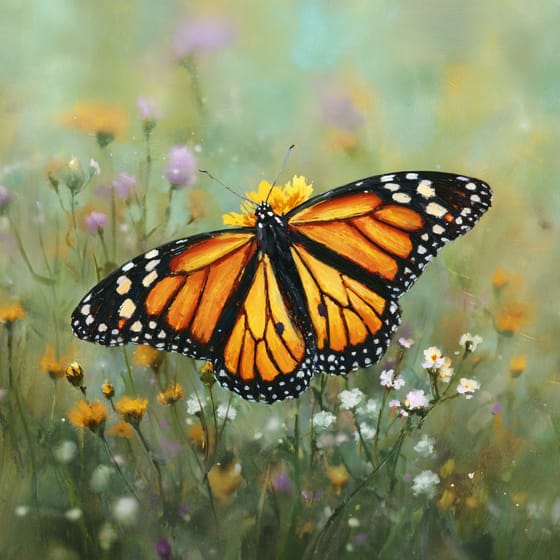
Danaus plexippus
Larval host; caterpillars feed on leaves.
Apis mellifera
Gathers nectar and pollen from flowers.
Bombus impatiens
Large bees are effective pollinators.

Aphis nerii
Aphids feed on the plant's sap.
Flowering plants are any plants that produce flowers as part of their reproductive cycle.
Summer blooming plants produce their flowers during the summer season, often providing vibrant color when many other plants have finished.
Colorful describes organisms or objects displaying a wide range of bright and distinct colors.
Edible plants are those parts of a plant that are considered safe for human consumption.

Grassland habitats are terrestrial biomes dominated by grasses and herbaceous plants, supporting a variety of grazing animals.

Describes plants that are particularly attractive and beneficial to a wide range of pollinating organisms.

Describes a species whose presence and role have a disproportionately large effect on its environment.
Danger
1/5 · Very low
Always look but don't touch wild plants, as some can be harmful.
The easiest way to identify butterfly milkweed is to use the Snappit nature identifier app.
30-90 cm
30-60 cm
0.5-0.7 cm
Summer
No
Moderate
Perennial
Zoom in to split clusters and explore where this object has been snapped.
Jun 19, 2026
Camp EvansPhoto attribution
(c) Jason K., some rights reserved (CC BY)
License: CC BY 4.0 ↗
Image may be shown cropped inside the card frame.
Jun 18, 2026
Willowwood ArboretumPhoto attribution
(c) Bonnie Semmling, some rights reserved (CC BY)
License: CC BY 4.0 ↗
Image may be shown cropped inside the card frame.
Jun 2, 2026
Tennessee AquariumPhoto attribution
(c) Nina Grauley, some rights reserved (CC BY)
License: CC BY 4.0 ↗
Image may be shown cropped inside the card frame.
May 25, 2026
Murphey Candler ParkPhoto attribution
(c) Dan Vickers, some rights reserved (CC BY)
License: CC BY 4.0 ↗
Image may be shown cropped inside the card frame.
May 23, 2026
Francis Beidler ForestPhoto attribution
(c) Ryan Watson, some rights reserved (CC BY)
License: CC BY 4.0 ↗
Image may be shown cropped inside the card frame.

New York, US
You might spot Sundial Lupine, Spotted Horsemint, and New Jersey Tea.
View guide →

Florida, US
You might spot Anole, Eastern Box Turtle, and Golden Silk Spider.
View guide →

Illinois, US
You might spot Common Eastern Bumble Bee and Brown-Belted Bumble Bee.
View guide →

Arkansas, US
You might spot Eastern Gray Squirrel and Asian Lady Beetle.
View guide →

Maryland, US
You might spot Crane-Fly Orchid, Fragile Forktail, and Ebony Jewelwing.
View guide →

Illinois, US
You might spot Carolina Mantis and Goldenrod Soldier Beetle.
View guide →
Take the discovery with you
Snap it with Snappit to identify it, learn what makes it special, and add the discovery to your collection.








.jpg&width=800)



_001.jpg&width=800)



