





Common Purslane
Portulaca oleracea
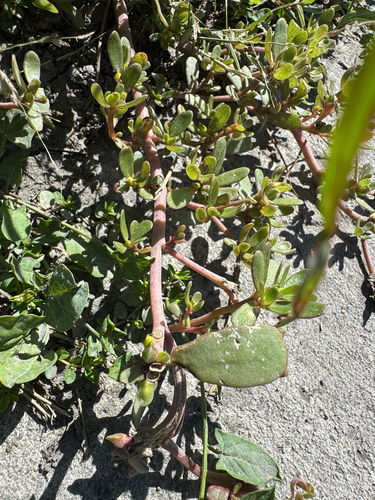
Common Purslane is a small, leafy plant that grows close to the ground. It has bright green leaves and pretty yellow flowers that bloom in the sunshine. This plant is often found in gardens and can be eaten too!
Habitat: Urban areas
The Common Purslane has succulent, reddish stems that spread along the ground, bearing thick, spoon-shaped green leaves. Its small, five-petaled yellow flowers typically open only in bright sunlight. This prostrate growth habit helps distinguish it from more upright garden weeds.
Category
PlantsRarity
Common
Danger
1/5 · Very low
Snaps
10
It contains more Omega-3 fatty acids than many fish oils!
Its tiny seeds can stay alive in the soil for up to 40 years!
People have been eating this resilient plant for thousands of years.
This amazing plant can close its flowers at night to save energy!
Common Purslane has juicy leaves that store water, helping it survive and thrive in hot, dry conditions.
Common Purslane can re-root from stem fragments, allowing it to quickly spread and grow new plants.
Common Purslane can perform two types of photosynthesis, optimizing carbon capture in different light conditions.
Apis mellifera
Visits flowers for nectar and pollen

Cornu aspersum
Snails and slugs graze on its leaves
Spodoptera exigua
Larvae feed on the leaves
.jpg&width=800)
Diabrotica undecimpunctata
Beetles can feed on its foliage
Flowering plants are any plants that produce flowers as part of their reproductive cycle.
Medicinal plants possess chemical compounds that can be used for therapeutic purposes to treat illnesses or maintain health.
Night blooming plants open their flowers after sunset, often to attract nocturnal pollinators with their scent and appearance.
Drought-tolerant plants can survive and flourish in conditions with limited water availability.

Succulent plants have thickened, fleshy parts, usually leaves or stems, adapted to store water in arid climates.

Edible plants are those parts of a plant that are considered safe for human consumption.

Describes plants that are particularly attractive and beneficial to a wide range of pollinating organisms.

Rapid growing plants exhibit accelerated growth rates, quickly increasing in size and biomass within a short period.

This habitat trait indicates species that can coexist with humans in urban and suburban environments, utilizing man-made structures and green spaces.
Danger
1/5 · Very low
Always check with an adult before eating any plants.
The easiest way to identify Common Purslane is to use the Snappit nature identifier app.
5-15 cm
30-50 cm
0.4-0.8 cm
Summer
Yes
None
Annual
Zoom in to split clusters and explore where this object has been snapped.
Oct 3, 2025
Dawson County CourthousePhoto attribution
(c) Nick T., some rights reserved (CC BY-SA)
License: CC BY-SA 4.0 ↗
Image may be shown cropped inside the card frame.

Colorado, US
You might spot Eastern Fox Squirrel, Bee, and Duck.
View guide →

California, US
You might spot Giant Anteaters and Black-and-Gold Howler Monkey.
View guide →

Nebraska, US
You might spot Two-Spined Spur-Throat Grasshopper.
View guide →

Texas, US
You might spot Eastern Fox Squirrel, American Robin, and Duck.
View guide →

Alabama, US
You might spot Spanish Moss, Mediterranean House Gecko, and Anole.
View guide →

US
You might spot Great Barracuda, Gray Snapper, and Atlantic Sergeant Major.
View guide →
Take the discovery with you
Snap it with Snappit to identify it, learn what makes it special, and add the discovery to your collection.








.jpg&width=800)



_001.jpg&width=800)



