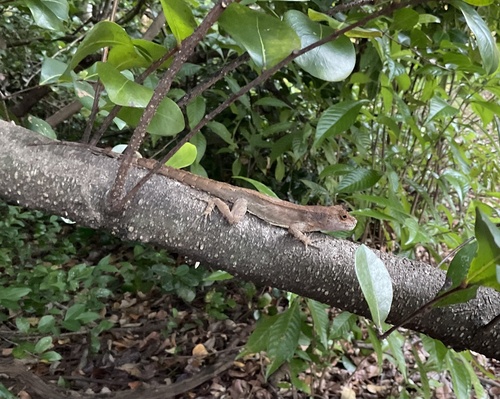


Crested Anole
anolis cristatellus
The Crested Anole, or Puerto Rican Crested Anole (Anolis cristatellus), is a highly adaptable and charismatic lizard native to Puerto Rico and the Virgin Islands. Known for its striking appearance, the mature male of this species proudly displays a prominent, sail-like crest along its back and tail, which it uses to establish dominance and attract mates. Like many anoles, they possess an impressive ability to communicate using a brightly colored throat fan, known as a dewlap. Fascinatingly resilient, Crested Anoles have seamlessly integrated into human-modified environments and have even expanded their range as an introduced species in Florida and parts of Central America. Their rapid evolutionary adaptations to urban habitats, such as developing longer limbs and specialized toe pads for gripping smooth artificial surfaces, make them an intriguing subject for modern evolutionary biology.
Habitat: Found in tropical forests and open woodlands, typically perching on lower tree trunks, branches, or the ground.
Crested Anoles are small to medium-sized lizards typically ranging from brown to grayish-brown, though they can rapidly shift their coloration to dark brown, pale green, or almost black depending on temperature and mood. The most distinguishing feature is found in mature males, which possess a distinct, fleshy crest running down their back and along the tail. Males also sport a large, extendable dewlap (throat fan) that is usually a vibrant yellow or orange with a deep reddish-orange center. Females are generally smaller, lack the prominent dorsal crest, and may have a faint mid-dorsal stripe. Both sexes have long, slender toes equipped with adhesive pads that allow them to climb smooth surfaces with ease.
Category
ReptilesRarity
Common
Danger
1/5 · Very low
Snaps
12
The 'crest' that gives the Crested Anole its name is actually supported by elongated bones extending from the vertebrae, similar to the sails of some ancient dinosaurs.
Urban-dwelling Crested Anoles have rapidly evolved longer legs and more specialized toe pads to help them navigate smooth surfaces like glass windows and painted concrete.
When threatened by a predator, they have the ability to drop their tail (autotomy) to escape, eventually regenerating a new, albeit shorter and cartilaginous, tail.
They can rapidly change their skin color from shades of brown to green or black in response to temperature, light, and social interactions.
Males possess a vibrant yellow and orange throat fan called a dewlap, which they extend rhythmically to attract mates or warn off rival males.
Their specialized toe pads are covered in microscopic hairs that utilize Van der Waals forces, allowing them to scale smooth vertical surfaces.
Crested Anoles primarily feed on a wide variety of small invertebrates, though they will occasionally consume small fruits, seeds, or even smaller lizards.
Age differences: Juveniles consume much smaller insects, while large adults may occasionally prey on small vertebrates, including smaller anole species.
Margarops fuscatus
This native Caribbean bird frequently preys upon crested anoles in forested and urban habitats.

Anolis sagrei
In introduced regions like Florida, they compete for territory, basking spots, and food resources.
Camponotus spp.
Crested Anoles actively hunt and consume various ant species as a staple part of their invertebrate diet.
No trait badges are assigned for this object yet.
No aliases listed yet.
Collections for this object will appear here as more themes are added.
Danger
1/5 · Very low
No special safety notes yet.
Compare toes, scales, head shape, crests and tail proportions. Many lizards can drop and regrow their tails, so a short tail isn't always a species trait. Lizard Identifier: upload a photo and compare the visible details.
12-18 cm
0.004-0.01 kg
2-4 years
8 km/h
Crested Anoles primarily feed on a wide variety of small invertebrates, though they will occasionally consume small fruits, seeds, or even smaller lizards.
Found in tropical forests and open woodlands, typically perching on lower tree trunks, branches, or the ground.
Ambush
Zoom in to split clusters and explore where this object has been snapped.

Florida, US
You might spot Crested Anole, Brown Anole, and Peters's Rock Agama.
View guide →

US
You might spot Brown Anole, Peters's Rock Agama, and Green Iguana.
View guide →

Florida, US
You might spot Crested Anole, Brown Anole, and Green Iguana.
View guide →

Florida, US
You might spot Crested Anole, Brown Anole, and Green Iguana.
View guide →

Florida, US
You might spot Crested Anole, Brown Anole, and Peters's Rock Agama.
View guide →

US
You might spot Crested Anole, Brown Anole, and Peters's Rock Agama.
View guide →
Take the discovery with you
Snap it with Snappit to identify it, learn what makes it special, and add the discovery to your collection.