





Culver'S Root
veronicastrum virginicum
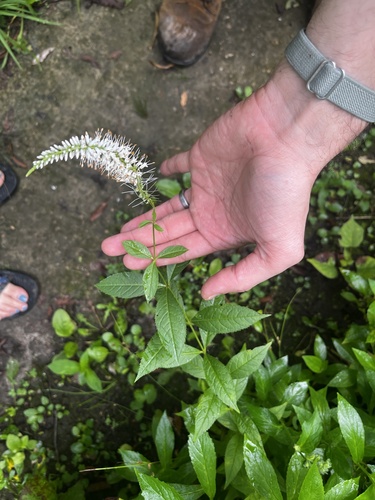
Culver's Root is a tall, beautiful plant with spikes of white flowers that attract many pollinators. It grows in wet meadows and can reach heights of up to 5 feet!
Habitat: Culver's Root typically lives in wet meadows, along stream banks, and in low-lying areas.
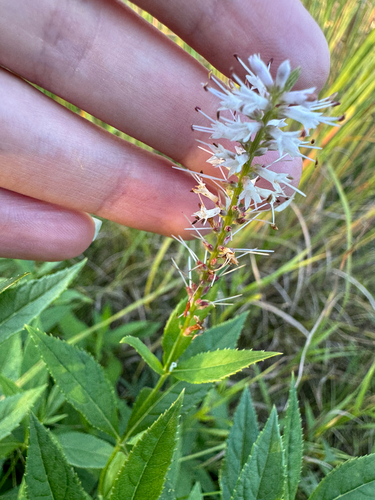
The Culver'S Root is a majestic, tall perennial with upright, candelabra-like spikes of tiny white to pale lavender flowers. Its distinctive long, slender floral spires rise above whorled leaves, making it stand out in any sunny meadow.
Category
PlantsRarity
Common
Danger
0/5 · No known danger
Snaps
4
Ancient people powdered its roots for a super strong, natural tummy medicine! Wow!
Hundreds of tiny flowers bloom on each spire, looking like a fuzzy white bottle brush! Wow!
Its tall flower spikes can grow over 6 feet (2 meters) high, taller than many grown-ups! Wow!
Some people call it "Black Root" because of its very dark, almost black, roots! Wow!
Culver'S Root can grow towering flower spikes that act like a billboard, inviting pollinators from far away to its abundant nectar.
Culver'S Root has deep roots that help it find water in dry soils, allowing it to survive when other plants might wilt.
Culver'S Root grows leaves in neat circles around its stem, which helps it efficiently capture sunlight for energy.
Apis mellifera
Visits flowers for nectar and pollen.
Bombus impatiens
Efficiently collects pollen from its dense spires.

Papilio glaucus
Feeds on nectar, helping spread pollen.

Celastrina neglecta
Small butterfly attracted to its delicate flowers.
Perennial plants live for more than two years, typically returning to grow and bloom each year from their roots.
Herbaceous plants are non-woody plants with soft stems that typically die back to the ground at the end of the growing season.
Colorful describes organisms or objects displaying a wide range of bright and distinct colors.
This habitat trait identifies species found in wetlands, which are areas of land saturated with water, either permanently or seasonally, including marshes, swamps, and bogs.

Describes organisms that transfer pollen, enabling the fertilization and reproduction of plants.
Danger
0/5 · No known danger
No special safety notes yet.
The easiest way to identify Culver'S Root is to use the Snappit nature identifier app.
90-200 cm
45-90 cm
0.5-1 cm
Summer to early fall
No
Mild
Perennial
Zoom in to split clusters and explore where this object has been snapped.
Aug 27, 2025
International Crane FoundationPhoto attribution
(c) Elizabeth Axley, some rights reserved (CC BY)
License: CC BY 4.0 ↗
Image may be shown cropped inside the card frame.
Aug 12, 2025
Iowa ArboretumPhoto attribution
(c) Bryant Brumbill-Corral, some rights reserved (CC BY)
License: CC BY 4.0 ↗
Image may be shown cropped inside the card frame.

Illinois, US
You might spot Dame's Rocket, Ivy-Leaved Toadflax, and Wild Bergamot.
View guide →

Iowa, US
You might spot Painted Turtle, Blue Phlox, and Jack-In-The-Pulpit.
View guide →
Missouri, US
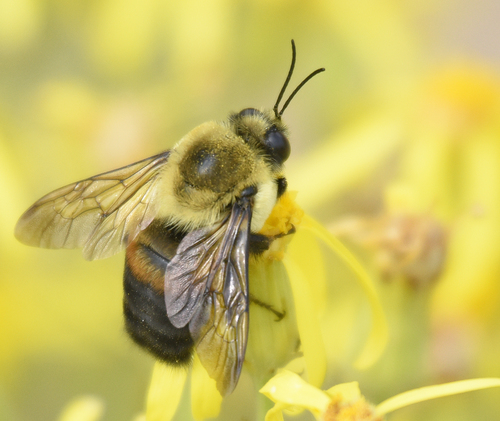
You might spot Brown-Belted Bumble Bee, Bee, and Eastern Carpenter Bee.
View guide →

Wisconsin, US
You might spot Whooping Crane, Sarus Crane, and Sandhill Crane.
View guide →
Michigan, US
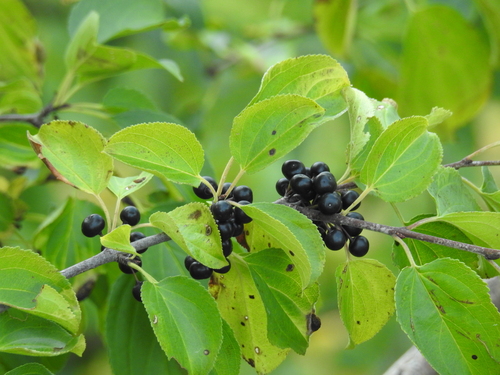
You might spot Common Buckthorn, False Indigo Bush, and Honey Locusts.
View guide →
Take the discovery with you
Snap it with Snappit to identify it, learn what makes it special, and add the discovery to your collection.









.jpg&width=800)



_001.jpg&width=800)




