





Eastern Cicada-killer Wasp
Sphecius speciosus
The Eastern Cicada-killer Wasp is a big, friendly-looking wasp that helps control cicada populations. They are not aggressive and are often seen buzzing around in gardens and fields.
Habitat: Urban areas
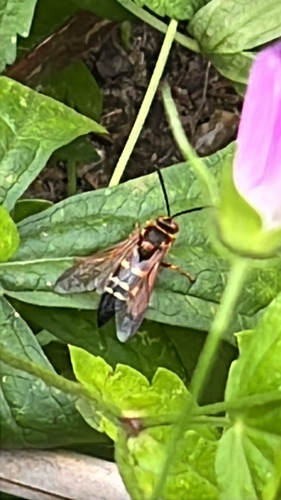
The Eastern Cicada-killer Wasp is a large, robust insect with a black body marked by bright yellow bands on its abdomen. It has distinctive rusty-orange wings and a prominent head, making it visually striking compared to other wasps.
Category
InsectsRarity
Common
Danger
1/5 · Very low
Snaps
15
A single Eastern Cicada-killer Wasp can catch and carry multiple large cicadas!
Each female digs her own personal underground nursery for her developing young!
Some females can choose if their eggs will hatch into male or female wasps!
These giant wasps rarely sting humans unless seriously provoked!
Eastern Cicada-killer Wasps can deliver a paralyzing sting because of venom that helps them subdue large cicadas for their young.
Eastern Cicada-killer Wasps can dig intricate underground burrows because of strong legs and mandibles that help them create nurseries for their larvae.
Eastern Cicada-killer Wasps can stock their underground nurseries because of their hunting prowess that helps them provide abundant food for their developing larvae.
Adult wasps feed on nectar, while their larvae feast exclusively on paralyzed cicadas.
Age differences: Adult wasps primarily consume nectar and tree sap, while larvae exclusively feed on cicadas paralyzed by the female.
Neotibicen pruinosus
Paralyzed as food for larvae.
Solidago canadensis
Adults visit flowers for nectar.
Mephitis mephitis
Digs up burrows to consume larvae.
Solitary animals live alone for most of their lives, only interacting with others for mating or parental care.
Describes plants that are particularly attractive and beneficial to a wide range of pollinating organisms.
This trait identifies organisms whose diet consists entirely or primarily of animal tissue.
Diurnal animals are primarily active during daylight hours, typically resting or sleeping at night.

Describes a species whose presence and role have a disproportionately large effect on its environment.

Giant describes organisms or objects of significantly larger size than average for their species or type.

This habitat trait indicates species that can coexist with humans in urban and suburban environments, utilizing man-made structures and green spaces.

Describes organisms that transfer pollen, enabling the fertilization and reproduction of plants.
No aliases listed yet.
Danger
1/5 · Very low
Even though they are friendly, it's best to watch them from a distance.
The easiest way to identify Eastern Cicada-killer Wasp is to use the Snappit nature identifier app.
30-55 mm
15-50 mm
15-45 days
Adult wasps feed on nectar, while their larvae feast exclusively on paralyzed cicadas.
Urban areas
Pursuit
6
Zoom in to split clusters and explore where this object has been snapped.
Jun 13, 2026
Missouri Botanical GardenPhoto attribution
(c) Lena Struwe, some rights reserved (CC BY-SA)
License: CC BY-SA 4.0 ↗
Image may be shown cropped inside the card frame.
Jul 31, 2021
Gloria Dei (Old Swedes') ChurchPhoto attribution
no rights reserved
License: CC0 1.0 ↗
Image may be shown cropped inside the card frame.

Georgia, US
You might spot Gulf Fritillary, Anole, and American Beautyberry.
View guide →
Illinois, US
You might spot Canada Goose, House Sparrow, and Rock Pigeon.
View guide →

Pennsylvania, US
You might spot Canada Goose, American Robin, and Red-Winged Blackbird.
View guide →

Illinois, US
You might spot Viceroy, Common Wood-Nymph, and Acadian Hairstreak.
View guide →

Illinois, US
You might spot Canada Goose, House Sparrow, and Rock Pigeon.
View guide →

Illinois, US
You might spot Canada Goose, House Sparrow, and Red-Winged Blackbird.
View guide →
Take the discovery with you
Snap it with Snappit to identify it, learn what makes it special, and add the discovery to your collection.








.jpg&width=800)



